How do reinstatement and redecoration differ?
Commercial leases often bury reinstatement and redecoration in separate clauses. Missing the difference can freeze your bond and force you to pay for works twice.
Published
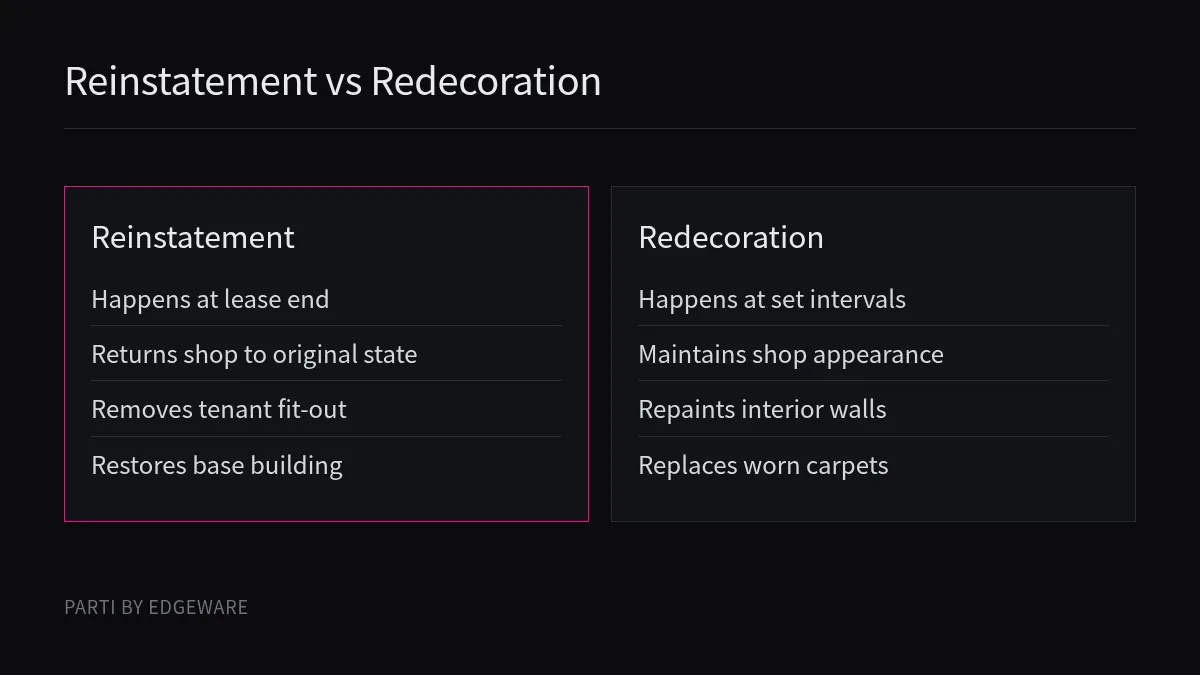
Reinstatement (or make good) is an end-of-lease duty to return the shop to its original or agreed state, often by removing your fit-out. Redecoration is a duty to maintain or upgrade the shop's appearance, such as repainting, at set intervals.
Both clauses cost money, yet they happen at different times and solve different problems for the landlord. Reading them side by side before you sign or alter a café helps you budget properly and protect your deposit.
What is reinstatement?
Leaving a shop often triggers a demand to strip out every counter and wall you built. That surprise bill can swallow your security deposit.
Reinstatement, often called making good, is the tenant's obligation at the end of the lease term to return the premises to their original condition or the condition specified in the lease, including removing alterations and repairing damage.
How make good works at the end of a lease
In Queensland, the Queensland Small Business Commissioner's make good factsheet1 explains that a make good clause requires the tenant to return the property to its original condition, or as specified in the lease, when the lease ends. Under Section 3 of Schedule 1 of Queensland's Property Law Act 2023, standard commercial lease terms require returning the premises in the same or better condition as at the start, excluding reasonable wear and tear, specified disasters such as fire and earthquakes, and risks the lessor insured against. However, Section 139 of that Act allows the lessor and tenant to exclude those standard terms and agree on different make good conditions in the lease.
In England and Wales, landlords also look closely at alterations when a lease ends. According to Russell-Cooke's guide to a licence for alterations2, a landlord will seek to impose an obligation on the tenant to reinstate the property and make good any damage caused at the end of the term. If you want to read more on exit duties, see our guide on what make good means when you leave a shop.
Common make good terms in Queensland leases include:
* Repairing damage caused during the occupancy. * Removing tenant-installed fixtures, partitions, joinery, installations, flooring, and ceiling finishes. * Restoring the premises to an open floor plan, including removing walls. * Returning base building services such as air conditioning, fire, and hydraulic systems to their original state. * Leaving the area clean and tidy.
Tenants in Queensland may meet these obligations by physically carrying out or managing the works (often required to be done by a professional or to a professional standard), or by negotiating a cash settlement with the lessor instead. Missing the deadline can lead to additional rent or penalties, and disputes almost always affect the return of the tenant's bond. Other places have different rules, and your own contract and local authority decide what applies to your shop.
What is redecoration?
You might budget for an end-of-lease strip-out, then get hit mid-lease with a notice to repaint the whole shop and replace the flooring.
Redecoration clauses require a tenant to carry out maintenance or upgrade works at specified intervals during the lease term to keep up the property's appearance, such as repainting walls or replacing carpets.
Upkeep during the term versus refurbishment rules
In Queensland, the Small Business Commissioner notes that while make good and redecoration clauses are separate, they are often confused. A redecoration clause focuses on maintaining the property's appearance at specified intervals throughout the lease term, rather than stripping out alterations when you leave. Typical tasks specified in a redecoration clause include repainting walls or replacing carpets during the tenancy.
Queensland law also places limits on vague upgrade demands in retail shops. Under Section 50B of the Retail Shop Leases Act 1994 (Qld), a clause in a retail shop lease requiring the tenant to refurbish or refit the shop is void unless the lease gives general details of the nature, extent, and timing of the requirements.
How the two obligations compare
| Feature | Reinstatement / Make good | Redecoration |
|---|---|---|
| When it happens | At the end of the lease term | At specified intervals during the lease term (or as part of end-of-lease make good) |
| Main purpose | Return premises to original or agreed state; give lessor a neutral space | Maintain the property's appearance during the tenancy |
| Typical tasks | Removing fixtures, partitions, joinery, flooring; restoring base building services | Repainting walls or replacing carpets |
Keeping on top of general wear and tear during your tenancy makes both obligations easier to manage. When we plan our own spatial layouts and look at how a modular room fits into a leased building, we pay close attention to how much touches the landlord's walls and floors, because anything fixed into the shell can become a point of argument later.
Why are the two clauses confused?
Lease language blends these duties together. When a landlord asks you to strip out your café and repaint, the boundary between them blurs.
They are confused because end-of-lease make good clauses frequently include redecoration tasks like repainting, and because alterations agreements signed mid-lease can overlap with or contradict the original lease's exit terms.
Where make good and redecoration overlap
In New South Wales, the NSW Small Business Commissioner's guidance on retail leases3 points out that make good provisions describe end-of-lease obligations and typically require returning the property in a similar condition to the start of the lease. However, in some cases in NSW, make good requires a tenant to strip back the premises to base building (or bare shell) condition and redecorate the premises, for example by repainting. Because repainting appears both as an interval duty in redecoration clauses and as a final task inside make good clauses, tenants easily mix them up.
Lease clauses versus licences for alterations
Confusion also starts when you alter a shop after moving in. In England and Wales, a Licence for Alterations is a legal document supplemental to a lease that records the landlord's written permission and sets the scope, conditions, and reinstatement requirements for the tenant's works. For minor non-structural fit-out works (such as installing fixtures, branding, signage, and electrical wiring), reinstatement at the end of the term is usually unproblematic. Where tenant works are structural (such as removing or replacing walls, doors, or staircases), the landlord and their surveyors should give careful consideration, as the landlord may actually prefer for those structural works to remain at the end of the term.
Russell-Cooke highlights that both the lease and the Licence for Alterations contain reinstatement provisions, and you need to check both documents so they work harmoniously and do not contradict each other. Before you build or change anything, read our guide on how to get landlord consent to alter a shop.
Why disputes break out between tenants and lessors:
* Limited or no evidence of the condition of the premises at the start of the lease. * Vague or ambiguous make good clauses. * Disagreement over the quality of the work done. * Removal of something of value that was added by the other party.
What should you check in your own lease?
Signing a lease or buying an existing café business without checking these clauses can leave you paying to remove the previous tenant's walls.
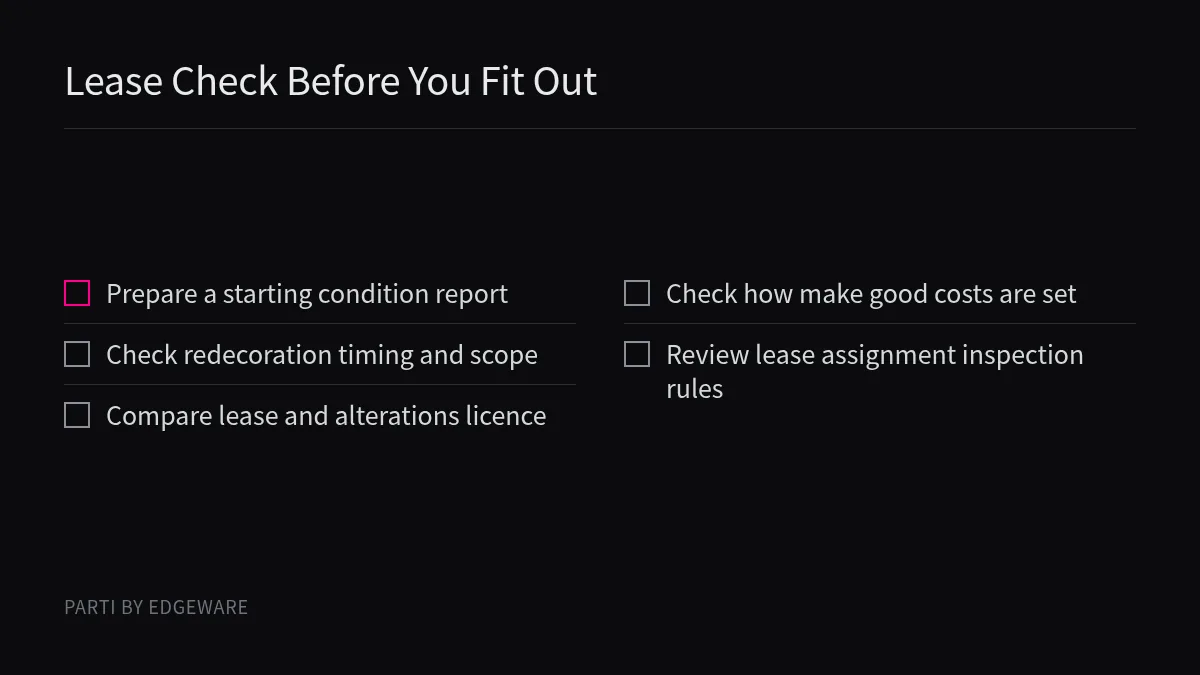
Check how your lease defines original condition, whether a schedule of condition is attached, what intervals apply to redecoration, how alterations licences affect exit duties, and how disputes or costs are decided.
Step-by-step checks before you sign or fit out
In England and Wales, the RICS Code for leasing business premises (2020)4 states under section 7.1 that leases should contain tenant repairing obligations appropriate to the length of the term, the condition of the premises, and the financial terms. Under section 7.2, if the tenant's repairing obligations are to be limited to the initial condition of the premises, a schedule of condition will normally be required, and the parties should agree who pays for obtaining it. For newly built premises, section 7.3 notes that a tenant taking on direct or indirect responsibility for repairs should be given suitable protection against inherent construction defects for an appropriate period.
In NSW and Queensland, the Small Business Commissioners advise tenants to document the condition of the premises at the start of the lease by preparing a condition report, and in Queensland even preparing one now if there is not one already. You can see what to record in our guide on why to write a condition report before a fit-out.
Key items to check and put in writing:
* Condition evidence: Prepare and attach a condition report or schedule of condition at the start. If a lease is assigned to you from another party, the NSW Commissioner warns that you need to check the make good requirements and may need to obtain a new inspection report. * Refurbishment details: Check whether any redecoration or refurbishment clause states the general nature, extent, and timing of the works. * Cost determination and surveyors: In NSW, retail leases often stipulate procedures for when landlord and tenant cannot agree on make good costs, including appointing an independent certified quantity surveyor to make a binding determination. We cannot tell from the lease text alone what a quantity surveyor will price a strip-out at, so getting early estimates helps you allocate funds before the lease ends. * Dispute resolution: Both the NSW and Queensland Small Business Commissioners note that mediation can help resolve disputes and save time and money, particularly where there is little evidence of the original condition. Seek legal advice from a lawyer experienced in property and tenancy law before you sign or if a dispute arises.
Conclusion
Separate your mid-lease redecoration duties from your end-of-lease reinstatement obligations early. Record the shop's starting condition and align your lease with any alterations licence.
About Parti
Parti by Edgeware is Edgeware's first industry solution. We are designing a café where one room can change how it is used by changing the props, with no rebuild of the room. Counters, tables and displays are meant to be carried in and out again by hand, so less is built into the walls and floor and less is left to take down when a lease ends. That is a design aim, not a tested result. The first café is planned for Hangzhou and is not open. See the room and how the floor connects. This guide is for tenants who are weighing a shop or café fit-out. It is general information, not legal advice, and your own contract and local rules decide.
Sources
- Queensland Small Business Commissioner: Make good: Explains Queensland make good and redecoration clauses, Property Law Act 2023 standard terms, and Retail Shop Leases Act rules.
- Russell-Cooke: Understanding a licence for alterations: Details how licences for alterations handle minor fit-outs, structural works, and reinstatement clauses in England and Wales.
- NSW Small Business Commissioner: 'Make good' and retail leases: Covers New South Wales retail lease make good duties, bare shell strip-backs, lease assignments, and quantity surveyor determinations.
- RICS: Code for leasing business premises, England and Wales (2020): Sets out professional standards on tenant repairing obligations, schedules of condition, and alterations control in England and Wales.