What does 'make good' mean when you leave a shop?
A surprise strip-out bill can wipe out your deposit when you hand back the keys. This guide shows how to avoid it.
Published
In a shop lease, 'make good' is your obligation to return the premises to their original condition, or to the state written in your lease, when the tenancy ends. That can mean anything from a basic clean to removing your entire fit-out.
Most shop owners only read the handback clauses during their final month of trading. Looking at how these terms work before you build a single counter will save you from paying for the same fit-out twice: once to put it in, and once to rip it out.
What does 'make good' mean in a shop lease?
Handing back a commercial shop is rarely as simple as sweeping the floor. If you do not check the baseline rules, your landlord may expect a bare concrete shell.
A make good clause sets out the exact condition you must leave the shop in when your lease finishes. Depending on your contract and local law, it requires returning the unit in the condition you took it, or stripping it back to base building state.
In Queensland, Australia, the Queensland Small Business Commissioner's make good guidance1 defines a make good clause as the tenant's obligation to return the property to its original condition, or as specified in the lease, at the end of the term. Under Schedule 1, Section 3 of Queensland's Property Law Act 2023, standard terms require a tenant to return the premises in the same or better condition as at the start of the lease, excluding reasonable wear and tear, specified disasters such as fire and earthquakes, and risks the lessor has insured against.
Standard law versus your lease terms
Standard statutory rules rarely have the final word. In Queensland, Section 139 of the Property Law Act 2023 lets the landlord and tenant exclude those standard terms and agree to hand the shop back in a different condition. Those agreed rules become the make good conditions in the lease.
In New South Wales, Australia, the NSW Small Business Commissioner's retail lease guidance2 notes that make good typically requires returning the property in a similar condition to how it was at the start, though some leases require stripping the shop back to base building (or bare shell) condition and redecorating. Other places have different rules, and your own contract and local authority decide what applies to your unit. This guide is general information, not legal advice.
Why landlords and tenants clash
The tension shows at the end of a tenancy. Tenants put money into upgrading a space and view ripping out working counters or lighting as a waste. Landlords, as the Queensland Commissioner points out, often want a neutral box that appeals to the next incoming tenant, so they write strict strip-out obligations into the agreement. If you assign a lease to a new business owner, the NSW guidance warns that the incoming tenant needs to check the make good requirements and may need a fresh inspection report.
What does a make good clause usually ask you to do?
Vague lease wording hides expensive physical labour. When you know the standard list of tasks, you can price the exit before you sign the contract or hammer a nail.
Common make good clauses ask you to repair occupancy damage, remove fixtures, partitions, joinery, and floor or ceiling finishes you added, restore an open floor plan, return air conditioning, fire, and hydraulic services to their original layout, and leave the shop clean.
According to the Queensland Small Business Commissioner, requirements vary by contract. One lease might ask for nothing more than a clean, empty unit, while another demands repainting and stripping out every piece of custom carpentry. Typical requests include:
- Repairing damage caused during your occupancy.
- Removing all tenant-installed fixtures, partitions, joinery, flooring, and ceiling finishes.
- Taking down internal walls to restore an open floor plan.
- Returning base building services (air conditioning, fire systems, and hydraulics) to their original state.
- Leaving the premises clean and tidy.
Make good versus redecoration
Tenants often mix up make good with redecoration or refurbishment, even though they sit in separate parts of the lease. Redecoration clauses require maintenance or upgrades at set intervals during the tenancy, such as repainting walls or replacing carpets while you are still trading. Make good happens at the end. In Queensland, Section 50B of the Retail Shop Leases Act 1994 states that a clause in a retail shop lease requiring a tenant to refurbish or refit the shop is void unless the lease gives general details of the nature, extent, and timing of the work.
Physical work versus cash settlement
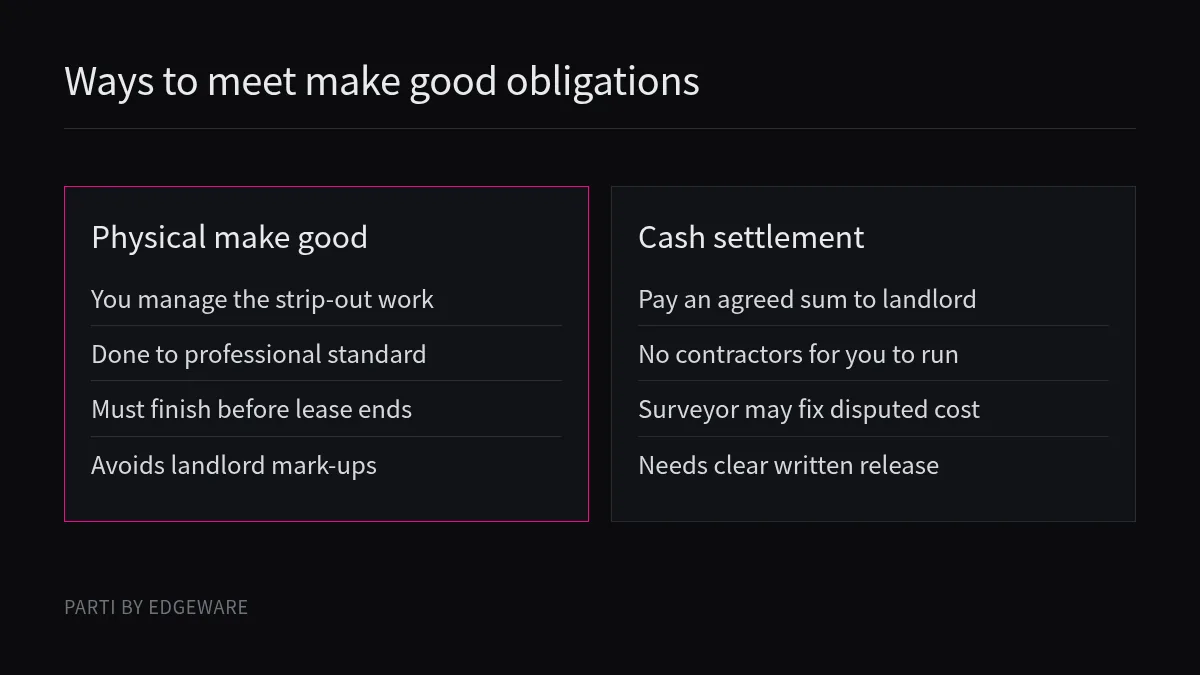
Leases in Queensland often outline two ways to meet your obligations:
| Option | How it works | What to watch |
|---|---|---|
| Physically making good | You carry out or manage the removal and repair work yourself. | The lease often requires the job to be done by a professional or to a professional standard. |
| Cash settlement | You negotiate a sum of money to pay the landlord instead of doing the physical strip-out. | If you cannot agree on costs, NSW retail leases often specify appointing an independent certified quantity surveyor to make a binding determination. |
Choosing shop fittings that leave no mark reduces how much you have to rip out or pay for at the end. That is also why we are designing our café room around removable pieces rather than fixed demolition work.
Where do make good disputes start?
End-of-lease arguments rarely come out of nowhere. They start on day one when both sides skip the paperwork, and they end with your security deposit frozen.
Disputes usually start from missing day-one condition records, vague lease wording, arguments over repair quality, or removing something valuable the other side added. If you miss the deadline or fail to agree, the landlord may claim against your bond or charge extra rent.
In Queensland, the Small Business Commissioner lists four main triggers for make good arguments: limited or no evidence of the shop's condition at the start of the lease, vague or ambiguous clauses, disagreement over the quality of the restoration work, and removing something of value added by the other party.
How your bond and rent get caught up
When a disagreement drags on, your security is on the line. The Queensland commercial lease bond fact sheet3 explains that tenants commonly provide a cash bond (a sum paid up-front, typically a multiple of monthly rent) or a bank guarantee (an undertaking from the tenant's bank to pay the landlord if the tenant breaches the lease). Where a company is the tenant, directors are often asked for a personal guarantee too, which can expose personal assets like a home.
In Queensland, no legislation requires a commercial or retail bond to be held in a registered account, the amount is unregulated, and the Retail Shop Leases Act 1994 sets no statutory timeframe for returning it. If make good is incomplete, the landlord may be entitled under the lease to keep the cash bond or call on the bank guarantee. In New South Wales, if make good is not completed as agreed, the landlord may withhold the bond or pursue the tenant for loss or damages, including rent for the time it takes to return the shop to the agreed state. Read more on why deposits get held back after a fit-out.
Resolving a deadlock
We do not know how every local tribunal weighs informal phone photos when no signed report exists, so avoiding court is usually smarter. Both the Queensland and NSW Small Business Commissioners offer mediation, where a mediator guides discussion without acting as a judge. Before a dispute escalates, the Queensland Commissioner recommends talking to the landlord to clarify what they want done, checking whether those requests match the lease, putting requests in writing, and getting legal advice on the cost of litigation.
What should you record and agree before you fit out?
Once your glue dries and the walls are painted, you lose your bargaining power. The time to limit your exit bill is before you sign the lease or start alterations.
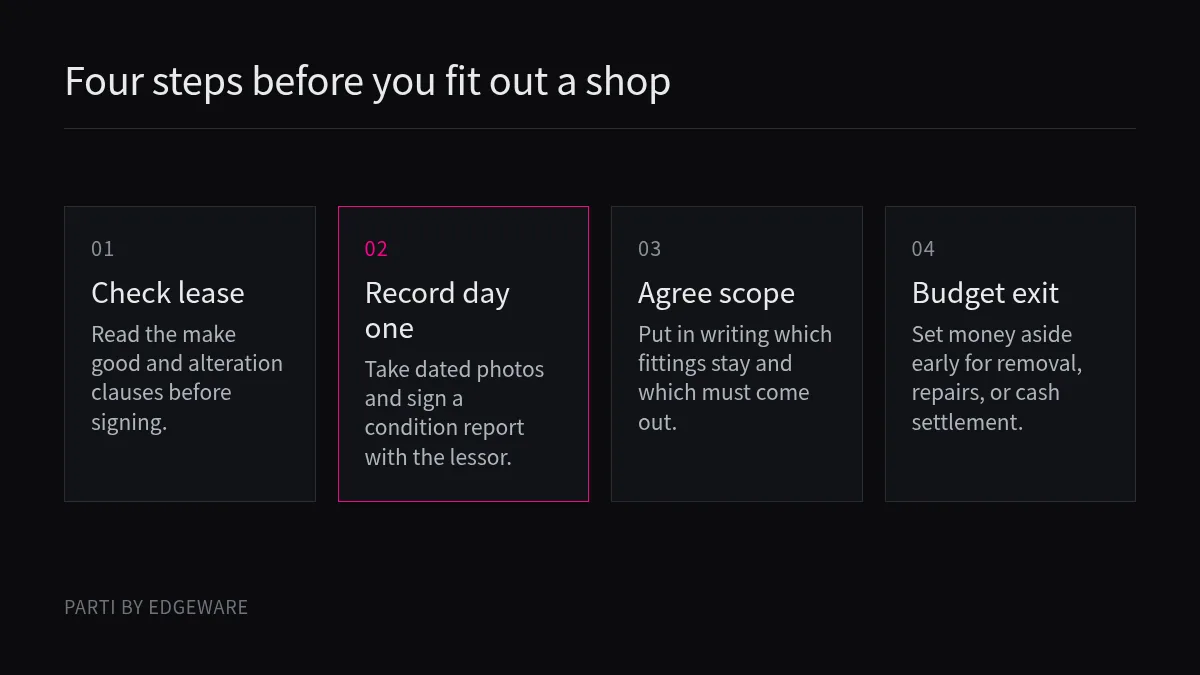
Before you fit out, agree on a written condition report, clarify in writing which alterations must be removed at the end, check whether a cash settlement is allowed, and set money aside in your budget so the exit work is never a shock.
In England and Wales, Section 7.2 of the RICS Code for leasing business premises (2020)4 states that if a tenant's repairing obligations are to be limited to the initial condition of the premises, a schedule of condition will normally be required, and the parties should agree who pays for obtaining it. Even if your lease has already started, the Queensland Commissioner recommends preparing a condition report right away. Our guide on writing a condition report before a fit-out covers how to document every wall and floor.
Agree on alterations before you build
Under Section 8 of the RICS Code for England and Wales, where a shop is a unit in a multi-let building or part of a building, it is common to prohibit structural and external alterations (apart from shop fronts, where appropriate) and require the landlord's consent for internal non-structural alterations, with a rule that consent is not unreasonably withheld or delayed. If the landlord requires a licence before alterations take place, the tenant should be notified at the outset to get early professional advice.
When you ask for landlord consent for shop alterations, get the handback terms agreed at the same time. Use this pre-fit-out checklist:
- Document day one: Prepare a dated condition report with photos and get both sides to sign it.
- Pin down the scope: Ask which planned items must come out at the end and which may stay, and put the answers in writing with the lease.
- Check valuation rules: Check if the lease requires a quantity surveyor to determine make good costs if you disagree.
- Budget from the start: As the NSW Commissioner advises, allocate funds to undertake the required make good work at the end of the lease.
- Negotiate early: Start talking to the landlord well before the expiry date so your bond is released on time.
Conclusion
Treat make good as part of your fit-out budget, not an afterthought. Record the initial state, agree the handback rules in writing, and build with removal in mind.
About Parti
Parti by Edgeware is Edgeware's first industry solution. We are designing a café where one room can change how it is used by changing the props, with no rebuild of the room. Counters, tables and displays are meant to be carried in and out again by hand, so less is built into the walls and floor and less is left to take down when a lease ends. That is a design aim, not a tested result. The first café is planned for Hangzhou and is not open. See the room and how the floor connects. This guide is for tenants who are weighing a shop or café fit-out. It is general information, not legal advice, and your own contract and local rules decide.
Sources
- Queensland Small Business Commissioner: Make good: Explains Queensland make good rules, standard terms, redecoration differences, common lease clauses, and mediation.
- NSW Small Business Commissioner: 'Make good' and retail leases: Covers NSW retail lease make good duties, quantity surveyor clauses, budgeting, and bond or rent claims.
- Queensland Small Business Commissioner: Commercial lease bond: Details cash bonds, bank guarantees, personal guarantees, and how make good disputes affect bond return.
- RICS: Code for leasing business premises, England and Wales (2020): Sets out professional standards on schedules of condition, repair limits, and landlord consent for alterations.