How do you get landlord consent to alter a shop?
Starting a shop fit-out without written permission risks lease breach and paying twice. This guide shows what to ask your landlord and put in writing.
Published
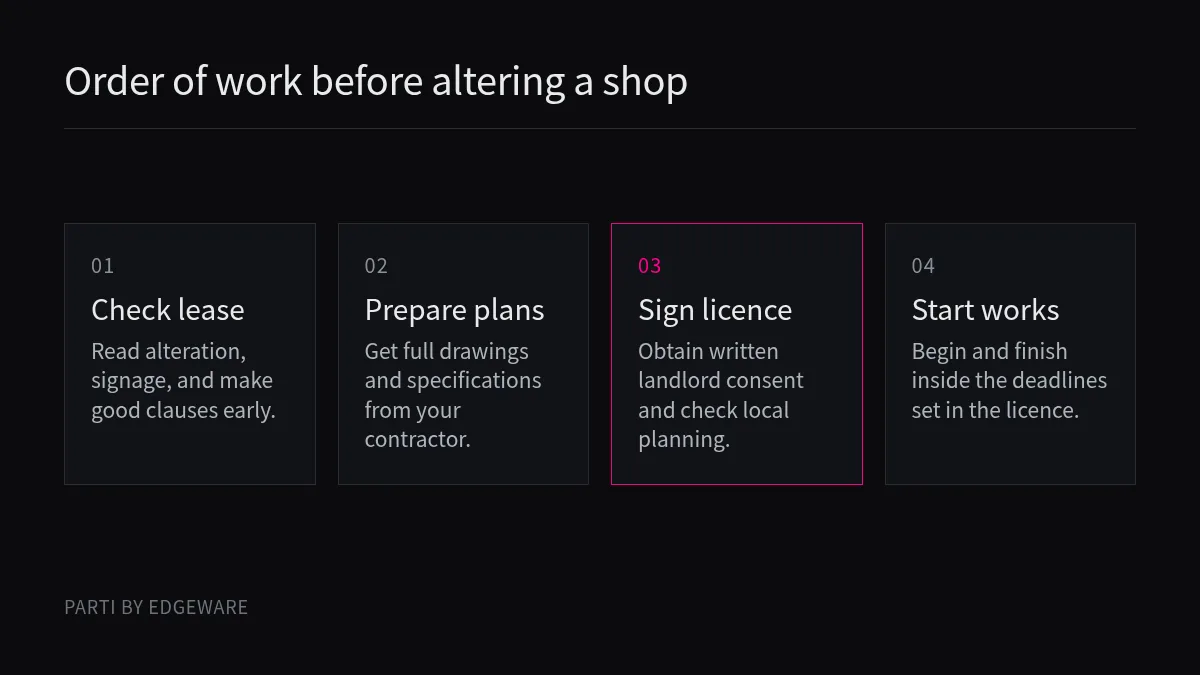
To get landlord consent to alter a shop, check your lease early, submit full plans, drawings, and specifications for approval, and sign a written licence for alterations that settles scope, safety compliance, work deadlines, and end-of-lease reinstatement rules before starting.
Getting written permission protects both your deposit and your opening schedule. Here are the four questions every shop or café tenant should settle before builders step on site.
Do you need your landlord's consent to alter a shop?
You want to fit out a rented unit into a working café. Guessing whether your lease allows alterations risks breaching your tenancy before opening.
In England and Wales, commercial tenants usually need the landlord's written permission before carrying out alterations. Whether you need formal consent for internal non-structural works depends on your lease and whether you rent a whole building or one unit.
In England and Wales, a commercial tenant who wants to change the property usually needs the landlord's written permission before carrying out any works, often recorded in a legal document called a licence for alterations1. In Queensland, Australia, the Property Law Act 2023 also sets out defined processes for altering the premises under a commercial lease, as noted in the Queensland Small Business Commissioner's commercial lease tips2. Other places have different rules, and your own contract and local authority decide what applies to your shop. This guide is general information, not legal advice.
According to Russell-Cooke, works generally fall into two categories:
- Major or substantial works: structural changes such as removing or replacing walls, doors, or staircases, building extensions or conversions, or installing equipment on the roof or exterior.
- Minor non-structural works: often called fit-out works, which turn a commercial shell into a working space by installing fixtures, branding, signage, and electrical wiring.
Even minor works usually need compliance with lease obligations. Under the RICS Code for leasing business premises (2020)3 in England and Wales, landlord control over alterations should be no more restrictive than necessary to protect the value of the premises and any adjoining or neighbouring premises of the landlord.
Whole building versus a unit in a multi-let building
The RICS code draws a clear line based on what you rent. Look at how the two situations compare:
| Property type in England and Wales | RICS standard on internal non-structural alterations |
|---|---|
| Lease of an entire building | The landlord should not normally prohibit or require consent if works do not adversely affect character, value, structural stability, statutory compliance, or energy efficiency, though the tenant must carry out works properly without damage or nuisance and give written details. |
| Lease of a unit in a multi-let building | The landlord may require that its consent is obtained (not to be unreasonably withheld or delayed) and normally prohibits structural and external alterations (apart from altering shop fronts, if appropriate). |
If you have already carried out alterations without required permission, you are in breach of your lease obligations. Russell-Cooke notes that if both parties agree the works are suitable and the landlord does not want to forfeit or end the tenancy, they can use a retrospective licence to document consent after completion.
What should a consent or licence for alterations cover?
A vague email saying "go ahead" leaves too much room for argument later. When your lease ends, unclear terms quickly turn into deposit disputes.
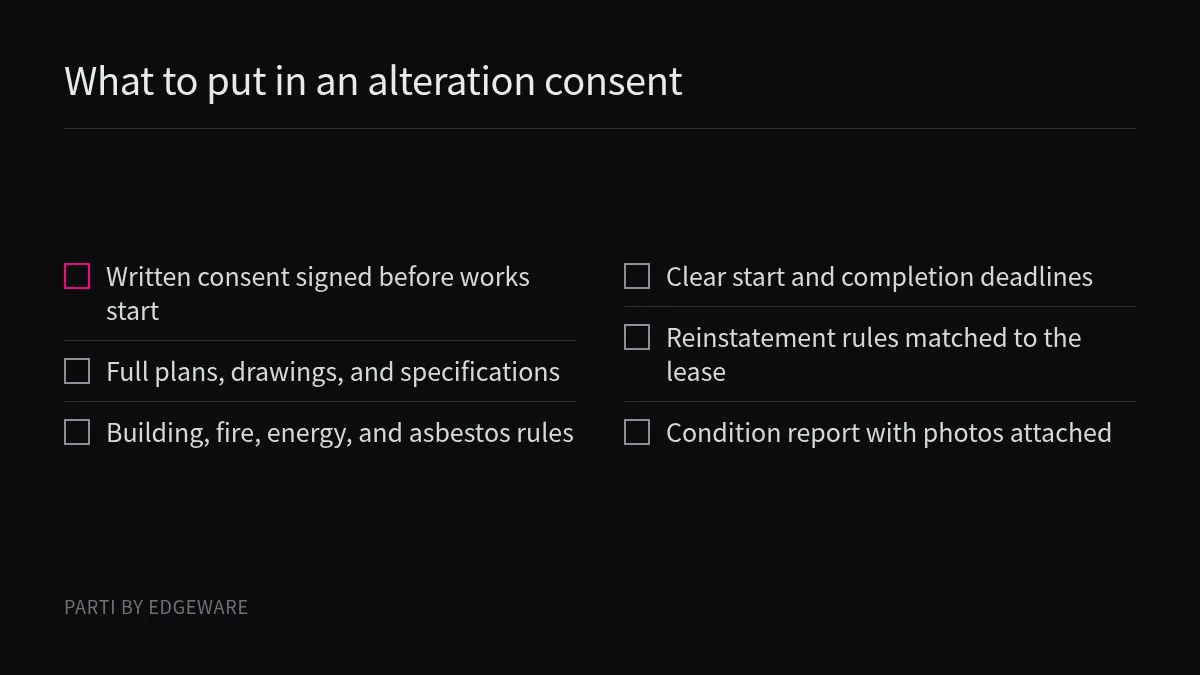
A licence for alterations is supplemental to the lease and should attach approved plans, drawings, and specifications, address building, fire, energy, and asbestos regulations, set start and completion deadlines, and align reinstatement rules with your lease.
In England and Wales, Russell-Cooke explains that a licence for alterations supplements the lease and protects both landlord and tenant by recording the exact scope, conditions, and requirements for the works. Before you sign or start work, make sure your written consent covers four areas.
Scope of works and insurance
Ahead of any consent being granted, you should produce full plans, drawings, and specifications showing the extent of the proposed alterations for the landlord's approval. Once approved, these plans are annexed to the licence. Your landlord may also need to notify its building insurers with details of the works if the insurance policy requires it. It helps to pair these drawings with a condition report before you fit out so both sides have a clear record of how the unit started.
Building, safety, and signage rules
Alterations often trigger statutory duties. In England and Wales, Russell-Cooke notes that major construction projects bring health and safety obligations under the Construction (Design and Management) Regulations 2015 (CDM 2015), and mixed-use buildings require consideration of the Building Safety Act 2022 (BSA 2022). Both major and minor works require checking the impact on the building's Energy Performance Certificate rating, implementing fire precautions under the Regulatory Reform (Fire Safety) Order 2005, and checking whether materials contain asbestos or risk disturbing existing asbestos. Your surveyor or contractor should give input on these risks.
Under the RICS code in England and Wales, leases normally require tenants to comply with all legislation at their own cost, including the Equality Act 2010, Town and Country Planning Acts, Health and Safety Acts, and Environmental Protection Acts. Where a landlord wants the right to approve the size and appearance of signage, RICS advises tenants to ask for a provision that approval will not be unreasonably withheld or delayed.
How long does consent take, and what does it cost?
Signing a lease or booking builders before permissions are ready is a common trap. Waiting on approvals while paying rent drains your budget fast.
Our legal sources do not give a fixed timeframe or fee for obtaining a landlord's licence for alterations, though RICS notes that local planning permission in England and Wales takes at least eight to ten weeks or longer.
We do not know how long your landlord will take to grant consent or what the legal and surveyor fees will be, because our sources do not state a duration or price for a licence for alterations. In practice, timing depends on how complete your drawings are and whether insurers or superior landlords must be consulted.
Planning and service upgrades
While we cannot put a number on the landlord's turnaround time, the RICS code in England and Wales points out two practical hurdles to build into your schedule and budget:
- Planning permission: If you need planning permission for your proposed use, RICS states you should allow at least eight to ten weeks (and sometimes longer) for the local council to process the application. In Queensland, the Small Business Commissioner similarly notes that tenants are usually responsible for getting local council approval for permitted use, onsite or outside dining, grease traps, and parking before operating.
- Mains services: RICS warns that altering electricity and gas services can be expensive, so you should check early that the property has adequate mains services in good working order.
Deadlines inside the licence
Once the licence is granted, the clock starts ticking on your works. Russell-Cooke notes that a licence for alterations generally sets two strict deadlines:
- Start deadline: Consent commonly ceases if you do not start the works within a set timeframe from the date of the licence. If you miss it, the landlord may agree to an extension, but has no obligation to do so.
- Completion deadline: Once works begin, the licence will likely impose a deadline to finish them and require you to notify the landlord on completion.
In England and Wales, RICS states that where a landlord intends to prohibit certain alterations or require a licence before they take place, the tenant should be notified at the outset so they can get early professional advice. In Queensland, the Small Business Commissioner also recommends seeking legal advice before signing a lease, taking possession, or paying rent.
What should you ask for about taking alterations out later?
Spending money to build a shop counter and then paying again to rip it out hurts. Yet many tenants ignore end-of-lease rules until moving week.
Before starting work, check that the reinstatement terms in your licence for alterations and your lease match, and ask whether your alterations can stay at the end of the term instead of being stripped out.
In England and Wales, Russell-Cooke explains that landlords usually seek to require the tenant to reinstate the property and make good any damage when you leave a rented shop. For minor works, removing fixtures is usually straightforward. Where works are structural, the landlord and its surveyors should give careful thought to whether the landlord would actually prefer the alterations to remain at the end of the term.
Keep the lease and the licence aligned
Russell-Cooke stresses one rule above all: read the reinstatement clauses in your lease and in your licence for alterations side by side to make sure they work together and do not contradict each other. It also helps to check how your lease separates reinstatement and redecoration, so you know which obligations apply to your alterations and which apply to general surfaces.
Before you sign the consent, walk through this checklist with your advisor:
- Have we attached final drawings and specifications so nobody argues later about what was altered?
- Does the licence clearly state which alterations must be removed and which can stay at the end of the lease?
- Do the reinstatement terms in the licence match the make good clause in the main lease?
- Have we checked with the landlord whether structural or layout improvements can remain without a strip-out charge?
- Are the start and completion dates realistic for our contractor's schedule?
Thinking through how objects enter and leave our planned room is part of why we study commercial lease rules so closely. Settling what stays and what goes before a single tool comes into the shop saves arguments years down the line.
Conclusion
Ask for written consent early, attach clear plans, check safety rules, and match reinstatement clauses with your lease before you start any shop work.
About Parti
Parti by Edgeware is Edgeware's first industry solution. We are designing a café where one room can change how it is used by changing the props, with no rebuild of the room. Counters, tables and displays are meant to be carried in and out again by hand, so less is built into the walls and floor and less is left to take down when a lease ends. That is a design aim, not a tested result. The first café is planned for Hangzhou and is not open. See the room and how the floor connects. This guide is for tenants who are weighing a shop or café fit-out. It is general information, not legal advice, and your own contract and local rules decide.
Sources
- Russell-Cooke: Understanding a licence for alterations: Explains what a licence for alterations covers in England and Wales, including scope, safety, deadlines, and reinstatement.
- Queensland Small Business Commissioner: Tips when entering a commercial lease: Outlines commercial lease questions in Queensland, condition reports, council approvals, and Property Law Act 2023 rules.
- RICS: Code for leasing business premises, England and Wales (2020): Sets professional standards in England and Wales on landlord alteration controls, multi-let units, planning timelines, and compliance.