Why write a condition report before a fit-out?
New shop tenants rush straight into demolition and carpentry. Without baseline proof of the room, you risk paying to fix someone else's damage at handover.
Published
A condition report records the exact state of a rented shop before you alter it. Signed by both landlord and tenant with dated photos, it sets the baseline for end-of-lease make-good duties and helps protect your security deposit from unfair claims.
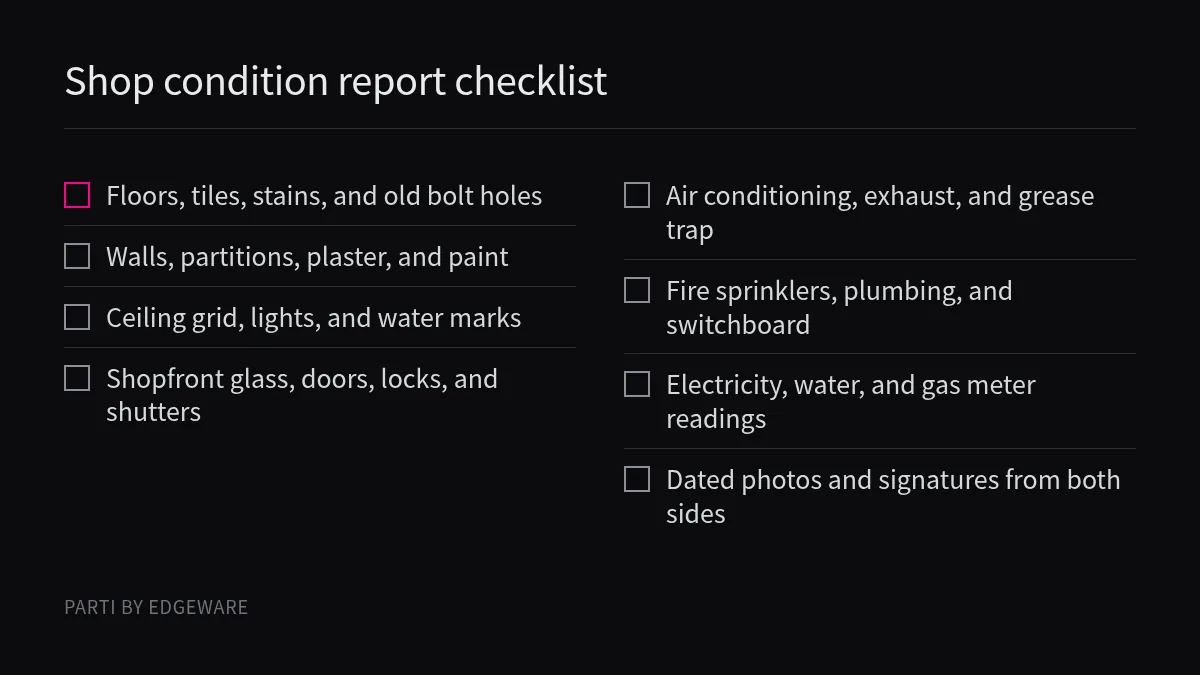
Before the first contractor steps onto the floor, a few hours with a camera and a notepad can save you thousands at the end of the lease. Here is how the record works, why public agencies warn tenants not to skip it, and how to put yours together.
What is a condition report for a rented space?
You get the keys to an empty unit and spot cracked tiles and stained ceilings. If you do not log them now, they become your problem later.
A condition report is a written and photographic record of a commercial property's physical state when a tenancy starts. Both the landlord and the tenant sign it so neither side has to rely on memory when the lease ends.
A baseline, not a building survey
A condition report is simpler than an engineering inspection. It is an agreed description of what the space looks like on handover day, before you bring in tools, paint, or counters. In New South Wales, Australia, guidance on retail lease make-good1 from the NSW Small Business Commissioner explains that make-good clauses typically require a tenant to return the property in a condition similar to how it was at the start of the lease, and advises documenting that starting state with a condition report. Other places have different rules, and your own lease contract and local authority decide what applies to your shop.
In Queensland, Australia, the Small Business Commissioner's commercial lease entry checklist2 tells tenants to check whether the lease requires make-good at the end of the term, and if so, whether there is a condition report (including photos) signed by both the lessor and the tenant. It also prompts both sides to check whether existing structures, fixtures, and plant and equipment are in good working order, and who must repair or maintain them.
What the document actually does
When you read our guide on what make-good means when you leave a shop, you see that end-of-lease obligations depend on comparison. A tribunal, mediator, or quantity surveyor cannot compare the end of your tenancy with the beginning if nobody recorded the beginning. The report turns "it was already like that" from an argument into a page with a date and two signatures.
A working report usually pairs two things: * Written notes room by room, listing surfaces, fittings, and any marks or faults already present. * Dated photographs and walk-through video that show both wide angles of each wall and close-ups of existing wear.
Why does a record from day one matter?
Landlords and tenants rarely remember a room the same way after several years of trade. When memories clash at handover, the tenant's bond sits on the line.
Missing proof of the property's starting condition is a leading cause of end-of-lease make-good disputes. Without a day-one record, your landlord can withhold your bond or claim the cost of stripping out or repairing items you never touched.
The direct link to your security deposit
In Queensland, the Small Business Commissioner's make-good fact sheet3 lists limited or no evidence of the condition of the premises at the beginning of the lease as a primary reason disputes arise. The same office notes that the return of the tenant's bond (security deposit) is almost always affected by a make-good dispute. You can read more on how these hold-ups happen in our guide on why deposits get held back after a fit-out.
The numbers from Queensland show how often security money gets stuck. According to the Queensland Small Business Commissioner's guide on commercial lease bond returns4, 39% of small business lease dispute mediations conducted by the office in the 2024 to 2025 financial year involved disputes over the bond, and bond disputes accounted for over 30% of its small business lease mediations across three consecutive financial years from 2022 to 2025.
What happens when there is no record
Under Queensland's Property Law Act 2023 Schedule 1 standard terms, a tenant is required at the end of a commercial lease to return the premises in the same or better condition as at the start of the lease, excluding reasonable wear and tear and specified insured risks, unless the lease excludes those standard terms and sets its own make-good conditions. In New South Wales, if make-good is not completed as agreed, the landlord may seek to withhold the bond or pursue the tenant for loss or damages, including rent for the time it takes to return the premises to the agreed state.
When there is little or no evidence of the original condition, the Queensland commissioner points out that you have to consider what proof you could actually show a tribunal or court that the premises were returned to that state. Negotiating or mediating can save time and money when the record is missing, because nobody has a clear baseline. We do not know how any single mediator or tribunal member will weigh old emails or contractor recollections when a formal report is missing, which is why starting without a signed record is a gamble you do not need to take.
What should the record show, and who should sign it?
Taking a few quick phone snaps of the front window is not enough. If a photo does not show the defect clearly, it will not settle an argument.
Your condition report should cover every room, floor, wall, ceiling, fixture, and building service, backed by dated photos, video, and meter readings. Both the tenant and the landlord or managing agent must sign and date identical copies.
What to inspect and photograph
Walk the space slowly in good light before moving a single box in. As we explore in our spatial planning notes, the shell you inherit dictates how your fit-out goes together and how it comes apart. Make sure your report captures both the surfaces you will cover and the base building services you will connect into.
| Area or item | What to check and write down | How to photograph it |
|---|---|---|
| Floors and skirtings | Cracks in concrete or tiles, stains, uneven patches, old bolt holes, missing skirting boards | Wide shot of the whole floor plus close-ups with a ruler or coin for scale |
| Walls and partitions | Stud walls already in place, plaster dents, damp marks, peeling paint, old signage fixings | One full shot per wall from corner to corner, then detail shots of damage |
| Ceilings and lighting | Missing grid tiles, water stains, hanging cables, working and non-working light fittings | Angled shots with lights switched on, then switched off |
| Shopfront and doors | Scratches on glass, locks, roller shutters, threshold strips, awning condition | Inside and outside views, plus video of shutters and doors opening |
| Base building services | Air conditioning units, fire sprinklers, exhaust ducts, grease trap, plumbing, electrical board | Photos of serial plates, distribution boards, and whether plant is working |
| Meters | Electricity, water, and gas meter numbers and exact readings on handover day | Clear close-up showing the serial number and the digits on the dial |
Signatures and storage
In Queensland, the commissioner's pre-lease tips specifically ask whether there is a condition report, including photos, signed by both the lessor and the tenant. A folder of photos sitting only on your phone is easy for the other side to challenge years later.
Compile the written sheet and the image files into a single dated document. Print two copies or create a locked digital file, have both the landlord (or their authorised agent) and the tenant sign and date it, and attach it to the lease records. Keep your copy backed up outside the shop so a leak or computer failure never wipes it out.
When should you update it?
A shop rarely stays frozen after opening day. You might take over an existing lease, add a partition wall, or realize you never wrote a report at all.
Prepare a condition report before you take possession or start any fit-out work. Update or add to the record whenever you get landlord consent for alterations, if you take over an assigned lease, or immediately if you started without one.
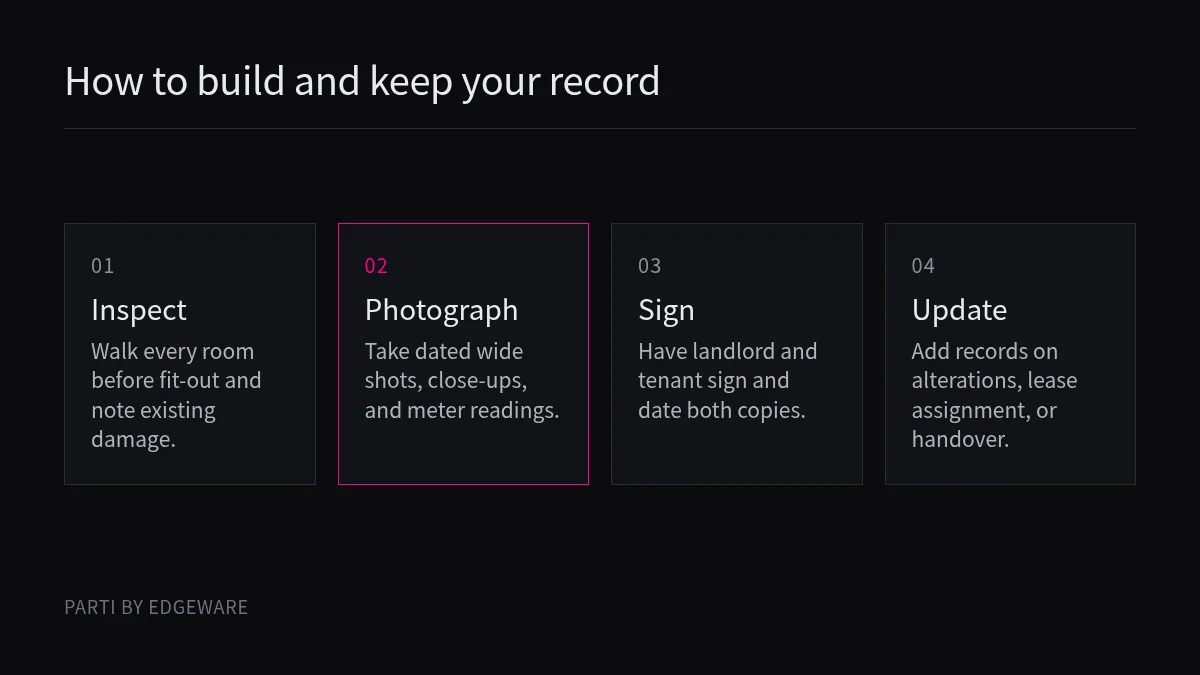
Four moments to put the state of the shop on paper
* Before keys and fit-out: The cleanest time to record the premises is after the lease is agreed and before you start work. Note that in Queensland, under section 11 of the Retail Shop Leases Act 1994, a retail shop lease can be deemed to have been entered into if the tenant pays rent or takes possession of the premises, even if the lease has not been signed by the parties. Do not start ripping out old counters the afternoon the agent hands you the keys until the baseline is signed. * Right now, if you skipped it: If you are already trading and never made a report, do not wait until the end of the lease. The Queensland Small Business Commissioner's top tip on make-good is to prepare a condition report now, even if there is not one already. Record the current state, gather any dated photos from before your fit-out, and agree on what belongs to the base building versus your own installations. * When you alter the shop during the lease: Before you change anything mid-lease, read our guide on how to get landlord consent to alter a shop. Attach before-and-after photos to the written consent and record whether the new work must be removed at the end of the lease. * When a lease is assigned: If you buy a business and take over the seller's lease, or assign your lease to a buyer, the baseline matters again. The NSW Small Business Commissioner advises that when leases are assigned to another party, tenants need to check the make-good requirements and may also need to obtain a new inspection report. Finally, at the end of the lease, Queensland's bond return guide recommends taking photos and keeping receipts of any make-good works or cleaning completed before the landlord's final inspection.
Conclusion
Walk the shop before work begins, photograph every surface and service, and get both signatures on the report. A clear record protects your bond.
About Parti
Parti by Edgeware is Edgeware's first industry solution. We are designing a café where one room can change how it is used by changing the props, with no rebuild of the room. Counters, tables and displays are meant to be carried in and out again by hand, so less is built into the walls and floor and less is left to take down when a lease ends. That is a design aim, not a tested result. The first café is planned for Hangzhou and is not open. See the room and how the floor connects. This guide is for tenants who are weighing a shop or café fit-out. It is general information, not legal advice, and your own contract and local rules decide.
Sources
- NSW Small Business Commissioner: 'Make good' and retail leases: Explains retail lease make-good obligations, condition reports at lease start, and inspection reports on lease assignment.
- Queensland Small Business Commissioner: Tips when entering a commercial lease: Lists key pre-lease checks including signed condition reports with photos and rules on taking possession.
- Queensland Small Business Commissioner: Make good: Details common causes of make-good disputes, Property Law Act standard terms, and advice to prepare a report.
- Queensland Small Business Commissioner: Understanding the return of a commercial lease bond: Provides Queensland mediation statistics on bond disputes and end-of-lease inspection and photo steps.