What should a tenant ask a landlord before signing?
What you must repair or strip out later is settled before you sign. This checklist covers what to ask the landlord first.
Published
Before signing a commercial lease, ask the landlord about the space's current condition, permitted business use, alteration rules, end-of-lease reinstatement duties, break clauses, and how your security deposit, outgoings, and guarantees work, then get every agreed answer written into the lease.
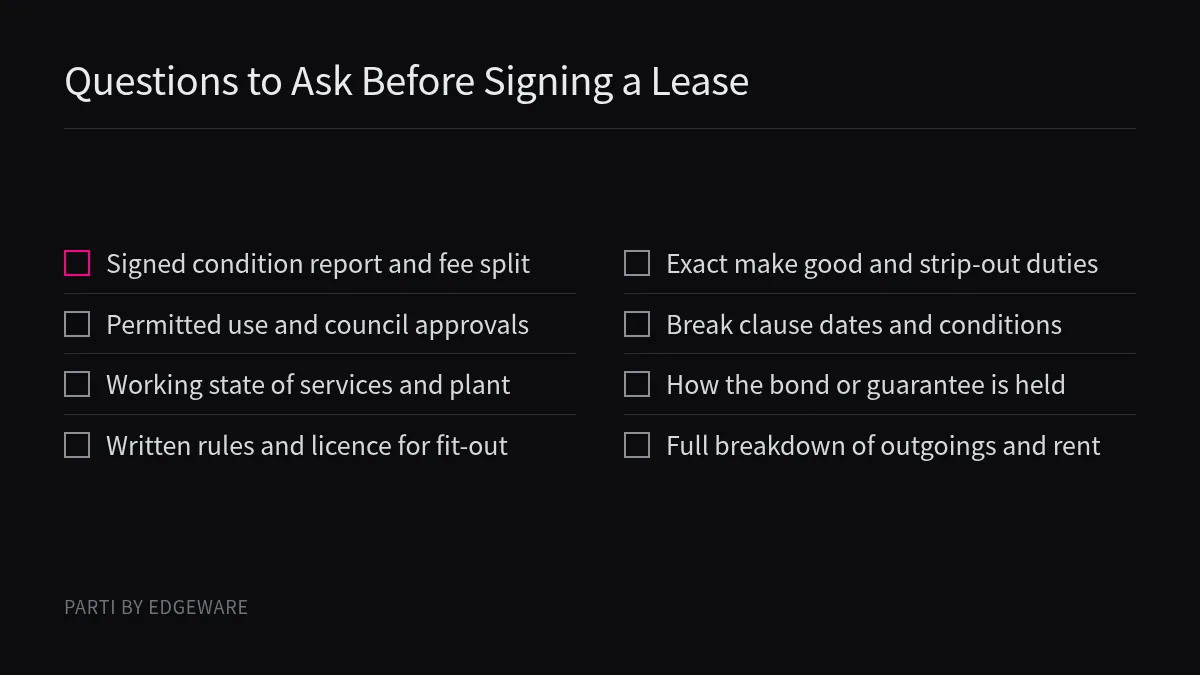
The questions below group what to ask into four areas: the premises, fit-out works, ending the tenancy, and money. The examples draw on rules in England and Wales and in Queensland, Australia, so remember that other places have different rules, your own contract and local authority decide, and this guide is not legal advice.
What should you ask about the space itself?
Taking keys to a shop with hidden repair needs or planning limits can stall your opening. A few direct questions before signing clarify your starting position.
Ask for a signed condition report or schedule of condition, who pays to prepare it, whether your exact business activity is permitted by the local council and title covenants, and whether mains services, equipment, and safety compliance are in working order.
We would start with what the building can legally and physically handle. In England and Wales, the RICS leasing code1 states that if a tenant's repairing obligations are to be limited to the initial condition of the premises, a schedule of condition is normally required, and both parties should agree who pays for it. In Queensland, the commissioner's lease tips2 likewise ask whether a condition report with photos is signed by both the lessor and the tenant. You can read more in our guide on why to write a condition report before a fit-out.
Questions on physical state and permitted use
- Will my repair duties be capped at the starting condition, and who pays for the schedule of condition? Under the RICS code in England and Wales, limiting repair duties to the initial state requires a schedule of condition and an agreement on its cost; put both the attached schedule (with photos, as Queensland's guidance notes) and the fee split in writing.
- Are all existing structures, fixtures, plant, equipment, and mains services in good working order, and who maintains them? Queensland's guidance tells tenants to ask who repairs existing plant and equipment, while RICS notes that altering electricity and gas services can be expensive; record the working state of services and the maintenance split in the lease.
- If the building is newly built, what protection do I get against inherent construction defects? In England and Wales, RICS states that a tenant taking on direct or indirect repair duties in newly built premises should be given suitable protection against inherent construction defects for an appropriate period; ask for that defect protection clause in writing.
- How was the space used recently, and do any title covenants or planning permissions restrict my planned use, hours, or noise? In England and Wales, RICS says landlords should disclose recent use and title or planning restrictions, and notes that if you need planning permission you should allow at least eight to ten weeks (sometimes longer) for processing; in Queensland, tenants usually must hold council approval for the permitted use, onsite or outside dining, grease traps, and parking before operating, so get disclosures in writing and check with the local council first.
- Does the building already comply with fire, health and safety, and disability access laws? RICS warns that leases in England and Wales normally require tenants to comply with all legislation at their own cost, including the Equality Act 2010, Town and Country Planning Acts, Health and Safety Acts, and Environmental Protection Acts; ask the landlord for current compliance records and get a surveyor's advice before signing.
- Could nearby construction works or disturbances affect my trading? Queensland's small business guidance flags this directly; ask the landlord to disclose planned building works in writing.
What should you ask about alterations and fit-out?
Fitting out a shop without the right written permission can put you in breach of your lease. Ask how the landlord handles alterations before you plan the work.
Ask which alterations are prohibited outright, whether you need a formal licence for alterations for internal fit-out works or signage, what drawings and safety checks the landlord requires, and whether landlord consent cannot be unreasonably withheld or delayed.
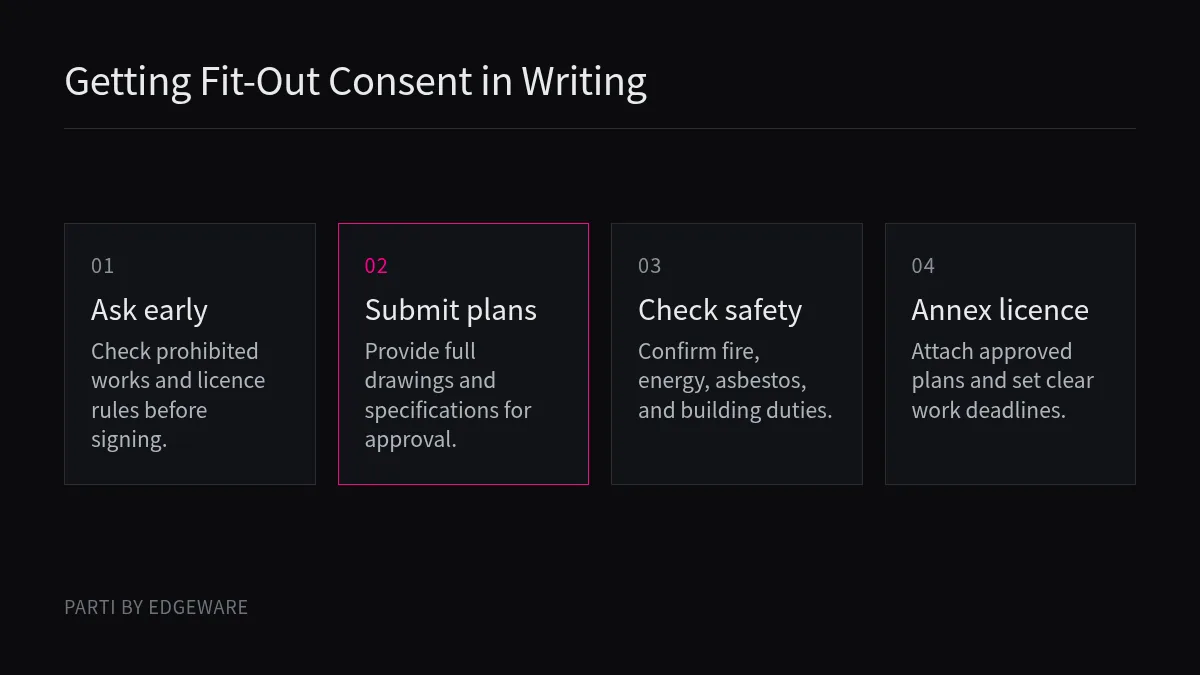
Turning a bare unit into a working shop or café can mean wiring, counters and signs. In England and Wales, Russell-Cooke's guide to alteration licences3 explains that a Licence for Alterations is a legal document supplemental to a lease that records the landlord's written permission and sets the scope, conditions, and requirements for the works. Before you plan how your interior space will function, check our guide on getting landlord consent for shop alterations and put the questions below to the landlord.
Questions on fit-out permissions and rules
- Do you intend to prohibit specific alterations or changes of use, or require a formal licence before I start? Under the RICS code in England and Wales, where a landlord intends to prohibit certain alterations or changes of use or require a licence, the tenant should be notified at the outset to get early professional advice; ask for these restrictions in the heads of terms.
- For internal non-structural fit-out works, do I need prior written approval or only to give you written notice? RICS notes that in a lease of an entire building, landlords should not normally prohibit or require consent for internal non-structural works that do not harm character, value, structural stability, statutory compliance, or energy efficiency (though they will require written details), whereas in a unit in a multi-let building the landlord may require consent; confirm in the lease whether consent is needed and that it will not be unreasonably withheld or delayed.
- What are the rules for approving my shop front and signage? In England and Wales, RICS states that where a landlord wants the right to approve the size and appearance of signage, tenants should ask for a clause stating that approval will not be unreasonably withheld or delayed; get that wording into the lease.
- What plans, drawings, and specifications must I submit, and does your building insurer need to be notified? Russell-Cooke notes that tenants should produce full plans, drawings, and specifications ahead of consent, that the landlord may need to notify its insurers under the building insurance policy, and that approved plans are annexed to the Licence for Alterations; agree the submission list in writing.
- How will the licence address building, fire, energy, and asbestos regulations? In England and Wales, Russell-Cooke highlights that major structural works may require planning permission and compliance with the Construction (Design and Management) Regulations 2015 and the Building Safety Act 2022 for mixed-use buildings, while any licence should consider the Energy Performance Certificate rating, fire precautions under the Regulatory Reform (Fire Safety) Order 2005, and whether materials contain or risk disturbing asbestos; confirm each party's statutory duties in the licence.
- What are the start and completion deadlines once the licence is granted? Russell-Cooke points out that consent in a Licence for Alterations commonly ceases if works do not start within a set timeframe, with no obligation on the landlord to extend it, and that the licence also sets a completion deadline and a duty to notify the landlord on completion; get realistic dates written into the licence.
What should you ask about the end of the lease?
Handing back the keys rarely ends your obligations on its own. If you do not clarify reinstatement and break rules early, you risk paying for the same fit-out twice.
Ask whether you must strip out your alterations and make good at lease expiry, whether your lease and alteration licence match on reinstatement, and what exact dates, notice periods, and conditions apply if either party uses a break clause.
We do not know how your business will trade several years from now, and neither do you. That is why exit terms matter just as much as entry terms. In England and Wales, the RICS code notes that landlords traditionally preferred terms of 15 to 25 years, though shorter terms or break clauses are used where tenants want mobility. In Queensland, the commissioner warns that breaking a lease early carries legal ramifications and that failing to diarise strict timelines can cost you an option to renew. For a broader look at contract clauses, read our guide to which lease terms a shop tenant should understand.
Questions on reinstatement, break clauses, and renewal
- What exact "make good" or reinstatement works will you require at the end of the lease? Queensland's guidance asks whether the tenant must make good the premises at the end of the lease, and Russell-Cooke notes in England and Wales that while landlords usually require reinstatement for minor works, they may sometimes prefer structural works to remain; make sure the lease and any Licence for Alterations state the exact reinstatement rules and do not contradict each other.
- Are statutory renewal rights included or excluded, and what are the deadlines for any option to renew? In England and Wales, RICS states that if the landlord proposes to exclude statutory renewal rights under the Landlord and Tenant Act 1954, the tenant should be notified at the outset; in Queensland, tenants are advised to diarise renewal and option periods so they do not lose the right to renew, so get all renewal rights and notice dates written clearly in the lease.
- If there is a break clause, what are the break dates, notice period, and pre-conditions? Under RICS in England and Wales, unless stricter conditions are agreed in the heads of terms, a tenant's break should be conditional only on paying all basic rent due before the break date, giving up occupation, and leaving no subtenants or other occupiers, with disputes over the state of the premises settled later as at normal expiry; verify in writing that repair disputes cannot be used to invalidate your break.
- Is there any penalty payment, or return of rent and service charges, when a break is exercised? RICS notes that landlords sometimes ask for a specified sum if a tenant breaks after receiving a capital contribution or rent-free period, and states that leases should require landlords to repay rent, service charge, or insurance paid for any period after the break takes effect (though service charge refunds may wait until accounts are finalised); check too with your solicitor about non-refundable stamp duty land tax or land transaction tax on longer leases with breaks, and get refund clauses written into the lease.
- Are you the freehold owner or a leaseholder yourself, and will my lease be registered? In England and Wales, RICS advises checking whether a landlord who is a leaseholder has break clauses in their own head lease; in Queensland, short-term leases of three years or less (including options) are protected under section 185(b) of the Land Title Act 1994, while leases over three years (including options) can be registered with Titles Queensland, so confirm the title position and registration in writing.
What should you ask about money and security?
Rent is only part of what a commercial tenant pays. Ask how the bond, outgoings and any guarantee work before you sign.
Ask whether the security is a cash bond or bank guarantee, who holds it, what rules govern its return, whether a personal guarantee is required, and how outgoings, rent reviews, and default rules work.
Do not assume a government body holds your deposit or sets a deadline for its return. In Queensland, the commissioner's commercial lease bond fact sheet4 explains that there is no legislative requirement for a commercial or retail shop lease security to be held in a particular manner or registered with an authority, the sum is not regulated by legislation, and the Retail Shop Leases Act 1994 contains no provisions on releasing a security or any statutory timeframe for its return. The lease itself is the primary source of law. Read our guide on why deposits get held back after a fit-out to see how end-of-lease claims arise.
| Security Type in Queensland (QSBC) | How It Works | Key Risk to Clarify in Writing |
|---|---|---|
| Cash bond | Up-front sum paid by the tenant, typically a multiple of monthly rent, held by the lessor or an agreed third party. | How it transfers if the agent changes or the lessor sells, and when it must be returned. |
| Bank guarantee | An undertaking from the tenant's bank to pay the lessor if the tenant breaches the lease; no up-front transfer of funds to the lessor. | Whether it is conditional or unconditional, has an expiry date or is ongoing, and what breaches allow the lessor to call on it. |
| Personal guarantee | Commonly requested from company directors alongside a security; makes the guarantor personally liable for company debts or losses. | Potential exposure of personal assets (such as a home owned in the guarantor's name) and whether liability can be capped. |
Questions on bonds, guarantees, and ongoing costs
- Will the security be a cash bond or a bank guarantee, who holds it, and how is it transferred if the building is sold? Based on Queensland's bond guidance, a lost cash bond after a sale or lease assignment requires legal advice and proof of payment and transfers, while sections 140 and 141 of the Property Law Act 2023 address rent paid to a seller without notice; specify in the lease who holds the bond, how transfers are documented, and the timeframe for return at lease end.
- Under what exact circumstances can you draw on the cash bond or call on the bank guarantee? Queensland's guidance notes that lessors may keep a cash bond or call on a bank guarantee for unpaid rent, unpaid outgoings, or incomplete de-fitting and making good; state the exact trigger events and notice steps in the lease.
- If my company is the tenant, are you asking the directors for a personal guarantee? Because a personal guarantee in Queensland exposes personal assets like a director's home to legal processes for the company's lease debts, ask whether it can be avoided or limited in writing before signing.
- What outgoings are payable on top of rent, and when are statements and payments due? In Queensland, outgoings are operating costs reasonably incurred and passed on by the lessor (usually due quarterly, with an annual audited statement usually due September 30), and the Retail Shop Leases Act 1994 restricts some charges for retail shop leases and requires a disclosure statement at least seven days before entering the agreement; get a full written breakdown of outgoings and disclosure documents before paying rent or taking possession (since paying rent or taking possession can deem a retail shop lease entered into under section 11 of the RSL Act).
- How will rent be adjusted during the term, and what happens if I cannot pay on time? Queensland's tips highlight checking how rent is adjusted and whether a tenant who cannot pay rent could be locked out; require clear rent review formulas and default notice procedures in the lease.
Conclusion
Ask these questions before you sign, pay rent, or take the keys. Put every agreed answer and condition report into the written lease with legal advice.
About Parti
Parti by Edgeware is Edgeware's first industry solution. We are designing a café where one room can change how it is used by changing the props, with no rebuild of the room. Counters, tables and displays are meant to be carried in and out again by hand, so less is built into the walls and floor and less is left to take down when a lease ends. That is a design aim, not a tested result. The first café is planned for Hangzhou and is not open. See the room and how the floor connects. This guide is for tenants who are weighing a shop or café fit-out. It is general information, not legal advice, and your own contract and local rules decide.
Sources
- RICS: Code for leasing business premises, England and Wales (2020): Professional standard on repair schedules, alterations, use restrictions, and break clauses in England and Wales.
- Queensland Small Business Commissioner: Tips when entering a commercial lease: Pre-lease checklist covering condition reports, council approvals, outgoings, registration, and retail shop lease rules in Queensland.
- Russell-Cooke: Understanding a licence for alterations: Legal overview of when a licence for alterations is required and what terms it should contain.
- Queensland Small Business Commissioner: Commercial lease bond: Fact sheet explaining cash bonds, bank guarantees, personal guarantees, and bond disputes in Queensland.