Why do deposits get held back after a fit-out?
You hand back the shop keys expecting your bond back. A surprise deduction hurts your cash flow, so this guide shows how to protect your deposit.
Published
A landlord usually holds back a commercial lease deposit for unpaid rent, outgoings, or unfinished make-good work after a fit-out. Because your lease governs how security is returned, vague restoration clauses and missing start-of-lease photos often trigger these end-of-lease deductions.
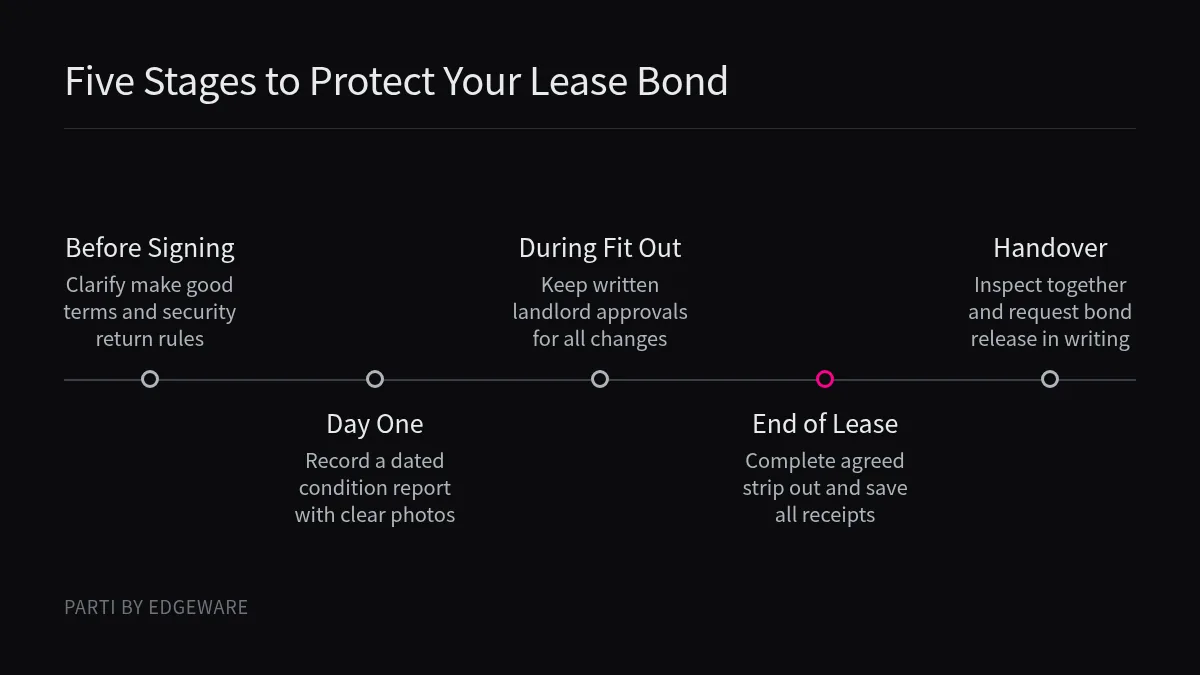
Getting your money back starts with knowing what the security covers and why shop alterations cause so many arguments at handover.
What can a landlord hold the deposit for?
Commercial leases almost always require security up front. If you do not know what that money covers, a landlord can call on it unexpectedly.
Under most commercial leases, a landlord can hold your cash bond or call on your bank guarantee to cover lease breaches. The main reasons include unpaid rent, unpaid outgoings, and the cost of incomplete de-fitting or make-good work when you leave.
How lease securities work
In Queensland, commercial lease security usually takes one of two forms, according to the Queensland Small Business Commissioner fact sheet on commercial lease bonds1:
* Cash bond: A sum paid up-front, typically calculated as a multiple of monthly rent, held directly by the lessor or by a third party as agreed. * Bank guarantee: An undertaking from your bank to pay the lessor a set amount if you breach the lease. It can be conditional or unconditional, and have an expiry date or be ongoing. * Personal guarantee: If the tenant is a company, lessors commonly ask directors for a personal guarantee alongside the security, making them liable for company debts or losses and potentially exposing personal assets like a home.
In Queensland, legislation does not regulate the bond amount, require it to be lodged with a government authority, or set a statutory deadline for its return. The Retail Shop Leases Act 1994 does not contain provisions for releasing a security, so your lease contract is the primary rulebook. Other places have different rules, and your own contract and local authority decide how your deposit is handled.
When the landlord can claim your money
Whether a lessor can keep your security at the end of the lease depends on the specific contract terms and whether a breach occurred. If you fall behind on rent, leave outgoings unpaid, or do not complete the agreed make-good work when leaving a rented shop, the lessor may be entitled to retain the cash bond or draw down the bank guarantee until those arrears or make-good costs are covered.
In New South Wales, the NSW Small Business Commissioner guidance on make good and retail leases2 similarly notes that if make-good is not completed as agreed, a landlord may withhold the bond or pursue the tenant for losses or damages, including rent for the time needed to return the premises to the agreed state.
Why do fit-outs turn into deposit disputes?
You view your café counters and lighting as improvements to the building. Your landlord often views them as an obstacle to finding the next tenant.
Fit-outs trigger deposit disputes because tenants and landlords want opposite things at handover. While you see value in your upgrades, landlords usually want a neutral shell, and poorly worded make-good clauses or missing entry records leave the costs open to argument.
How common bond disputes are
Disagreements over security money are not rare. According to the Queensland Small Business Commissioner guide on commercial lease bond returns3, 39% of small business lease dispute mediations conducted by the QSBC in the 2024 to 2025 financial year involved bond disputes. Across three consecutive financial years from 2022 to 2025, bond disputes consistently accounted for over 30% of their small business lease mediations.
The clash over shop alterations
In Queensland, the Queensland Small Business Commissioner make-good fact sheet4 explains that make-good disputes almost always affect the return of the tenant's bond. While the Property Law Act 2023 Schedule 1 includes a standard term requiring tenants to return premises in the same or better condition as at the start (excluding reasonable wear and tear and specified insured disasters), section 139 allows landlords and tenants to exclude that standard term and write their own make-good rules into the lease. Under Section 50B of the Retail Shop Leases Act 1994, a clause requiring a retail shop tenant to refurbish or refit is void unless the lease gives general details of the nature, extent, and timing of the work.
If the clause requires a bare shell, you pay once to build the space and a second time to take it apart, so price the strip-out before you sign.
| Common trigger for a bond dispute | What the tenant expects | What the lease or landlord often demands |
|---|---|---|
| No start-of-lease condition record | To leave the shop clean and tidy | Repair of marks or alterations the landlord claims happened during the tenancy |
| Vague make-good wording | To leave useful partitions, flooring, or counters behind | Full removal of tenant fixtures, joinery, ceiling finishes, and walls back to an open plan |
| Base building services altered | To leave adjusted lighting or plumbing in place | Returning air conditioning, fire, and hydraulic systems to their original state |
| Redecoration vs make good confusion | Normal wear and tear to be excused | Scheduled repainting or carpet replacement alongside end-of-lease strip-out |
Disputes also surface if you are leaving a lease early after a fit-out or if a lease is assigned without getting a fresh inspection report.
What evidence helps you get it back?
Handing back the keys without paperwork leaves your bond vulnerable. If a disagreement goes to mediation or a tribunal, memory will not protect you.
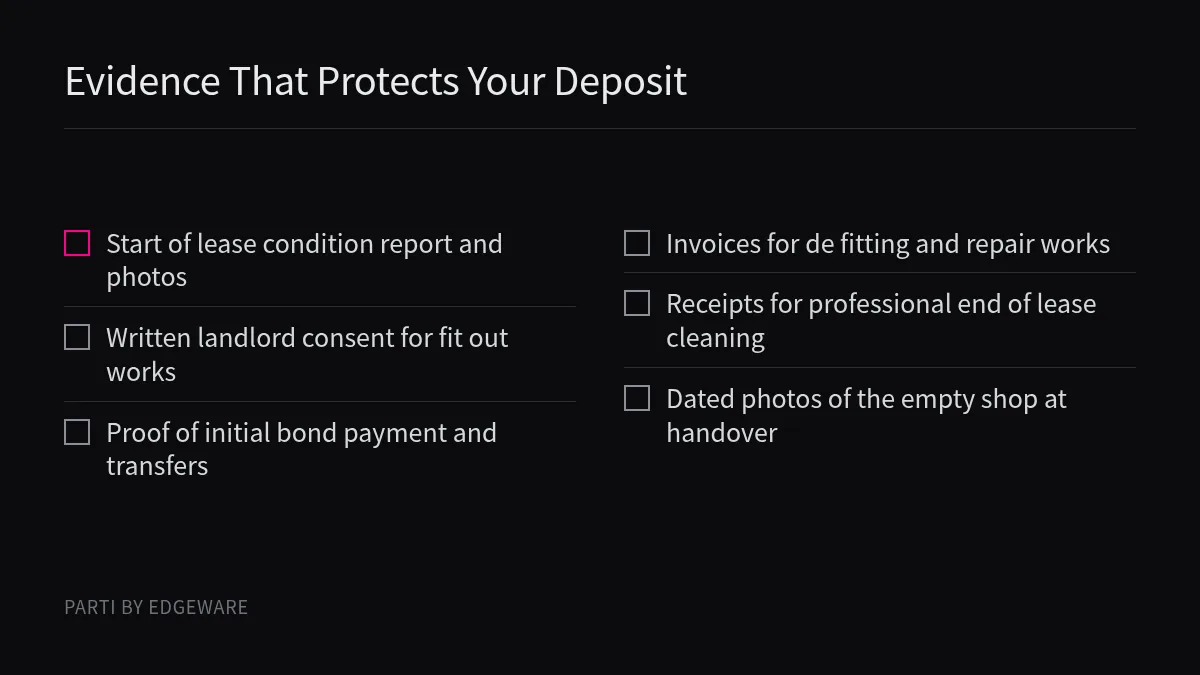
To get your deposit back in full, document the shop's condition before your fit-out and after your strip-out. Keep your entry condition report, written landlord approvals, dated handover photos, receipts for professional cleaning and repairs, and proof of bond payment.
Build a paper trail from day one
Both the New South Wales and Queensland commissioners emphasize preparing a condition report before you start a fit-out. Even if you are already part-way through your tenancy and do not have one, the Queensland commissioner suggests preparing a condition report now and staying on top of general wear and tear.
When the end of the lease approaches in Queensland, the return process works best when you gather specific proof before the landlord or agent inspects the shop:
* Proof of original condition: Photos, inspection reports, and lease schedules showing how the space looked before you built anything. * Receipts and work records: Invoices from contractors and cleaners proving that de-fitting, repairs, and cleaning were completed to a professional standard. * Dated exit photos: Clear photographs taken once the shop is empty and cleaned, showing you met the agreed condition. * Payment records: Evidence of your initial bond payment and any subsequent transfers, which is vital if the building or business was sold during your lease and the cash bond goes missing. * Quantity surveyor reports (where required): In New South Wales, some retail leases specify appointing an independent certified quantity surveyor to make a binding determination on make-good costs when parties cannot agree.
Know where your bond is sitting
In Queensland, unlike New South Wales (which operates a Retail Bond Scheme) or South Australia (where bonds are lodged with the Small Business Commissioner), there is no central authority holding commercial bonds. If a licensed real estate agent holds your bond in Queensland, the Property Occupations Act 2014 and the Agents Financial Administration Act 2014 require them to deposit it into an audited trust account under the Agents Financial Administration Regulation 2014. Legal practitioners follow trust accounting rules under the Legal Profession Regulation 2017. If your landlord holds the cash directly, there is no legal requirement for a separate account, though keeping it distinct from business funds is considered best practice.
Where can you go if you cannot agree?
Waiting weeks in silence after you vacate is frustrating. When the landlord will not release the security or claims the whole bond, you need a clear path forward.
Start by reviewing your lease terms and putting your request in writing to the landlord or agent. If direct negotiation fails, you can apply for low-cost mediation through your state Small Business Commissioner or take legal advice on tribunal or court action.
Step-by-step resolution
Because Queensland sets no statutory deadline for returning a commercial bond, the bond should generally be returned promptly once the lease ends, you vacate, and all obligations are met. If delays or arguments arise, the Queensland and New South Wales commissioners outline practical steps:
- Check the lease first: Read the security and make-good clauses to see whether the landlord's demands match the contract.
- Talk and clarify in writing: Ask the landlord or property manager directly what they want done to resolve the issue, or negotiate a cash settlement in lieu of physical make-good. Follow up in writing and respond promptly.
- Send a formal request: If all conditions are met and the landlord delays, send a written request or a formal letter of demand. If the other party is short on cash, consider whether a payment plan would solve the problem.
- Use mediation: Both the Queensland Small Business Commissioner and the NSW Small Business Commission offer low-cost mediation. In mediation, a mediator guides discussion without acting as a judge, so you keep control over what you agree to. This saves time and money, especially when evidence of the original condition is thin.
- Assess tribunal or court options: Get legal advice from a commercial tenancy lawyer on the cost and viability of litigation. In Queensland, if all return conditions are met, a tenant may seek legal advice on pursuing a debt dispute in QCAT (where the debt is less than $25,000) or claiming in court that withholding the bond is unconscionable conduct.
If you are planning how you set up commercial spaces in the future, you can also explore how we think about flexible layouts on our Parti room concept page.
Conclusion
Read your make-good clause early, photograph the shop before and after your fit-out, and get every restoration agreement in writing before you hand back the keys.
About Parti
Parti by Edgeware is Edgeware's first industry solution. We are designing a café where one room can change how it is used by changing the props, with no rebuild of the room. Counters, tables and displays are meant to be carried in and out again by hand, so less is built into the walls and floor and less is left to take down when a lease ends. That is a design aim, not a tested result. The first café is planned for Hangzhou and is not open. See the room and how the floor connects. This guide is for tenants who are weighing a shop or café fit-out. It is general information, not legal advice, and your own contract and local rules decide.
Sources
- Queensland Small Business Commissioner: Commercial lease bond: Explains cash bonds, bank guarantees, personal guarantees, and when a Queensland landlord can retain lease security.
- NSW Small Business Commissioner: 'Make good' and retail leases: Covers NSW retail lease make-good obligations, quantity surveyor clauses, bond withholding, and low-cost mediation.
- Queensland Small Business Commissioner: Understanding the return of a commercial lease bond: Provides QSBC bond dispute mediation statistics, trust account rules, return steps, and QCAT debt dispute thresholds.
- Queensland Small Business Commissioner: Make good: Details Queensland make-good rules under the Property Law Act 2023, common dispute triggers, and mediation steps.