Which lease terms should a shop tenant understand?
Shop leases put big obligations into short clauses. A few lines decide what you hand back, what you may build and what you pay.
Published
Before signing a shop lease, check four groups of terms: hand-back clauses (make good, reinstatement, schedule of condition), build clauses (alterations and licences), early-exit clauses (break rights and pre-conditions), and money clauses (rent, service charges, cash bonds, and guarantees).
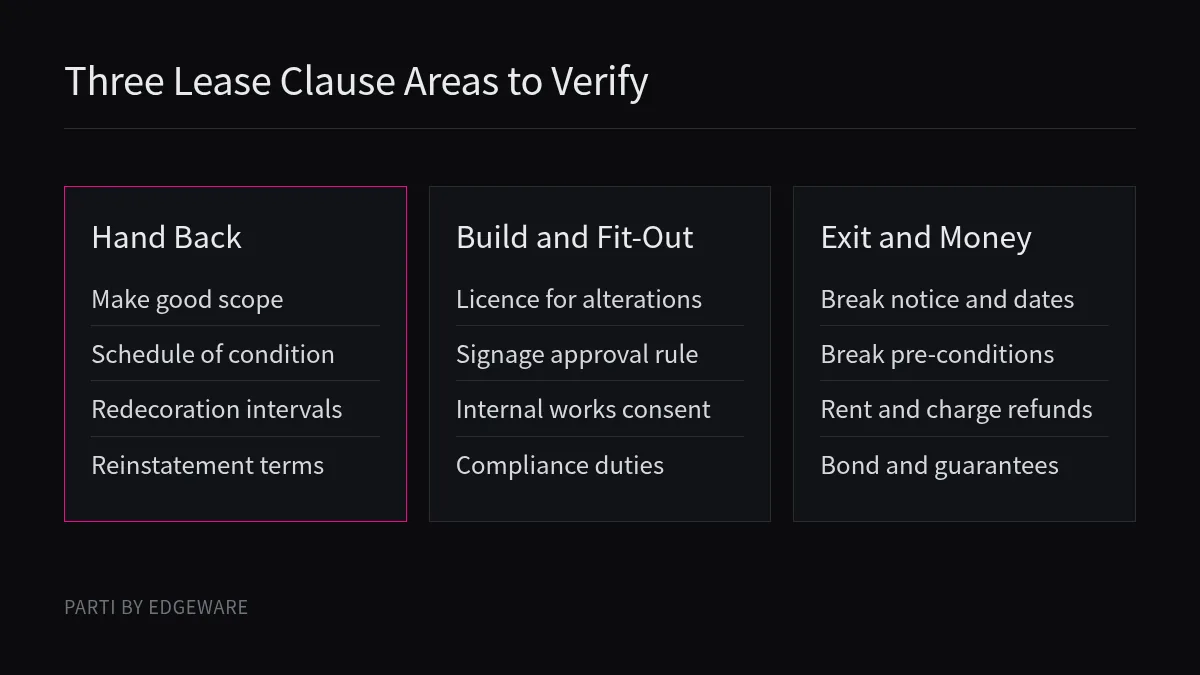
Below we group the main terms under four questions and list what each means and what to get in writing. Rules vary by jurisdiction, so your own contract and local authority always decide, and this guide is not legal advice.
Which clauses cover what you hand back?
Hand-back terms decide the state of the shop when your lease ends. Read them with the last day of the lease in mind.
Look for make good, redecoration, reinstatement, and schedule of condition clauses. They set whether you return the shop in its initial state, strip out your fit-out, repaint during the term, or cap repairs at a documented starting baseline.
Key hand-back terms to check
- Make good: In Queensland, Australia, the Queensland Small Business Commissioner's make good guidance1 defines a make good clause as the tenant's obligation to return the property to its original condition (or as specified in the lease) at the end of the lease term. Under the Property Law Act 2023 (the PLA) Schedule 1 Section 3, standard commercial lease terms require returning the premises in the same or better condition as at the start, excluding damage from reasonable wear and tear, specified disasters (like fire and earthquakes), and risks the lessor insured against; however, Section 139 allows both parties to exclude those standard terms and agree on different make good conditions. You can read more in our guide on what make good means when leaving a shop.
- Refurbishment vs redecoration: In Queensland, Section 50B of the Retail Shop Leases Act 1994 states that a retail shop lease clause requiring the tenant to refurbish or refit the shop is void unless the lease gives general details of the nature, extent, and timing of the requirements. Redecoration clauses are separate from make good and require maintenance or upgrade works at specified intervals during the lease term, such as repainting walls or replacing carpets.
- Physical make good vs cash settlement: In Queensland, leases may outline options to meet make good obligations either by physically carrying out the works (often required to be done by a professional or to a professional standard) or by negotiating a cash settlement with the lessor instead. Common make good requirements range from leaving the area clean and tidy to repairing occupancy damage, removing tenant-installed fixtures, partitions, joinery, installations, flooring, and ceiling finishes, restoring an open floor plan (including removing walls), and returning base building services (air conditioning, fire, and hydraulic systems) to their original state.
- Reinstatement: In England and Wales, the landlord will seek to impose an obligation to reinstate the property and make good any damage at the end of the term. When structural works are involved, a landlord may actually prefer the works to remain, so you should check that the reinstatement provisions in the lease and in any licence for alterations work harmoniously and do not contradict each other.
- Schedule of condition: In England and Wales, the RICS Code for leasing business premises2 (a professional standard effective 1 September 2020, not law) states at section 7.1 that repairing obligations should suit the length of term, the condition of the premises, and the financial terms. Under section 7.2, if your repairing obligations are limited to the initial condition of the premises, a schedule of condition will normally be required, and the parties should agree who pays for obtaining it. See our guide on why to write a condition report before a fit-out.
- Inherent construction defects: Under RICS code section 7.3, in England and Wales, where premises are or will be newly built, a tenant taking on direct or indirect responsibility for repairs should be given suitable protection against inherent construction defects for an appropriate period.
| Term | Jurisdiction of source | What to ask and put in writing |
|---|---|---|
| Make good | Queensland, Australia | Ask whether PLA Schedule 1 applies or is replaced, and list exact strip-out or cleaning tasks. |
| Redecoration | Queensland, Australia | Ask for exact intervals and scope for any mid-term repainting or carpet replacement. |
| Schedule of condition | England and Wales | Attach dated photos and text to the lease and state which party pays to prepare it. |
| Reinstatement | England and Wales | Confirm that the lease and any licence for alterations agree on what stays and what goes. |
Which clauses cover what you may build?
Alterations clauses govern how you turn a bare unit into a working shop. Starting work without written permission can put you in breach of lease.
Check the alterations clause, use and signage restrictions, and whether you need a supplemental Licence for Alterations. In England and Wales, landlord controls should only go as far as needed to protect property value, with early notice of prohibitions.
Build and fit-out terms to check
- Licence for Alterations: In England and Wales, Russell-Cooke's guide to a licence for alterations3 explains that a tenant wanting to change a commercial property usually needs the landlord's written permission before carrying out any works. A Licence for Alterations is a legal document supplemental to the lease that records consent and sets the scope, conditions, and requirements. We cover the practical steps in our guide on getting landlord consent for shop alterations.
- Major vs minor works: In England and Wales, Russell-Cooke notes that major or substantial works involve structural changes (removing or replacing walls, doors, or staircases, extensions, conversions, or installing equipment on the roof or exterior) and may require planning permission and compliance with the Construction (Design and Management) Regulations 2015 (CDM 2015) and the Building Safety Act 2022 for mixed-use buildings. Minor non-structural works (fit-out works like installing fixtures, branding, signage, and electrical wiring) rarely need planning permission, but the licence still covers consents, quality standards, timeframes, and reinstatement.
- Retrospective licence: In England and Wales, if a tenant has already carried out alterations without required landlord consent, that breaches the lease; however, if both parties agree the works are suitable and the landlord does not wish to pursue forfeiture or termination, they can formalise consent after completion.
- Plans, deadlines, and regulations in the licence: In England and Wales, before consent is granted, the tenant produces full plans, drawings, and specifications to be annexed to the licence (and the landlord may need to notify its building insurers). The licence also addresses compliance with CDM 2015, the Energy Performance Certificate rating, fire precautions under the Regulatory Reform (Fire Safety) Order 2005, and asbestos risks, and typically sets a deadline to start works (after which consent ceases unless extended) and a deadline to complete and notify the landlord.
- Landlord control over alterations: Under RICS code section 8.1 and 8.2 in England and Wales, leases should give landlords control over alterations and changes of use that are no more restrictive than necessary to protect the value of the premises and any adjoining or neighbouring landlord premises, and the landlord should notify the tenant at the outset if it intends to prohibit certain alterations or changes of use (outside normal planning use class provisions) or require a licence.
- Whole building vs multi-let unit: Under RICS code sections 8.3 and 8.4 in England and Wales, in a lease of an entire building, a landlord should not normally prohibit or require consent for internal non-structural alterations that do not adversely affect character, value, structural stability, statutory compliance, or energy efficiency performance (though the tenant must carry out works properly without damage or nuisance and give written details). In a unit in a multi-let building, a landlord may require consent (not to be unreasonably withheld or delayed) for internal non-structural alterations.
- Signage, mains services, and statutory compliance: Under the RICS code guidance in England and Wales, where a landlord wants the right to approve signage size and appearance, tenants should ask that approval not be unreasonably withheld or delayed. Because altering electricity and gas can be expensive and leases normally require tenants to comply with all legislation at their own cost (such as the Equality Act 2010, Town and Country Planning Acts, Health and Safety Acts, or Environmental Protection Acts), tenants should check mains services, fire and disability access compliance, working hour or noise restrictions, and allow at least eight to ten weeks (sometimes longer) if a planning permission application is needed.
Which clauses cover leaving early?
A business plan can change before a long lease runs out. Without a clear exit clause, you stay on the hook for rent and fit-out rules.
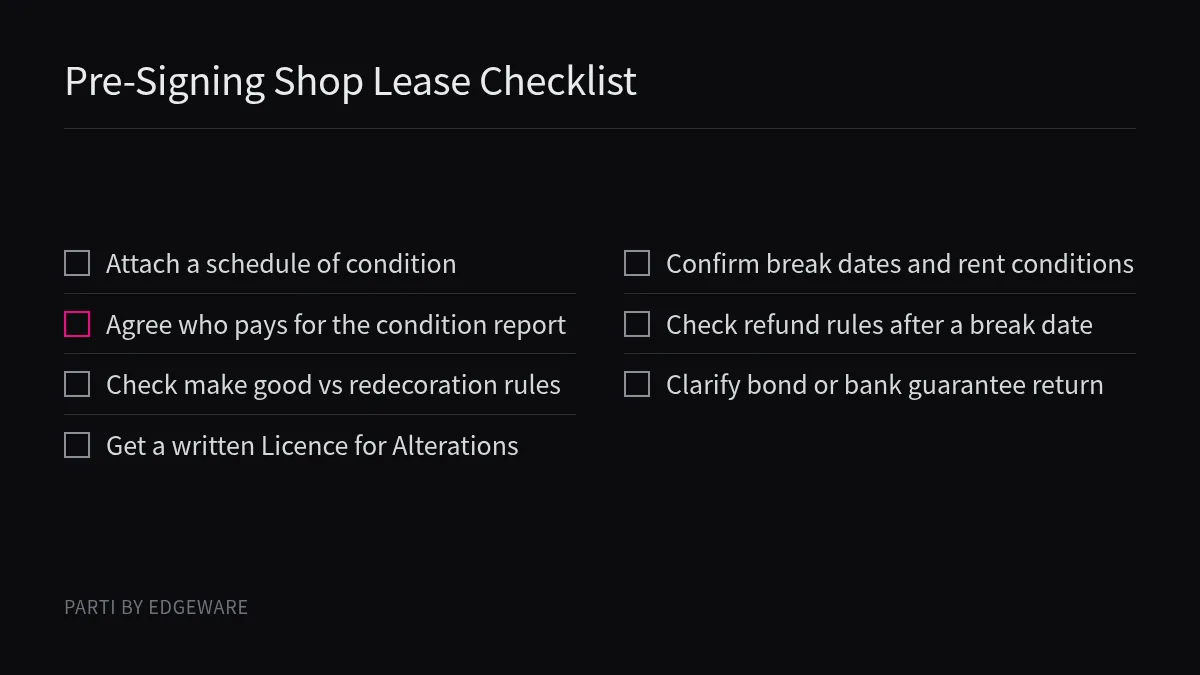
Look for a break clause. Under the RICS professional standard for England and Wales, it should specify break dates, prior notice, and pre-conditions, normally limited to paying basic rent due, giving up occupation, and leaving no subtenants.
Early-exit and term clauses to check
- Length of term and statutory renewal: Under RICS code sections 2.1 and 2.2 (a professional standard for England and Wales, not law), the length of the term and start date should be clearly specified, and if the landlord proposes to exclude statutory rights of renewal under the Landlord and Tenant Act 1954, the tenant should be notified at the outset to get early professional advice. RICS guidance B3 notes that landlords traditionally preferred long terms, often from 15 to 25 years, though shorter terms have become more common in some sectors.
- Break clause basics: Under RICS code section 2.3 and guidance B3 in England and Wales, a break clause gives one or either party the right to end a longer lease sooner by giving written notice at any time or on or between specified dates. The lease should clearly specify the break dates (or range of dates), the length of prior notice, and any pre-conditions for the break to be effective. You can read how an early exit interacts with your shop build in our guide on what happens to your fit-out if you leave early.
- Pre-conditions for a tenant break: Under RICS code section 2.4 and guidance B3 in England and Wales, unless stricter conditions were agreed in the heads of terms, a tenant's break should be conditional only on paying all basic (main) rent payable on any date before the break date, giving up occupation, and leaving behind no subtenants or other occupiers. Disputes about the state of the premises, service charges, or what was left behind or removed should be settled later, as at normal lease expiry, and should not be used by landlords to invalidate the right to break.
- Break payments and incentives: RICS guidance B3 notes that in some cases a landlord in England and Wales may require the tenant to pay a specified sum to exercise the break (particularly where the tenant received a capital contribution or extended rent-free period at the start), or occasionally agree to give a capital contribution or rent-free period if the tenant refrains from breaking.
- Refunds after the break date: Under RICS code section 2.5 and guidance B3 in England and Wales, leases should require landlords to repay any rent, service charge, or insurance paid by the tenant for any period after a break takes effect (service charge repayment may be deferred until accounts are finalised at the end of the accounting period), though not all leases include this refund requirement.
- Tax and superior lease traps: RICS guidance B3 warns that in England and Wales a longer lease with a break clause may attract a larger amount of stamp duty land tax or land transaction tax, which is not refundable if ended early under the break, and where the landlord is itself a leaseholder, both parties need to check whether the landlord's own lease contains break clauses and take legal advice.
We do not know your heads of terms or your tax position, so we would have a solicitor check the break pre-conditions before you sign.
Which clauses cover money?
Rent is only part of what a shop lease costs you. Security deposits, bank guarantees, and personal guarantees decide what is at risk if a dispute arises.
Check how your lease defines basic rent, service charges, insurance, cash bonds, bank guarantees, and personal guarantees. In Queensland, legislation does not cap commercial bond amounts or set a return deadline, so your lease wording governs.
Money and security terms to check
- Cash bond: In Queensland, Australia, the Queensland Small Business Commissioner's commercial lease bond factsheet4 defines a cash bond as an up-front sum paid by the tenant as security in case of specified breaches, typically calculated as a multiple of monthly rent as stated in the lease. The lessor and tenant can agree whether it is paid directly to the lessor or held by a third party.
- Bank guarantee: In Queensland, a bank guarantee is an undertaking from the tenant's bank to pay a certain amount to the lessor if the tenant breaches the lease (such as unpaid rent, unpaid outgoings, or incomplete de-fitting and making good). It does not transfer funds up front, can be conditional or unconditional, can have an expiry date or be ongoing, and once issued cannot be revoked unless all parties agree or it expires.
- Personal guarantee: In Queensland, where the tenant is a company, lessors commonly ask company directors for a personal guarantee alongside a security, making the guarantor personally liable for the company's debts or losses and potentially exposing personal assets (such as a home owned in their personal name) to legal processes.
- Rules on holding and returning security: In Queensland, there is no legislative requirement for a commercial or retail shop lease security to be held in a particular manner or registered with a government body, solicitor, or authority; the sum is not regulated by legislation; and because the Retail Shop Leases Act 1994 has no provisions on releasing a security, there is no statutory timeframe for its return and the lease itself is the primary source of law.
- Withholding security and lost bonds: In Queensland, whether a lessor can keep the cash bond or call on the bank guarantee at the end of the lease depends on the lease terms and any breach (such as rent arrears or incomplete make good). If a cash bond goes unaccounted for after a sale of the premises or business or a lease assignment, tenants should keep evidence of initial payment and transfers and seek legal advice on approaching QSBC, QCAT, or a court.
- Basic rent, service charge, and insurance refunds: In England and Wales, under RICS code sections 2.4 and 2.5, basic rent is distinguished from service charges and insurance when exercising a break, and tenants should ensure the lease requires the landlord to refund any rent, service charge, or insurance paid for periods after a break date.
Conclusion
Read every hand-back, alteration, break, and security clause before signing, attach a condition record, and ask a qualified local adviser to review the draft.
About Parti
Parti by Edgeware is Edgeware's first industry solution. We are designing a café where one room can change how it is used by changing the props, with no rebuild of the room. Counters, tables and displays are meant to be carried in and out again by hand, so less is built into the walls and floor and less is left to take down when a lease ends. That is a design aim, not a tested result. The first café is planned for Hangzhou and is not open. See the room and how the floor connects. This guide is for tenants who are weighing a shop or café fit-out. It is general information, not legal advice, and your own contract and local rules decide.
Sources
- Queensland Small Business Commissioner: Make good: Explains Queensland make good obligations, PLA standard terms, redecoration differences, and how to avoid end-of-lease disputes.
- RICS: Code for leasing business premises, England and Wales (2020): Sets out the professional standard in England and Wales for break clauses, repairing obligations, and alterations.
- Russell-Cooke: Understanding a licence for alterations: Details when a Licence for Alterations is needed in England and Wales and what it covers.
- Queensland Small Business Commissioner: Commercial lease bond: Covers cash bonds, bank guarantees, personal guarantees, and bond return rules for Queensland commercial leases.