Which shop fittings leave no mark on a rented space?
Signing a shop lease means every screw hole can trigger a deposit dispute. Paying twice for one fit-out hurts. This guide compares low-impact fitting options.
Published
Freestanding shop fittings that rest on the floor without screws or glue are the safest way to leave no mark on a rented space. Protect the floor beneath their feet, check stability, and get your landlord's written rules before installing.
Before you order shelving or build a counter, look closely at how each piece meets the building and what your lease says about handing the unit back.
Why does it matter what your fittings touch?
Every surface your shelving or counter touches becomes a potential repair bill at lease end. Knowing how handback clauses work saves your deposit.
What your fittings touch matters because commercial leases usually require you to repair damage and remove anything you attached. In Queensland and New South Wales, make good terms can mean stripping out fixtures, flooring, and partitions, or restoring a bare shell.
What leases require when you leave
When you move into a rented unit, the walls, floor, and ceiling belong to the landlord. What you attach to them determines how much work you face when the lease ends. In Queensland, Australia, the Queensland Small Business Commissioner's make good guidance1 explains that under Schedule 1, Section 3 of the Property Law Act 2023, standard terms require a tenant to return the premises in the same or better condition as at the start of the lease, excluding reasonable wear and tear and certain insured disasters. However, Section 139 of that Act lets landlords and tenants exclude those standard terms and agree on specific make good conditions instead.
Common make good requirements listed by the Queensland commissioner include:
- Repairing any damage caused during your occupancy.
- Removing all tenant-installed fixtures, partitions, joinery, installations, flooring, and ceiling finishes.
- Restoring the premises to an open floor plan, including taking down walls.
- Returning base building services like air conditioning, fire, and hydraulic systems to their original state.
- Leaving the area clean and tidy.
In New South Wales, Australia, the NSW Small Business Commissioner's retail lease guidance2 notes that make good clauses sometimes require a tenant to strip the premises right back to base building (or bare shell) condition and redecorate, such as repainting. Other places have different rules, and your own contract and local authority decide what applies to your unit. Because landlords typically want neutral spaces that appeal to future tenants, anything you bolt, nail, or glue to the shell can turn into a second bill at the end of your term: you pay once to put it in, and you pay again to take it out and patch the surface. To understand the handback process in detail, read our guide on what make good means when you leave a shop.
Freestanding, wall-fixed or ceiling-fixed: how do they compare?
You have three ways to hold up merchandise and counters. Choosing the wrong mounting method can turn a simple display into an alteration dispute.
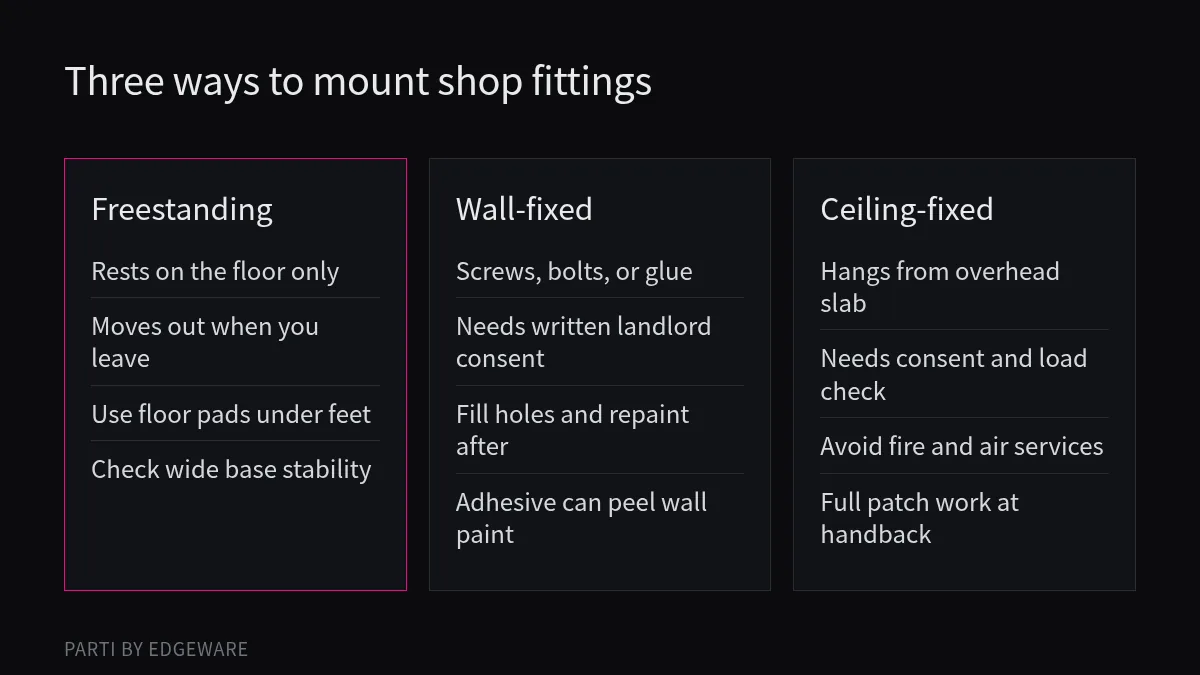
Freestanding fittings carry their own weight on the floor and leave with you. Wall-fixed and ceiling-fixed units require drilling or adhesives, which usually need landlord consent and end-of-lease repairs. Always balance surface protection against physical stability so tall units never tip.
Comparing the three mounting methods
| Fitting type | What it touches | Typical handback work | What to watch out for |
|---|---|---|---|
| Freestanding | Floor surface only | Lift and carry out; clean the floor | Point loads, dragging marks, and tipping hazards |
| Wall-fixed | Walls and panelling | Remove fixings, fill holes, sand, and repaint | Hidden pipes or wiring, adhesive peeling paint |
| Ceiling-fixed | Ceiling grid or slab | Remove hangers, patch penetrations, check services | Structural load limits and fire or air systems |
Freestanding fittings. A counter, rack, or shelving unit that stands on its own feet without touching the walls or ceiling is the lowest-risk option for a tenant. Because it is not attached to the building, it is easiest to pack up when you move; see our guide on whether you can take shop fittings with you for how leases treat removable items. Even with freestanding pieces, look at the floor surface. Heavy metal legs or hard castors can dent timber or scratch polished concrete, and dragging a loaded counter leaves scuff marks. Put protective pads under feet and unload units before moving them. Above all, do not trade safety for a clean wall. A tall freestanding shelf that leaves no hole but tips over when a customer leans on it or a child climbs it is dangerous. Choose units with a wide, weighted base, or link freestanding bays together so they brace each other. We are exploring how counters and displays connect to a floor grid in our own research for the Parti connection concept, though we have not tested how that approach sits with any particular lease.
Wall-fixed fittings. Screwing, bolting, or gluing racks to a wall gives stability, especially for narrow shelving, but every fixing point leaves a trace. Heavy-duty tapes and glues often pull paint or plaster paper right off the wall when removed. If you want to avoid holes altogether, read our article on fitting out a rented shop without drilling.
Ceiling-fixed fittings. Hanging rails, suspended menus, and overhead lighting grids touch the most sensitive part of a unit. In Queensland, common make good terms include removing ceiling finishes and returning base building services like air conditioning, fire, and hydraulic systems to their original state. Drilling into a ceiling without checking structural load ratings and service conduits risks serious damage.
What counts as damage, and who decides?
Tenants and landlords rarely see eye to eye on where normal use ends and damage begins. Without baseline proof, your security deposit is at risk.
Your lease and starting condition report define what counts as damage beyond reasonable wear and tear. If you and your landlord disagree at the end, leases in New South Wales often let an independent quantity surveyor make a binding cost decision.
How handback disputes happen and get resolved
Disputes at the end of a shop lease almost always delay or reduce the return of the tenant's security deposit (bond). In Queensland, the Small Business Commissioner notes that make good disputes frequently happen for four reasons:
- Limited or no evidence of the condition of the premises at the beginning of the lease.
- Vague or ambiguous make good clauses.
- Disagreement over the quality of the make good work performed.
- Removal of something of value that was added by the other party.
Notice the Difference between routine upkeep during your lease and handback repairs. The Queensland guidance points out that redecoration clauses and make good clauses are separate, even though people confuse them. A redecoration clause requires you to do maintenance or upgrades at set intervals during the lease term, like repainting walls or replacing carpets, whereas make good applies when the lease ends. Furthermore, Section 50B of Queensland's Retail Shop Leases Act 1994 states that a clause requiring a tenant to refurbish or refit a retail shop is void unless the lease gives general details of the nature, extent, and timing of the requirements.
Who decides if you and the landlord disagree on whether a floor scratch or a patched wall meets the standard? In England and Wales, the RICS Code for leasing business premises3 states in section 7.2 that if a tenant's repairing obligations are limited to the initial condition of the premises, a schedule of condition is normally required, and the parties should agree on who pays to obtain it. In New South Wales, retail leases often set out a procedure when parties cannot agree on make good costs, including appointing an independent certified quantity surveyor to make a binding determination on those costs. Both the Queensland and New South Wales commissioners also offer mediation, where a mediator guides discussion without acting as a judge, helping both sides reach an agreement when initial condition records are missing.
What should you ask before you choose?
Guessing what your landlord will tolerate leads to expensive mistakes. Asking a few clear questions before you buy fittings protects your cash and your bond.
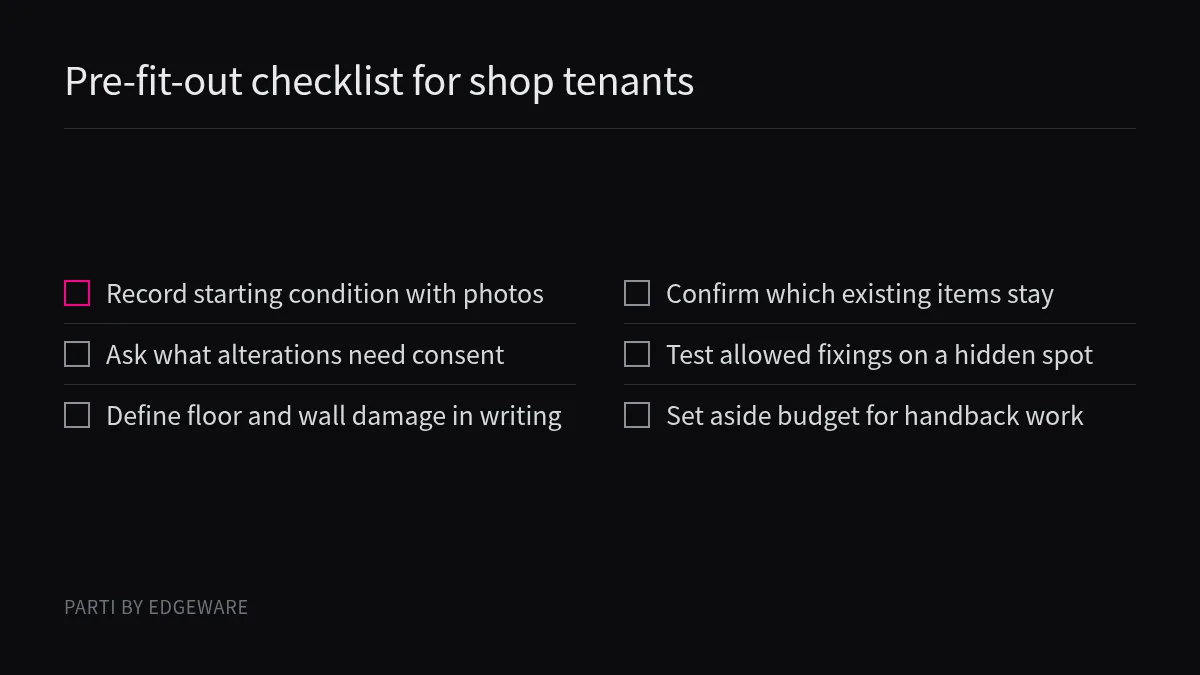
Before buying fittings, ask your landlord in writing what alterations need approval, what counts as floor or wall damage, and whether fittings must be removed at lease end. Document the starting condition and test any allowed adhesive on a small patch.
Your pre-purchase checklist and landlord questions
In England and Wales, the RICS lease code notes that for a unit in a multi-let building, landlords commonly prohibit structural and external alterations, while allowing internal non-structural alterations subject to landlord control. Depending on the lease, a landlord might only ask you to notify them of the details in writing, or might require you to get written approval first (which should not be unreasonably withheld or delayed). The code also notes that landlords often restrict signage size and appearance.
Before you pay for counters, racks, or hooks, put these questions to your landlord or managing agent and get the answers in writing:
- What needs formal consent versus simple notice? Check whether freestanding units that clip together, temporary partitions, or non-drill wall strips count as alterations under your lease.
- What counts as damage on these specific surfaces? Ask how the landlord treats minor pinholes, adhesive residue on glass or plaster, and compression marks on flooring from heavy cabinet feet.
- Must everything be removed, or can agreed improvements stay? Clarify whether you must strip the unit bare or if the landlord prefers to keep certain shelving, and know that tenants can either physically carry out the work (often to a professional standard) or negotiate a cash settlement instead.
- Are any existing fittings inside the shop already owned by the landlord? Do not remove or modify shelving left by a previous tenant without checking ownership, as removing something of value added by the other party triggers disputes.
- Can we test a fixing method on a tiny hidden patch? If the landlord allows removable tape or a specific wall anchor, ask permission to test one small spot in a back corner first. Wait a bit, remove it, and see if it lifts the paint before committing to a whole wall.
Prepare a thorough condition report with dated photographs before you move a single box into the shop, even if the lease has already started. Allocate funds in your budget ahead of time for end-of-lease handback work so you are never forced into late penalties or extra rent while repairs drag on. This article provides general information rather than legal advice; always ask a solicitor or qualified property advisor to review your specific lease terms.
Conclusion
Choose freestanding fittings with floor pads to keep handback simple, check stability, record your starting condition, and get every landlord agreement in writing first.
About Parti
Parti by Edgeware is Edgeware's first industry solution. We are designing a café where one room can change how it is used by changing the props, with no rebuild of the room. Counters, tables and displays are meant to be carried in and out again by hand, so less is built into the walls and floor and less is left to take down when a lease ends. That is a design aim, not a tested result. The first café is planned for Hangzhou and is not open. See the room and how the floor connects. This guide is for tenants who are weighing a shop or café fit-out. It is general information, not legal advice, and your own contract and local rules decide.
Sources
- Queensland Small Business Commissioner: Make good: Explains Queensland commercial lease make good clauses, typical strip-out requirements, condition reports, and dispute resolution.
- NSW Small Business Commissioner: 'Make good' and retail leases: Covers New South Wales retail lease make good rules, bare shell restoration, quantity surveyor determinations, and bonds.
- RICS: Code for leasing business premises, England and Wales (2020): Sets out England and Wales standards on schedules of condition, internal non-structural alterations, and landlord consent.