What happens to your fit-out if you leave early?
Closing a shop early puts your cash bond at risk. You already paid to build the fit-out, and paying again to rip it out hurts.
Published
If you leave a lease early, what happens to your fit-out depends on the clauses in your lease and any exit agreement you negotiate. Many leases require you to remove your installations, repair damage, or pay a cash settlement.
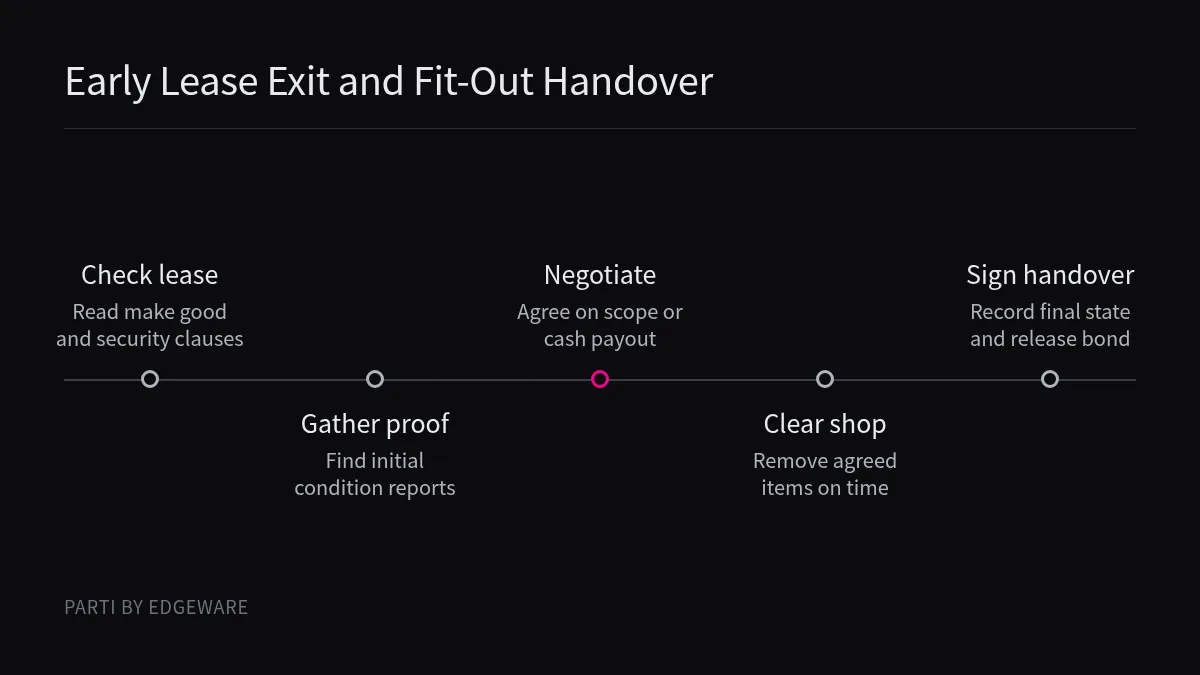
Before you hand back the keys or call in demolition contractors, you need to check what your paperwork actually requires and where you have room to negotiate. The four questions below walk through your obligations, the rules in different places, your preparation checklist, and ways to keep removal costs down.
Does leaving early change what you must remove?
Leaving before your lease ends triggers the exit terms in your contract. Guessing what stays or goes can cost you your security deposit.
Leaving early does not excuse you from make good duties. Your obligations depend on the specific lease clauses, any break or assignment conditions, and what you agree with the landlord. You may still need to strip out the fit-out.
When you end a tenancy ahead of schedule, whether through an agreed surrender, a lease assignment, or a breach, the starting point is always the written contract. In Queensland, Australia, the Queensland Small Business Commissioner's make good guidance1 explains that a make good clause refers to the tenant's obligation to return the property to its original condition, or as specified in the lease, at the end of the term. If you assign your lease to a new tenant to leave early, rules in New South Wales, Australia, noted in the NSW Small Business Commissioner's retail lease guidance2, state that tenants need to check the make good requirements and may also need to obtain a new inspection report.
Other places have different rules, and your own contract and local authority decide what applies to your shop. If you are not sure what your baseline obligations look like, read our guide on what make good means when you leave a rented shop.
Common fit-out removal requirements
Depending on your lease agreement, make good terms commonly include one or more of the following tasks:
* Repairing any damage caused during your occupancy. * Removing all tenant-installed fixtures, partitions, joinery, installations, flooring, and ceiling finishes. * Restoring the premises to an open floor plan, including removing walls, or stripping back the shop to a base building or bare shell condition. * Returning base building services, such as air conditioning, fire, and hydraulic systems, to their original state. * Leaving the area clean and tidy, or repainting where required.
It is also easy to mix up end-of-lease removal with ongoing maintenance. Redecoration clauses require tenants to perform maintenance or upgrade works, such as repainting walls or replacing carpets, at specified intervals during the lease term. Make good happens when you leave. You can compare the two in our article on how reinstatement and redecoration differ.
What do courts and regulators say about this?
Tenants often hope a standard rule will save their fit-out. Relying on assumptions instead of the lease leaves your bond and personal assets exposed.
Regulators point straight back to the written lease. Standard property laws often require returning a shop in the same or better condition, minus fair wear and tear, unless the lease says otherwise. We cannot say what a court anywhere would decide.
Because commercial tenancy laws vary across jurisdictions and lean heavily on contract wording, we honestly cannot say what a court or tribunal anywhere would decide in your specific case. We can only look at what official bodies publish in their own regions.
In Queensland, for a commercial lease, Schedule 1 (Section 3) of the Property Law Act 2023 requires the tenant at the end of the lease to return the premises to the lessor in the same or better condition as at the start, excluding reasonable wear and tear, specified disasters like fire and earthquakes, and risks the lessor insured against. However, Section 139 of that Act allows the lessor and tenant to agree to exclude those standard terms and hand the premises back in a different condition. In addition, Section 50B of Queensland's Retail Shop Leases Act 1994 states that a clause requiring a tenant to refurbish or refit the shop is void unless the lease gives general details of the nature, extent, and timing of the work.
In England and Wales, the RICS Code for leasing business premises3 (1st edition, February 2020, effective 1 September 2020) states that leases should contain tenant repairing obligations appropriate to the length of the term, the condition of the premises, and the financial terms. If repairing obligations are limited to the initial condition, a schedule of condition is normally required. For a unit in a multi-let building, a landlord may require consent for internal non-structural alterations (not to be unreasonably withheld or delayed) and prohibit alterations that adversely affect the property.
How your bond and guarantees are affected
If you leave early and do not complete make good as agreed, the financial fallout hits your security immediately. According to the Queensland Small Business Commissioner's commercial lease bond factsheet4, Queensland has no legislative requirement for how a commercial lease security is held, no cap on the amount, and no statutory timeframe for its return; the lease is the primary source of law.
| Security or claim type | How it works when you leave |
|---|---|
| Cash bond | Paid up-front (often a multiple of monthly rent). The lessor may keep it if make good is incomplete or rent is unpaid. |
| Bank guarantee | An undertaking from your bank. The lessor can call on it if left out of pocket for unpaid rent, outgoings, or incomplete de-fitting and make good. |
| Personal guarantee | Often requested from company directors. It makes the guarantor personally liable for company debts or losses, potentially exposing personal assets like a home. |
| Loss and damages | In New South Wales, a landlord may withhold the bond or pursue the tenant for loss or damages, including rent for the time it takes to return the premises to the agreed state. |
For a deeper look at how landlords hold onto security money, see our guide on why deposits get held back after a fit-out.
What should you do before you tell the landlord?
Telling the landlord you want out before checking your paperwork puts you on the back foot. A quick document check protects your negotiating position.
Before you give notice, read your lease's make good, alteration, and security clauses, gather your original condition report and approvals, and document the shop's current state. Check whether your lease sets a specific process for Valuing make good costs.
Walking into an early exit conversation without your records makes disputes much harder to resolve. Disputes frequently arise because there is limited or no evidence of the condition of the premises at the beginning of the lease, vague or ambiguous make good clauses, disagreement over the quality of the work, or the removal of something of value added by the other party.
Pre-notice checklist for shop tenants
- Pull out the lease and every variation: Read the exact wording on make good, redecoration, alterations, and what triggers a call on your cash bond or bank guarantee.
- Find the starting condition report: Check the schedule of condition or inspection report from when you took over the shop. If there isn't one, prepare a condition report now and gather any photos or emails from the start of the tenancy to show what was already there.
- Check for cost-determination rules: In New South Wales, retail leases often include a clause setting out procedures when the landlord and tenant cannot agree on make good costs, including appointing an independent certified quantity surveyor to make a binding determination.
- Review your alteration consents: Gather written approvals for the fit-out works you installed so you know what was authorised.
- Get legal and professional advice: Speak with a lawyer experienced in property and commercial tenancy law before you make formal requests or sign an exit deed.
- Budget for the exit: Allocate funds to undertake the required works or to propose a structured payment plan if money is tight.
How do you reduce the cost of leaving?
Paying contractors to demolish a working café while paying extra rent drains your remaining cash. Early negotiation gives you cheaper ways out.
Talk to the landlord early to clarify what they actually want removed. You can ask to leave useful fixtures behind, negotiate a cash settlement instead of physical demolition, or use low-cost mediation if you cannot agree on the scope.
Tenants and landlords look at fit-outs differently. While tenants value their investment in upgrades and see tearing out a fit-out as wasteful, lessors often want a neutral space to appeal to future tenants. Even so, landlords do not always want every wall or counter ripped out if the next tenant can use them.
Practical ways to lower your exit bill
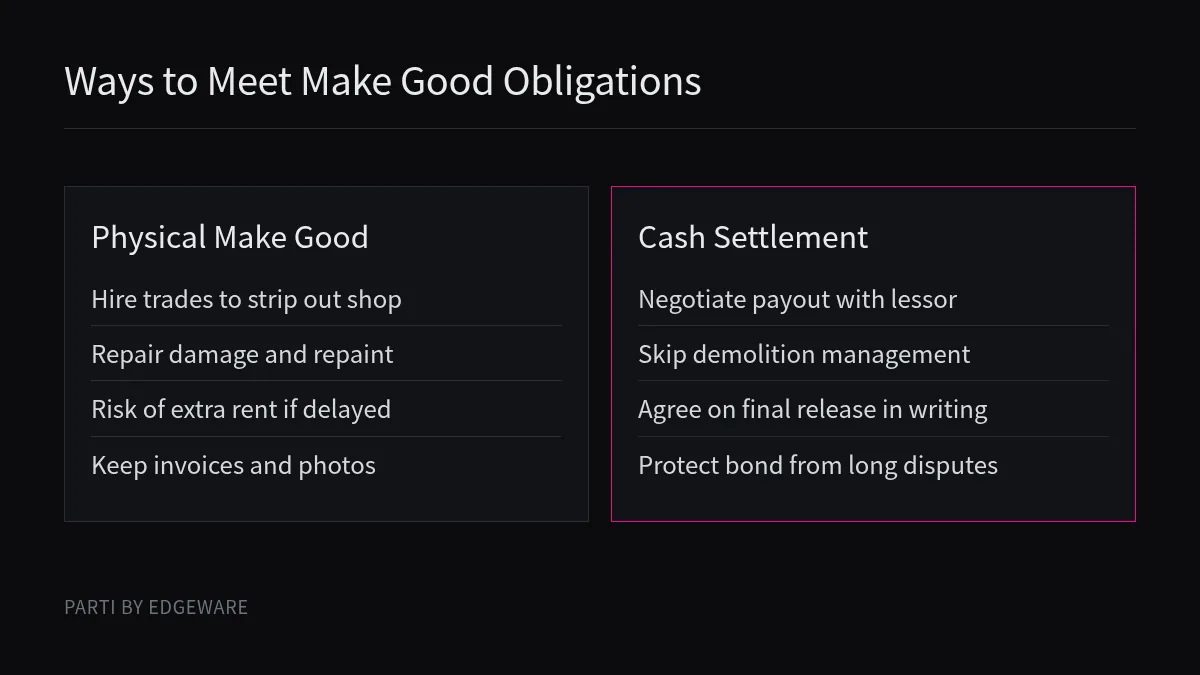
* Clarify what the landlord wants: Talk to the lessor or property manager early. Some leases require full removal, while others only ask for a clean premises, or the landlord may prefer to keep certain partitions or services in place. * Compare physical work against a cash settlement: Leases often give you two options to meet make good obligations: physically carrying out the works to a professional standard, or negotiating a cash settlement with the lessor in lieu of physical work. Weigh the quotes from your tradespeople against a lump-sum payout, keeping in mind that missing your deadline for physical works can result in additional rent or penalties. * Keep everything in writing: Put your proposals, agreed scopes of work, and any release from further make good duties into a written agreement before you hand back the keys. Respond promptly to property managers so delays do not add extra rent. * Use mediation before going to court: If there is little evidence of the original condition or the clause is vague, mediating a solution saves time and money. Both the Queensland and NSW Small Business Commissioners offer mediation where parties are guided through negotiation and no judge hands down a decision, leaving you in control of what you agree to.
As we research and design our own planned concept, you can see how we think about interior layouts on our room page.
Conclusion
Check your lease and condition records first, talk to your landlord early, and get every agreed fit-out and bond arrangement in writing.
About Parti
Parti by Edgeware is Edgeware's first industry solution. We are designing a café where one room can change how it is used by changing the props, with no rebuild of the room. Counters, tables and displays are meant to be carried in and out again by hand, so less is built into the walls and floor and less is left to take down when a lease ends. That is a design aim, not a tested result. The first café is planned for Hangzhou and is not open. See the room and how the floor connects. This guide is for tenants who are weighing a shop or café fit-out. It is general information, not legal advice, and your own contract and local rules decide.
Sources
- Queensland Small Business Commissioner: Make good: Explains Queensland make good clauses, Property Law Act rules, cash settlements, and dispute resolution steps.
- NSW Small Business Commissioner: 'Make good' and retail leases: Covers New South Wales retail lease make good duties, lease assignments, quantity surveyors, and mediation.
- RICS: Code for leasing business premises, England and Wales (2020): Sets out professional standards for repairing obligations, schedules of condition, and alterations in England and Wales.
- Queensland Small Business Commissioner: Commercial lease bond: Details cash bonds, bank guarantees, personal guarantees, and how make good disputes affect security returns.