What to ask before hosting an event in a café?
Event bookings can fill quiet evenings in a one-room café. Say yes before checking your lease, licences and reset time, and the extra revenue turns into stress. Ask these first.
Published
Before hosting an event in a café, ask four sets of questions: whether the physical room handles the headcount and furniture reset, whether local licensing and fire rules permit the activity, what the changeover costs in staff time, and what your lease allows.

Ordering these questions by who holds the answer saves you from chasing paperwork after taking a deposit. Start with the floor you stand on, then check the regulations, the budget, and the building agreements.
Which questions are about the room?
Your café floor works for daytime tables. An evening gathering changes how people stand, queue, and reach the doors in the same room.
Ask what safe capacity your fire risk assessment sets for the new layout, where cleared tables will sit without blocking escape routes, whether your mains power and toilets match a crowd arriving at once, and how sound behaves in the room.
When you consider turning your café into an event space, the physical shell sets your hard limits. A room that feels spacious during a staggered lunch service behaves differently when every guest arrives at the same time and stays for the whole session. Walk the floor with the event organizer and answer six operational questions before you confirm the date.
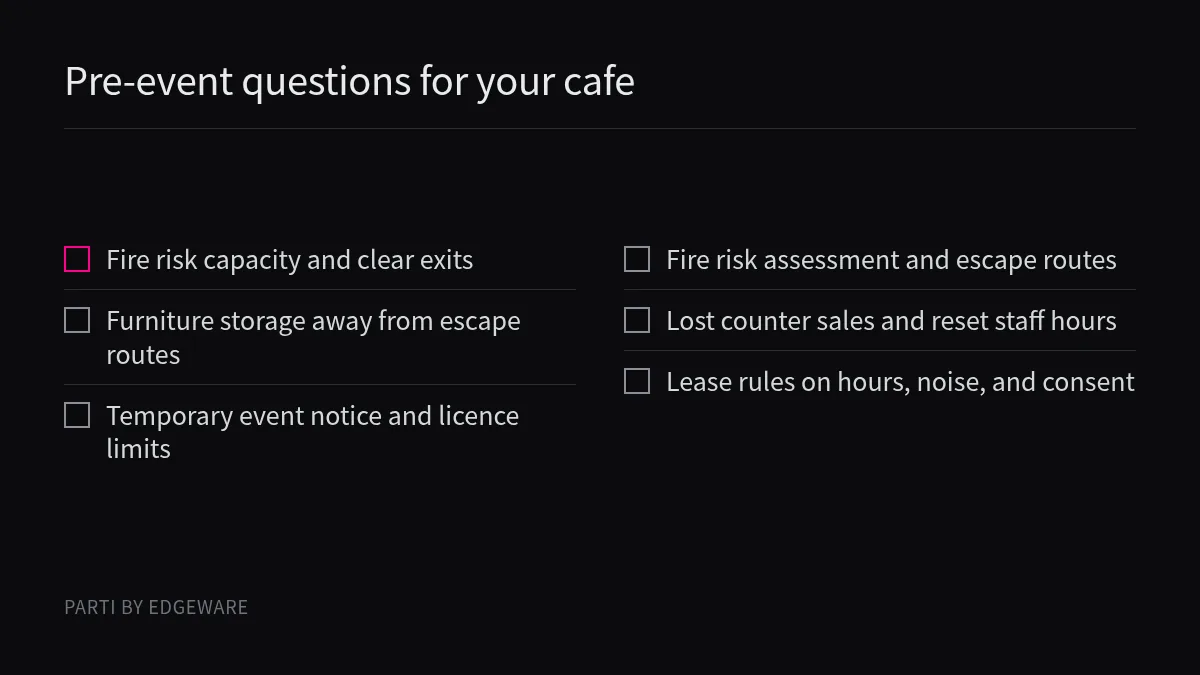
Room and layout checklist
- What does the fire risk assessment allow for this layout? Standing receptions, seated talks, and workshops change how people move toward exits, so check the safe occupancy limit recorded in your assessment rather than guessing by floor area.
- Where do the extra tables and chairs go during the event? Stacking furniture in corridors, near fire doors, or in front of electrical panels creates a hazard; you need a dedicated storage zone that leaves escape routes completely clear.
- Can the escape routes handle everyone leaving at once? Walk every path from the back of the room to the final exit doors to confirm that temporary stages, display boards, or coat rails will not narrow the passage.
- Are the mains services in good order for the extra load? Projectors, sound desks, and catering urns draw power from outlets that usually run only a few lamps, so ask early what equipment the host is bringing and which circuits they will use.
- How will the toilets and handwashing stations cope with peak breaks? Unlike café trade where customers trickle in and out, an event creates a single queue at the interval; check whether your facilities and supplies can handle that surge.
- Where does the sound travel inside the room? Hard café surfaces bounce voices and music back into the space; test whether a speaker at one end can be heard clearly at the other without turning the volume up to a level that spills outside.
If the booking involves teaching or table work, read our notes on running a class or training session in a café to see how sightlines and table spacing change the room check.
Which are about the rules?
Daytime café permissions rarely cover late-night food, alcohol, or live music automatically. Skipping a compliance check risks a cancelled night or a fine.
Ask whether the event involves licensable activities like selling alcohol, entertainment, or late-night hot food, whether you need a temporary notice, and whether your fire risk assessment covers the event layout and any flammable materials.
Public rules vary by country and municipality, so your local authority and your own premises licence always decide what is legal. In England and Wales, for example, you need to apply to your local council for a Temporary Event Notice for licensable activities1 if you want to carry out an activity on unlicensed premises, or if a particular activity is not included in the terms of your existing licence. Under those England and Wales rules, licensable activities include selling alcohol, serving alcohol to members of a private club, providing entertainment such as music, dancing, or indoor sporting events, and serving hot food or drink between 11pm and 5am.
Licensing and fire safety questions to verify
* Does the event fall within temporary notice limits? In England and Wales, an event under a Temporary Event Notice must have fewer than 500 people at all times (including staff running the event) and last no more than 168 hours (7 days). You must be at least 18 to apply as an individual, not an organisation, and pay a £21 fee. * Have you left enough working days to apply? In England and Wales, you must apply at least 10 clear working days before the event (not counting the day the council receives it or the event day), or between 5 and 9 clear working days before for a late notice. The police and environmental health have 3 working days to object if they think the event could lead to crime and disorder, cause a public nuisance, threaten public safety, or put children at risk of harm. If they object to a standard notice, the licensing committee holds a hearing no later than 24 hours before the event; if they object to a late notice, the notice is not valid and you cannot hold the event. * How many notices has the building used this year? In England and Wales, a single premises can have up to 15 notices applied for in a year, totaling no more than 21 days, with at least a 24-hour gap between separate consecutive events. An individual without a personal alcohol licence can get up to 5 notices a year (including up to 2 late notices); a personal licence holder can get up to 50 (including up to 10 late notices). You must keep the notice in a safe place on site and display a copy where it can be easily seen. * Does your fire risk assessment cover this assembly size and flammable materials? In England, the Home Office guidance on fire safety risk assessment for assembly places2 applies to small premises (accommodating up to 60 people) and medium premises (accommodating up to 300 people). The responsible person (the employer or person with control of the premises) must review precautions, especially if the event brings in flammable materials and substances.
Which are about money and time?
A hire fee looks clean on paper. It hides the hours your team spends clearing tables, staying late, and resetting for morning coffee.
Ask what daytime counter trade you lose by closing early, how many staff hours the pack-down and morning reset require, who pays for extra cleaning and breakages, and whether the booking leaves your team too tired for tomorrow's open.
We cannot give you a universal formula for pricing an evening hire because we do not know your wages, your rent, or what a quiet Tuesday afternoon brings in across your counter. What we do know is that operators lose money when they price only the hours the guests are in the room and forget the changeover window on either side. If you are planning a day-to-night café layout, run through these financial and scheduling questions before quoting a hire fee.
Commercial and scheduling questions
- What regular sales do you forfeit during setup? If an organizer needs the room empty two hours before doors open, compare the hire fee against the walk-in trade you will turn away and the irritation caused to regular customers who find the door locked early.
- Who moves the furniture, and on whose clock? Moving heavy tables, unplugging counter displays, and setting out chairs takes paid labour; decide whether your staff do the physical shift or whether the hirer brings a crew under your supervision.
- When does the reset back to café mode happen? Packing down late at night after guests leave can lead to rushed cleaning and exhausted baristas the next morning, while resetting before open requires an earlier shift start.
- Which party supplies and pays for consumables? Clarify in writing whether the fee includes napkins, glassware, dishwashing, waste disposal, and toilet paper, or whether the organizer pays a separate charge for kitchen and washroom use.
- How do you handle overruns and damage? Set a clear cut-off time when music stops and lights come up, and decide upfront how late departures or damaged furniture are billed so your closing manager is not negotiating at the door at night.
| Cost or time area | Question to ask the organizer | Question to ask your own team |
|---|---|---|
| Setup window | What time do deliveries and speakers arrive? | How early must we close the coffee counter? |
| Staffing | Are you bringing door and floor stewards? | Who holds the keys and runs the bar? |
| Pack-down | What leaves the building tonight versus tomorrow? | Can we open on time tomorrow if we reset at night? |
| Extras | Who covers extra bin bags and glassware washing? | Do we need an extra cleaner before morning service? |
Which are about the neighbours and the landlord?
You may own the coffee machine, yet you share walls, ceilings, and legal covenants with a landlord and neighbours who did not sign up for a party.
Ask what your lease says about permitted use and working hours, whether temporary fittings or signage need landlord consent, how you will coordinate fire risks with other tenants in the building, and when noise must stop for nearby residents.
Your lease contract and local planning approvals set rules that exist separately from your café licence. In England and Wales, the RICS Code for leasing business premises3 notes that leases normally require tenants to comply with all legislation at their own cost, and usually put the responsibility on the tenant to check that a proposed use complies with title covenants and planning law. If you need planning permission for a change of use in England and Wales, the RICS code notes you should allow at least eight to ten weeks (sometimes longer) for an application to be processed. You can also explore how our planned Parti events concept thinks about shared spaces.
Property and neighbour checklist
* Does your lease or planning permission restrict hours or noise? As the RICS guidance for England and Wales points out, tenants should check for planning or regulatory restrictions that affect business operations, such as limitations on working hours or noise emissions, consulting surveyors or solicitors where needed. * Do you need landlord approval for event signage or alterations? Under the RICS standard, landlords often restrict signage size and appearance as well as alterations. In a lease of an entire building, a landlord should not normally prohibit or require consent for internal non-structural alterations that do not adversely affect character, value, structural stability, statutory compliance, or energy efficiency, though tenants must carry out works without causing damage or nuisance and give written details. In a multi-let building unit, a landlord may require prior consent (not to be unreasonably withheld or delayed) for internal non-structural alterations. * Can your mains services handle event equipment without alterations? The RICS code warns that altering services such as electricity and gas can be expensive, advising tenants to ensure mains services are adequate and in good order, and that premises comply with fire regulations and disability access requirements. * Have you coordinated fire safety with adjoining managers? In England, the fire safety guidance notes that where premises adjoin other complexes, co-operation with the other managers will be necessary as part of an integrated risk assessment for the complex. * How will guests enter, smoke, and leave without disturbing neighbours? Even when noise inside the café is controlled, a group talking on the pavement waiting for taxis can trigger complaints; plan where queues form and remind guests of the neighbours as they leave.
Conclusion
Run through room limits, local licensing, staff reset hours, and lease terms before you take a deposit. A clear checklist keeps evenings manageable.
About Parti
Parti by Edgeware is Edgeware's first industry solution. We are designing a café where one room can serve several uses, reset by hand between them. We have not published how long a reset takes, because we have not tested it. That is a design aim, not a result. The first café is planned for Hangzhou and is not open. See the room and how the floor connects. This guide is for people who run a café, studio or event space. It is general information, not legal advice, and your own contract and local rules decide.
Sources
- GOV.UK: Temporary Events Notice (England and Wales): Official rules on licensable activities, capacity limits, fees, and notice deadlines in England and Wales.
- GOV.UK: Fire safety risk assessment, small and medium places of assembly: Home Office guidance on fire risk assessments, flammable materials, and multi-occupied buildings in England.
- RICS: Code for leasing business premises, England and Wales (2020): Professional standard explaining tenant duties on permitted use, working hours, noise, and alterations.