How to plan a café for coffee and evening events?
Running daytime coffee and evening events in one room strains your floor plan. Heavy furniture slows the switch. This guide shows how to plan both uses.
Published
Plan a dual-use café by pairing compatible formats, anchoring the bar, power, storage, and exits, and keeping seating and tables on the move. Write a step-by-step reset checklist with an owner for each task, then time your own rehearsal before booking.

A floor plan that earns its keep all day and night starts before you buy a single chair. You decide which activities actually share a room well, lock the parts that cannot move, and design a clear routine for everything else.
Which uses pair well in one room?
Not every evening event fits a working coffee shop. Clashing smells, lighting needs, and crowd habits ruin both shifts. Pick formats that share your setup.
Uses pair well when they share lighting levels, sound limits, cleanliness standards, and license rules. Acoustic gigs, talks, tastings, and workshops fit a daytime café floor far better than messy craft sessions or late-night club nights that fight your morning prep.
Matching the rhythm of the room
When we look at a single room doing double duty, we start with what the daytime trade leaves behind and what the morning team needs to walk into. A coffee bar depends on clean counters, clear sightlines to the menu, and a calm odor profile so people can smell the espresso. An evening format that leaves paint on the floor, strong cooking grease in the air, or sticky drink spills under the grinder creates a morning penalty your opening barista will resent. Good pairs borrow the same bones: the bar serves filter coffee at ten and pours natural wine or batch cocktails at seven, while the floor shifts from laptop tables to rows of chairs for a book talk. If you are still weighing whether to open your doors after hours at all, start with our guide on whether a café can double as an event space and see how we think through evening event formats.
| Pairing factor | Easy match with daytime coffee | Hard match with daytime coffee |
|---|---|---|
| Bar service | Wine, bottled beer, alcohol-free pairings, tea tastings | Full cocktail shaking that needs extra ice wells and sinks |
| Floor arrangement | Seated talks, small acoustic sets, board game nights | Standing dance floors that require clearing every table |
| Clean-down | Dry crumbs, glassware, light sweeping | Glitter, wet clay, heavy frying, candle wax |
Checking your license boundary early
Format choices also run into public rules long before opening night. In England and Wales, you need a Temporary Event Notice rules1 if you want to carry out a licensable activity on unlicensed premises, or if a particular licensable activity is not included in the terms of your existing licence. That official guidance lists selling alcohol, serving alcohol to members of a private club, providing entertainment such as music, dancing, or indoor sporting events, and serving hot food or drink between 11pm and 5am. Under those England and Wales rules, your event must have fewer than 500 people at all times, including staff running the event, and last no more than 168 hours (7 days). A single premises can have up to 15 notices applied for in one year, as long as the total length of the events is not more than 21 days, and there must be at least a 24 hour gap between separate consecutive events. Other places have different rules, and your own lease contract and local authority always decide what you can run.
What stays fixed and what moves?
If everything moves, staff burn out moving it. If nothing moves, events feel cramped inside a coffee shop. Draw a hard line between fixed and mobile.
Keep your espresso counter, plumbing, primary power drops, storage room, and fire exits completely fixed. Put café tables, chairs, retail displays, and stage lighting on the movable list so the center and edges of the room can open up on demand.
Anchoring the perimeter
Every multi-use room needs permanent anchors that never shift during a changeover. Your coffee machine, grinders, water filtration, and wash-up sinks sit on fixed plumbing and high-load electrical circuits, so the bar stays put. The trick is treating the bar face so it reads as a service counter at noon and a reception or drink point at night, simply by clearing the pastry case and dimming the overhead task lights. Power sockets along the skirting board, acoustic ceiling panels, and the dedicated storage closet also belong on the fixed drawing. Wait to buy tables until you have measured that storage closet door and floor footprint; every chair you pull off the floor for a standing reception needs a home that is not blocking the toilets. You can explore more layouts in our piece on what one room does across six planned uses.
Protecting the escape routes
What stays fixed most of all is the path out of the building. In England and Wales, the Home Office fire safety guide2 for small places of assembly (accommodating up to 60 people) and medium places of assembly (accommodating up to 300 people) explains that responsibility for complying with the fire safety order rests with the responsible person, such as the employer or occupier in control of the premises. That fire risk assessment is the foundation for all fire precautions in your premises, and the guidance notes you should dip into it when you are reviewing your precautions. When you swap cafe tables for rows of event chairs or bring in a temporary display, your escape corridors and exit doors cannot narrow or disappear behind stacked furniture.
Choosing what moves and how staff move it
Everything inside that fixed perimeter is fair game to move, provided your team can shift it safely without wrenching their backs. In Great Britain, the HSE manual handling risk filters3 note that employers must protect workers from the risk of injury from handling tasks. While the law does not set specific weight limits, HSE gives simple filters to spot low-risk tasks and see when you need a full assessment:
- For lifting and lowering, you need a more detailed assessment if the handling involves torso twisting, is more frequent than one lift every two minutes, is done by a team, or if the load is difficult to grasp.
- For carrying, the filter weights apply only where the load is held against the body, carried no further than about 10 m without resting, and does not obstruct the view of the person carrying it.
- For pushing and pulling on wheels, the task is likely to be low risk if force is applied with the hands between hip and shoulder height, the torso is largely upright and not twisted, and the distance moved without a pause is no more than about 20 m.
When you pick flip-top tables, nesting chairs, or rolling retail racks, test how one person actually grips, wheels, or carries them across your floor threshold. For a deeper look at hardware, read our guide on choosing furniture for a multi-use room.
How do you plan the switch between uses?
Closing the coffee bar at five and opening event doors at six fails when staff guess what to do next. Without a script, things get missed.
Plan the switch as a written sequence with a named person responsible for each zone. Break the changeover into bar reset, floor clearing, AV and lighting checks, and exit inspection so two people can work in parallel without blocking the aisles.
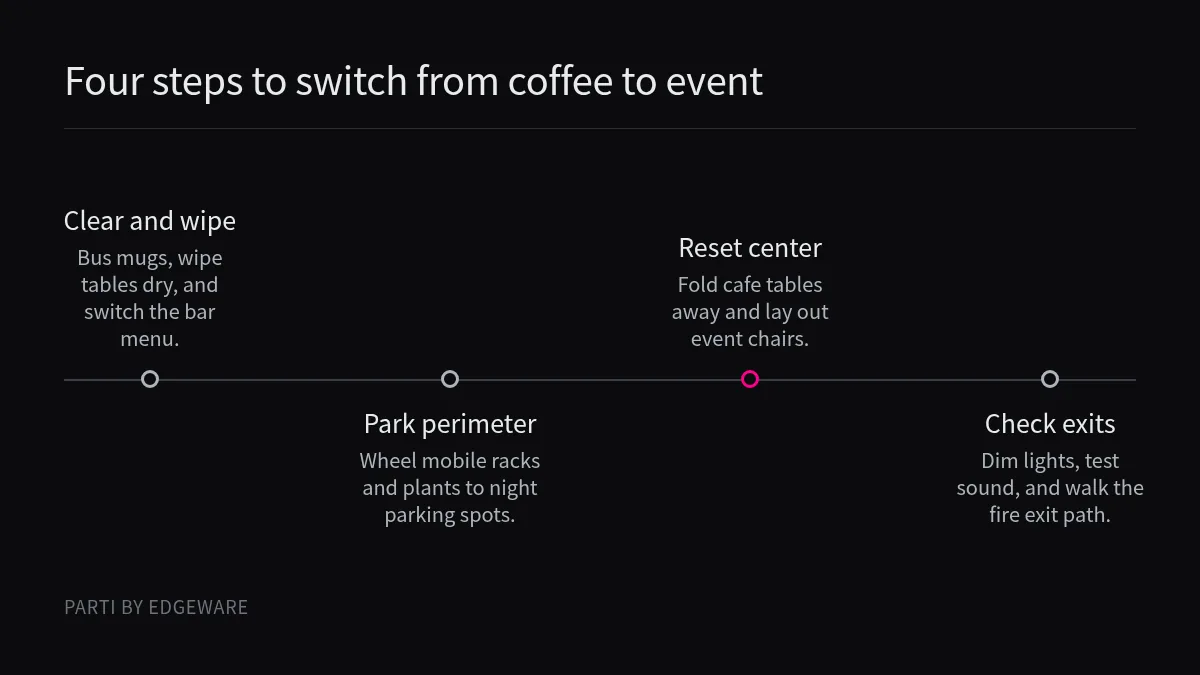
Writing the changeover script
A smooth switch between daytime coffee and an evening crowd is choreography, not heavy labor. When two staff members try to fold tables in the same narrow aisle while a speaker asks for the Wi-Fi password, tempers flare and glassware breaks. We write the changeover as a single-page checklist taped inside the bar cupboard, split by role rather than a vague group to-do list. One person owns the wet zone (purging the steam wands, locking away milk jugs, setting out wine glasses, switching the till menu), while the second person owns the dry floor (clearing mugs, wheeling retail shelves to the wall, setting the chair rows, plugging in the microphone).
- Step 1: Clear and wipe. Bus every table before a single chair is stacked. Wet spills on a stacked chair ruin the seat below it.
- Step 2: Move the perimeter first. Roll mobile displays and plant troughs to their night parking spots so the walls are ready to receive tables.
- Step 3: Reset the center floor. Fold and wheel away the café tables, then lay out the evening seating from the back of the room toward the entrance so you never trap yourself in a corner.
- Step 4: Tune light, sound, and safety. Dim the bar spots, test the speaker volume from the back row, and walk the fire exit path from start to street.
Briefing visiting hosts and temporary staff
Evening events often bring outside people behind your scenes: a visiting DJ, a caterer, or an agency bartender covering the late shift. Under the England and Wales fire safety guidance cited earlier, the responsible person must inform non-employees, such as temporary or contract workers, of the relevant risks to them, and tells them who the nominated competent persons are and what the fire safety procedures for the premises are. You also have to co-operate and co-ordinate with other responsible persons who share the building. Build a two-minute safety walk into your changeover checklist right before doors open: point out the fire exits, show the visiting host where cables must be taped down, and agree who calls the room to order if an alarm sounds.
What should you test before you promise anything?
Promising an event organizer a quick turnaround before your team has tried it on the floor invites chaos. Paper plans hide heavy tables and awkward corners.
Test the full switch with a stopwatch and your actual staff before taking bookings. Run a dry rehearsal from daytime layout to night setup and back, check sound bleed to neighbors, and verify your licensing calendar and notice deadlines.
Timing your own rehearsal
We never trust a speculative changeover time on a pitch deck, and you should not promise one to a client until you have timed your own room with a stopwatch. Every building has its own friction: a tight turn into the storeroom, a heavy velvet curtain that snags, or café customers who linger twenty minutes past closing time over their last cortado. Pick a quiet afternoon, set the room in full daytime coffee mode, and run the complete switch to your seated layout and back again. Write down how long each step actually took with the staff you normally roster on a weekday afternoon, not with four extra managers helping out. Add buffer time for late-staying coffee drinkers and a quick floor mop before you publish your evening hire slots.
Stress-testing the room and the paperwork
A dry run also exposes the invisible snags that ruin an evening event halfway through. Have someone stand outside the front door and in the hallway upstairs while you play music at evening volume to see where sound leaks. Plug your evening urns, projector, and soundboard into the sockets you plan to use at the same time the bar dishwasher and fridges are running, so you find out in rehearsal whether a breaker trips.
Finally, test your administrative timeline against local rules. If you operate in England and Wales and rely on a Temporary Event Notice, you must apply at least 10 clear working days before your event (not counting the day the council receives the application or the day of the event) and pay a fee of £21, or at least 5 clear working days before for a late notice. Notice limits are strict: an individual without a personal licence can get up to 5 notices a year (including up to 2 late notices), while a personal licence holder can get up to 50 (including up to 10 late notices), and if the police or environmental health object to a late notice, it is invalid and you cannot hold the event. Knowing those hard dates keeps you from saying yes to a last-minute Friday booking that you cannot legally host.
Conclusion
Pair evening uses that respect your morning coffee trade, lock your utilities and exits, script the floor reset by role, and time a full rehearsal first.
About Parti
Parti by Edgeware is Edgeware's first industry solution. We are designing a café where one room can serve several uses, reset by hand between them. We have not published how long a reset takes, because we have not tested it. That is a design aim, not a result. The first café is planned for Hangzhou and is not open. See the room and how the floor connects. This guide is for people who run a café, studio or event space. It is general information, not legal advice, and your own contract and local rules decide.
Sources
- GOV.UK: Temporary Events Notice (England and Wales): Check England and Wales rules, headcount caps, annual limits, fees, and working-day deadlines for temporary event notices.
- GOV.UK: Fire safety risk assessment, small and medium places of assembly: Read official England and Wales guidance on fire risk assessments, capacity bands, and briefing temporary workers.
- HSE: Simple manual handling risk filters: See Great Britain manual handling filters for lifting, carrying, and wheeling furniture safely during room resets.