Can a café double as an event space?
Your café sits empty after the afternoon rush while rent runs all day. Hosting events sounds simple until staff haul tables at midnight.
Published
A café can double as an event space if you can switch the seating, counter service, sound, and exit routes within your trading gap, and if your lease, fire risk assessment, and local licensing rules allow the new activity.

Before you advertise a talk or a tasting, walk through what the room has to do differently, what your paperwork allows, and how the clock works on the night.
What changes when a café becomes an event space?
Daytime coffee trade relies on quick turns and small tables. Evening events ask everyone to arrive together, face one way, and stay put.
Switching from café service to an event changes six things in the room: furniture layout and sightlines, the counter queue, sound and lighting, power access, storage for displaced tables, and guest flow to exits and toilets.
From scattered tables to one focal point
A café room is arranged for people to queue, sit in pairs, and leave at their own pace. An event asks the same floor to hold a crowd with one shared focus. When you look at planning a café for coffee and evening events, the first friction point is the furniture you already own. Heavy tables that feel sturdy under laptops become dead weight when two staff members have to clear the middle of the floor before doors open. Fixed booths, planters, and low pendant lights over tables also lock your sightlines. A pendant hung for a two-top sits right in a speaker's face once the table beneath it moves away.
| Feature | Daytime café mode | Evening event mode |
|---|---|---|
| Arrival pattern | Trickle across the day | All guests arrive in a short window |
| Sightlines | Private views at small tables | Clear view of one speaker or table |
| Counter role | Continuous orders and grinder noise | Pre-event welcome drink or closed |
| Furniture | Tables and chairs spread across floor | Rows of chairs, open floor, or long tables |
Counter noise, power, and storage
Your espresso machine, grinder, and dishwasher make enough noise to drown out an unamplified talk. You have to decide whether the counter closes once the event starts, shifts to pouring quiet drinks, or works only during an interval. Power is the next catch. Guests at a talk do not need floor sockets, but a projector, a microphone receiver, or warmers for a tasting do, and trailing cables across a walkway creates a trip hazard. Finally, count where the café's daytime tables go while the event runs. If stacked tables block the corridor to the toilet or narrow the route to the back door, your room capacity drops before the first guest walks in.
What do the rules and the neighbours need to know?
Good event ideas fall apart when a landlord, a neighbour upstairs, or a council officer learns about them from a poster in the window.
Before hosting events, check your lease for use and hours limits, update your fire risk assessment for assembly numbers and clear exits, and check whether alcohol, entertainment, or late hot drinks require a licence or temporary notice.
Leases, planning, and neighbour limits
Start with the building paperwork. In England and Wales, the RICS Code for leasing business premises1 notes that leases usually make the tenant responsible for checking that a proposed use complies with title covenants and planning law, and warns tenants to check for planning or regulatory limits on working hours or noise emissions. If you actually need planning permission for a proposed use, that RICS guidance advises allowing at least eight to ten weeks, and sometimes longer, for an application to be processed. It also reminds tenants that leases normally require compliance with legislation such as the Equality Act 2010, Health and Safety Acts, and Environmental Protection Acts at the tenant's own cost, and that multi-let building leases often require landlord consent for internal non-structural alterations. Other places have different rules, and your own contract and local authority decide what applies to your unit.
Licensing and fire safety duties
In England and Wales, if you want to carry out a licensable activity on unlicensed premises, or one not covered by your existing licence, you must contact your council for a Temporary Event Notice on GOV.UK2. Licensable activities include selling alcohol, providing entertainment such as music or dancing, and serving hot food or drink between 11pm and 5am. A standard TEN costs £21, requires the applicant to be at least 18, and must be applied for at least 10 clear working days before the event. The event must have fewer than 500 people at all times, including staff, and last no more than 168 hours. A single premises can get up to 15 TENs a year, up to a total of 21 days, with at least a 24-hour gap between separate consecutive events.
Fire precautions shift when a café holds a crowd. In England, Home Office guidance on fire safety risk assessment for assembly places3 states that a fire risk assessment is the foundation for all fire precautions, covering small places of assembly accommodating up to 60 people and medium ones up to 300 people. The responsible person, such as the employer or occupier in control, must inform temporary or contract workers of relevant risks and fire procedures, and co-operate with other responsible persons who share the building.
How do you plan the room and the time?
An event that makes money on paper can still lose on the night if turning the room around burns out your closing shift.
Plan the changeover by timing every task between the last daytime customer and event doors, assigning who moves furniture, and fixing a hard stop so the room returns to café mode before morning prep.
Counting the gap between coffee and doors
Turning a room around takes physical work, and that time comes out of either your daytime café hours or your evening hire window. You have to wait for the last coffee customer to leave, clear cups, wipe down surfaces, move tables into storage, set out chairs or workshop benches, test any microphone or screen, and reset the counter. At the end of the night, someone has to reverse the whole job or come in early before the morning bake. If you are thinking about running a class or training session in a café, the setup also includes laying out materials and keeping wet or messy work away from upholstery.
We do not know how long a changeover takes in your room, and we think anyone who promises a fixed number of minutes without seeing your floor plan and storage cupboard is guessing. The only honest way to find out is to run a dry rehearsal with your own staff and a stopwatch.
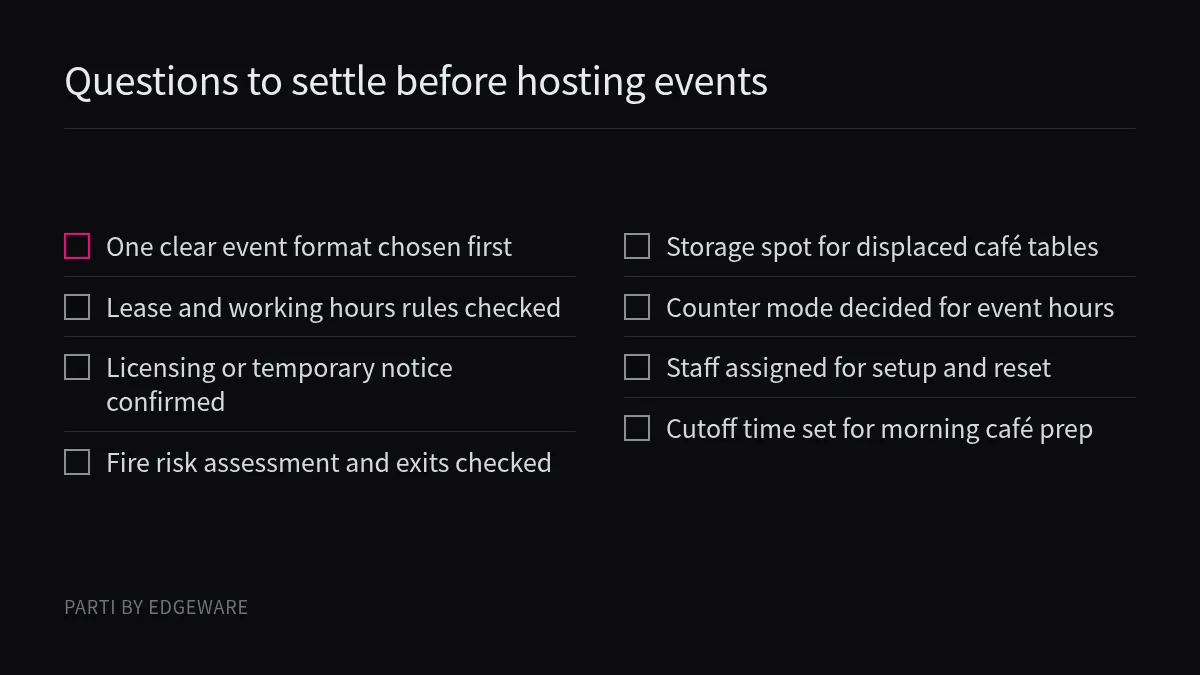
Questions to settle before you take bookings
* Who lifts and stores the daytime tables, and is that work paid inside normal shift hours? * Where do displaced chairs, highchairs, and countertop display stands go without blocking a fire exit? * Does the espresso bar stay open, switch to a simpler bottle or filter bar, or close completely? * How do guests check in and hang coats without jamming the front door? * Who briefs temporary event staff on fire exits and building procedures before doors open? * What is the latest minute the event can overrun before you miss your morning café reset?
Where do you start small?
Buying stacks of folding chairs and a sound system before hosting a single night locks up cash before you know what guests actually want.
Pick one simple event format that uses your existing furniture, run it on the same evening for a few sessions, and track setup time, bar sales, and complaints before changing the room.
Pick one format and test it
"Events" is too broad a word to design a room around. A quiet book talk with chairs in rows asks for different sightlines and acoustics from a standing product launch, a seated tasting, or a supper club. When we map out what one room would do across six planned uses or document our own planning for the room, we still treat each format as its own set of movements and floor needs. In an existing café, the safest start is the format that moves the fewest pieces of furniture. A workshop around your existing large sharing tables, or an acoustic talk where half the tables simply slide to the perimeter, lets you test demand without buying extra kit.
Compare what you earn against what you lose
After two or three trial evenings, put the numbers and the hassle side by side. Write down the ticket or hire income and the evening bar spend. Then subtract what you gave up: the last hour of afternoon coffee trade if you closed early to set up, the extra staff wages for staying late, the wear on walls and chair legs, and the energy of the team opening at seven the next morning. Pay attention to what dragged on the night. If guests queued across the doorway, if the speaker could not be heard over the fridge compressor, or if resetting the room took twice as long as expected, fix that bottleneck first or drop the format before spending money on alterations.
Conclusion
Start with one event format, check your lease and fire duties first, time the setup in your own room, and change only what drags.
About Parti
Parti by Edgeware is Edgeware's first industry solution. We are designing a café where one room can serve several uses, reset by hand between them. We have not published how long a reset takes, because we have not tested it. That is a design aim, not a result. The first café is planned for Hangzhou and is not open. See the room and how the floor connects. This guide is for people who run a café, studio or event space. It is general information, not legal advice, and your own contract and local rules decide.
Sources
- RICS: Code for leasing business premises, England and Wales (2020): Check lease rules on alterations, change of use, working hours, noise, and statutory compliance.
- GOV.UK: Temporary Events Notice (England and Wales): Read official limits, notice periods, fees, and rules for temporary licensable activities.
- GOV.UK: Fire safety risk assessment, small and medium places of assembly: See fire risk assessment duties for assembly spaces holding up to 60 or 300 people.