Can you run a class or training session in a café?
Your café sits quiet during off-peak hours, while teachers ask to book it. Turning down bookings hurts revenue, so this guide gives you a clear method to decide.
Published
Yes, you can run a class or training session in a café if the room provides clear sightlines, controlled bar noise, safe power access, and an updated fire risk assessment. Schedule classes outside peak coffee trade, or separate the two groups cleanly.

Running a workshop in a coffee shop sounds simple until a grinder drowns out the instructor or a cable trips a regular customer. Below, we cover what the room must provide, how to handle normal trade, what UK rules ask of you, and how to turn the floor around without hurting your team.
What does a class need from a café?
A café table built for two laptops rarely works for a group learning a skill. Bad sightlines and espresso noise ruin a class, so check four room basics first.
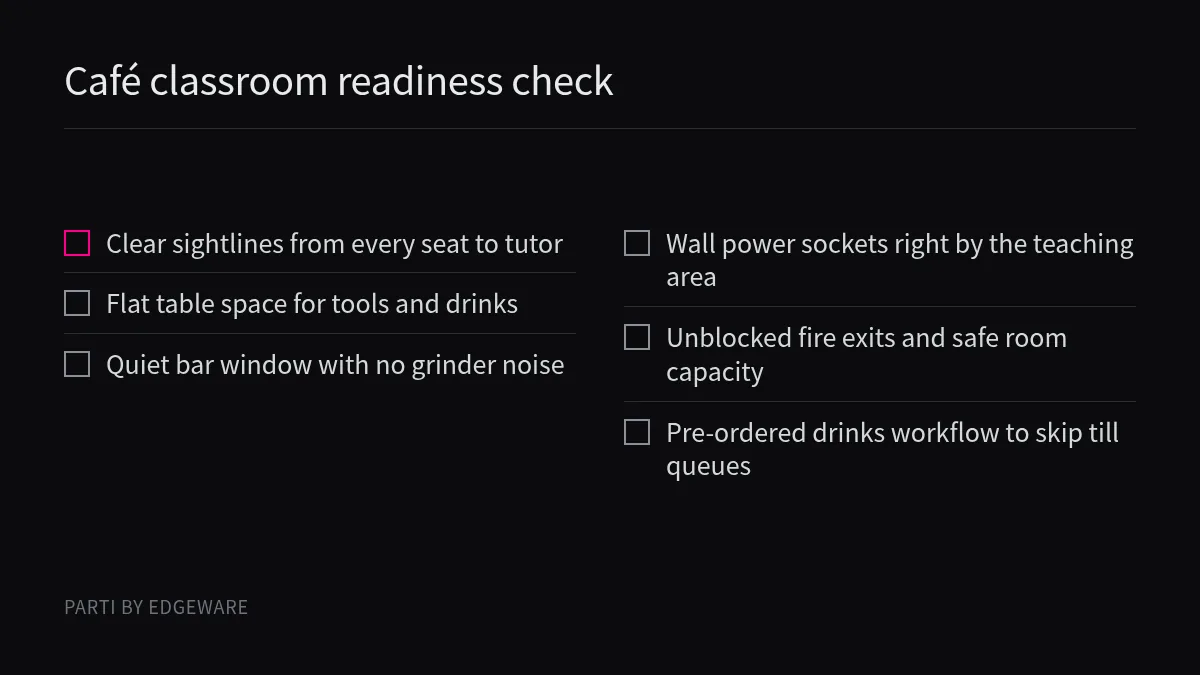
A class needs unobstructed sightlines to the instructor, seating that faces a single focal point or shared worktable, quiet bar periods so voices carry, and wall power that reaches equipment without trailing cords across walkways.
Sightlines and seating geometry
Regular coffee seating scatters people into small pockets so strangers do not feel crowded. A training session needs the exact opposite. Every participant has to see the instructor, a flipchart, or a demonstration bench without twisting their neck around a pillar or a tall plant. If you are teaching a hands-on craft or tasting, people also need enough flat table surface in front of them to set down tools, notebooks, and a drink at the same time. Low lounge chairs and tiny bistro rounds leave students balancing materials on their knees. Before you accept a booking, sit in the furthest seat yourself and check whether you can see and hear someone standing at the front of the room.
Noise and acoustic control
Coffee equipment is loud. A burr grinder, a steam wand purging milk, and the knock box will cut straight through a teacher's voice. Even background music and dishwashers become tiring when twelve people are trying to follow spoken instructions. Look closely at what your bar and kitchen do during the hours the teacher wants. You can pre-grind batch filter coffee, hold off on running the glasswasher, and pause the playlist, or you can limit classes to times when the espresso machine is off. We admit we do not know how your specific room carries sound until a group actually talks in it, so run one small pilot session before you sell a full term of bookings.
Power and lighting
Teachers often bring projectors, laptops, kettles, or craft heaters. Check where your wall sockets sit in relation to the teaching table. Running extension leads across the floor between the counter and the toilet door creates an immediate trip risk. Either position the teaching station right against a wall with outlets, or limit classes to formats that run on batteries and daylight. You can compare how other operators judge their floor in our guide on whether a café can double as an event space.
* Clear view from every chair to the tutor or demonstration surface * Worktable height that lets people write or use tools comfortably * Agreement on when the grinder and steam wand stay silent * Direct wall power at the teaching end of the room
How do you share the room with the coffee trade?
Mixing paying workshop guests with walk-in coffee regulars in one open room creates awkwardness fast. Both groups feel short-changed unless you draw a clear boundary by time or layout.
Share the room by running classes after closing or during your slowest hours, or by giving the class a distinct zone away from the till queue. Decide upfront how drinks are included so bar service does not interrupt the lesson.
Choosing between shared trade and closed doors
When you only have one room, trying to serve takeaway flat whites while an instructor leads a seminar three steps from the till rarely goes well. Walk-in customers feel like intruders when they open the door and twenty heads turn to look at them. Meanwhile, the person who paid for a ticket resents hearing order numbers called out over the lesson. You have two clean ways to handle this. The simplest is time separation: book classes for the afternoon lull, early evenings after the coffee rush ends, or a day you normally close. If you want to see how daytime service transitions into evening bookings, read our guide on planning a café for coffee and evening events.
| Operating mode | Effect on coffee regulars | Effect on the class |
|---|---|---|
| Closed door (out of hours) | Regulars see a clear closed sign or private session notice | Full quiet, uninterrupted use of tables and bar |
| Zoned floor (quiet trade hours) | Walk-ins keep a small front area near the counter | Class stays tucked in a back or side section, some ambient noise |
| Open mix during busy trade | Confused seating, blocked walkways around the till | Frequent interruptions from grinder, door, and queues |
Handling paying students alongside regular guests
If you stay open to the public while a class runs in a separate corner or back zone, set the drinks workflow before anyone arrives. Having twelve students join the main till queue at the exact start time delays the teacher and backs up your barista. Instead, fold a drink into the class ticket or use a pre-order sheet that the instructor hands to the bar at the start. Your team can bring those drinks over on a tray in one quiet drop before the teaching starts. Also put clear reserved cards on the class tables well ahead of time so you never have to ask a regular customer with a laptop to pack up and move ten minutes before the tutor begins.
What do the rules ask for?
A structured session changes how people use the room and how outside tutors work on your site. Ignoring fire or licensing duties puts people at risk.
In England and Wales, you must keep your fire risk assessment up to date, inform external instructors of fire procedures, and keep escape routes clear for the number of people your room allows. A Temporary Event Notice is only needed for licensable activities.
Fire risk assessment and outside instructors
When you rearrange tables for a class, you still have to protect everyone inside if a fire starts. In England and Wales, fire safety law requires the responsible person (such as the employer, occupier, or person with control of the premises) to put general fire precautions in place where necessary. According to the Home Office guide on fire safety risk assessment for small and medium places of assembly1, which applies to England and is intended for small premises accommodating up to 60 people or medium premises up to 300 people, your fire risk assessment is the foundation for all fire precautions. If a class introduces flammable craft materials or changes how chairs sit near exits, review your assessment so escape routes stay clear and headcounts stay within what your premises safely accommodate.
The same Home Office guidance sets out specific duties when people who are not your employees work in your space. You must inform non-employees, such as temporary or contract workers, of the relevant risks to them, tell them who the nominated competent persons are, and explain the fire safety procedures for the premises. If an outside organisation sends an instructor to run a training session in your café, you must provide their employer with clear, relevant information on the risks and the preventive and protective measures you have taken, and give the instructor appropriate instructions. And if you share a building with other businesses, you must co-operate and co-ordinate with the other responsible persons in that building.
When does licensing come into play?
A standard daytime class where people learn calligraphy, practise a language, or drink coffee does not need a special entertainment licence. Licensing only applies if the session includes a licensable activity that your premises licence does not already cover. Under the rules for a Temporary Event Notice in England and Wales2, you need a TEN if you want to carry out a licensable activity on unlicensed premises, or if that activity is not included in your existing licence. Licensable activities include selling alcohol, serving alcohol to members of a private club, providing entertainment such as music, dancing, or indoor sporting events, and serving hot food or drink between 11pm and 5am.
If a wine-tasting class or late-night event does cross into licensable activity in England or Wales, the official TEN rules set strict boundaries:
* You must be at least 18 and apply as an individual (not an organisation) to your local council, paying a fee of £21. * The event must have fewer than 500 people at all times (including staff running the event) and last no more than 168 hours (7 days). * You must apply at least 10 clear working days before the event (or between 5 and 9 clear working days before for a late TEN). * Without a personal alcohol licence you can get up to 5 TENs a year (including up to 2 late TENs); with a personal licence you can get up to 50 a year (including up to 10 late TENs). * A single premises can have up to 15 TENs applied for in one year, up to a total length of 21 days, with at least a 24 hour gap between separate consecutive events. * You must keep the TEN in a safe place at the event and display a copy where it can be easily seen.
Other countries and regions have different fire and licensing rules, and your own lease, insurance policy, and local authority always decide what you can run on site.
How do you set up and reset?
A workshop becomes a burden if staff must drag heavy tables across the floor at closing time. You need a repeatable reset routine.
Plan a layout that shifts with minimal lifting, assign clear duties between the café staff and the visiting tutor, and protect your team by assessing manual handling risks before moving tables and chairs.
Looking after your team during the turnaround
Turning a café floor into a classroom and putting it back for morning coffee involves lifting, lowering, carrying, pushing, and pulling furniture. In Great Britain, employers have duties under the Manual Handling Operations Regulations 1992 to reduce the risk of injury from these tasks. The Health and Safety Executive leaflet on manual handling at work3 explains the problems associated with manual handling and points employers to simple risk filters for lifting, lowering, carrying, pushing, pulling, and handling while seated. Do not leave a single staff member to wrestle heavy tables alone at night. Choose pieces that two people can move safely or that stay in place while only the chairs rotate. Our guide on choosing furniture for a multi-use room walks through what makes a floor easier to rearrange, and you can also view our planned room concepts to see how we are studying flexible layouts.
A step-by-step changeover agreement
Ambiguity between the venue host and the outside teacher causes most end-of-night friction. Write down a simple running order and attach it to your booking agreement so everyone knows what happens before and after the class:
- Walk the tutor through fire exits, nominated staff contacts, and power sockets before guests arrive.
- Shift chairs and tables into the agreed class arrangement using safe team handling, keeping every fire exit route completely clear.
- Serve pre-ordered café drinks in one batch at the start or during a planned break so the bar can clean down on time.
- Have the tutor pack away all teaching materials and wipe down work surfaces while staff return tables to the standard morning coffee map.
Conclusion
A café can host great classes when sightlines, bar noise, fire safety, and table resets are planned before you accept the first booking.
About Parti
Parti by Edgeware is Edgeware's first industry solution. We are designing a café where one room can serve several uses, reset by hand between them. We have not published how long a reset takes, because we have not tested it. That is a design aim, not a result. The first café is planned for Hangzhou and is not open. See the room and how the floor connects. This guide is for people who run a café, studio or event space. It is general information, not legal advice, and your own contract and local rules decide.
Sources
- GOV.UK: Fire safety risk assessment, small and medium places of assembly: Read official England guidance on fire risk assessments and duties toward visiting workers.
- GOV.UK: Temporary Events Notice (England and Wales): Check when an activity needs a Temporary Event Notice, plus fee, notice, and limit rules.
- HSE: Manual handling at work, a brief guide: Download HSE employer guidance on reducing injury risk when lifting, carrying, or pushing items.