What events can a small café host?
Empty seats in quiet hours still cost rent. Rebuilding the room drains your team. This guide groups café events by setup effort and rules.
Published
A small café can host low-setup events around existing tables, rearranged-room workshops and seated talks, or evening gatherings that need a temporary notice. Pick formats that fit your floor plan, fire risk assessment, and local licensing rules.

Every event format places a different demand on your furniture, your staff, and your paperwork. We sort the realistic options below by how much you have to move and what permissions you need to check before you put a date on the calendar.
Which events need almost no setup?
Moving heavy tables after a full coffee shift wears staff out. If resetting takes too long, you stop hosting. Start with formats that leave chairs still.
Zero-setup events use your daytime layout as it stands. Guests sit at existing café tables or gather along the service counter for readings, tastings, club meetings, and quiet study hours, so staff only clear cups and wipe surfaces before opening.
Formats that use your daytime tables
When your team finishes the daytime rush, the easiest event is one where the room is already ready. You keep the chairs where they are, keep your normal walkways clear, and use the counter you already work behind. We detail the broader trade-offs of sharing one room between service and bookings in our guide on whether a café can double as an event space.
- Book club or reading circle at a shared table: A small group pulls up to your largest standard table or a cluster of two-tops without blocking the main aisle.
- Counter tasting or brewing demonstration: Guests stand or sit on existing stools along the bar while a barista prepares samples on the worktop you already use.
- Board game or craft night on existing two-tops: Visitors bring small table-top projects or games that fit inside the footprint of a normal coffee service setting.
- Language exchange or neighbourhood meetup: Attendees rotate between regular seats, ordering drinks at the till as they would during normal daytime hours.
- Morning coffee Q&A before the midday rush: One speaker sits at a corner table with a handful of guests during a slow morning window, needing no stage or microphone.
- Silent reading or focused work session: Guests book a seat for quiet reading and a set drink, using your normal seating and lighting with the background music turned down.
Why zero-setup formats work for a busy crew
You do not need storage for spare chairs, and you do not have to pay staff for an extra hour of heavy lifting at the end of the night. Because the furniture stays in its daytime footprint, your aisles and doors stay where your staff expect them to be. If a format works well, you can repeat it weekly without adding strain to your closing checklist.
Which events need the room rearranged?
Some bookings pay better or draw a fuller room, yet they fail if guests cannot see the host or reach a shared work surface.
Rearranged-room events need tables joined into long workbenches, chairs lined into rows, or corners cleared for a display. Hands-on classes, seated talks, small launches, and pop-up markets belong here, provided your rearranged layout keeps escape routes clear.
Formats that ask you to move furniture
Once you are willing to slide tables together or stack a few chairs to one side, you can take bookings where everyone faces the same person or works on a shared task. You can compare the floor transitions in our guide on planning a café for daytime coffee and evening events, and check the practical details of teaching in our guide on running a class or training session in a café.
- Hands-on craft or food workshop on joined tables: You push small tables together to make one or two long benches so every attendee has elbow room and can reach shared tools.
- Seated talk or screening in chair rows: You move tables to the perimeter and line chairs in short rows facing one wall, leaving a clear path to the exit.
- Small book, zine, or product launch: You clear the centre of the floor so guests can stand and talk, keeping a single table near the wall for copies or display stock.
- Pop-up maker corner or weekend trunk show: You remove two or three tables near the window so an independent seller can set up a freestanding rack or table without narrowing the doorway.
- Supper club or set-menu tasting on long tables: You link daytime tables into communal dining rows so staff can serve plates down the line in one pass.
- Seated acoustic listening session: You angle all chairs toward a quiet corner of the room so every seat has a direct sightline to the performer.
Fire risk assessment and room capacity when you move tables
Whenever you change where people sit or stand, you also change how they leave the room in an emergency. In England, Home Office fire safety risk assessment guidance for small and medium places of assembly1 defines a small place of assembly as premises accommodating up to 60 people, and a medium place of assembly as premises accommodating up to 300 people. Under the fire safety order covering England and Wales, responsibility rests with the "responsible person", meaning the employer and any other person who has control of any part of the premises, such as the occupier or owner.
Before you rearrange a café for a class or a talk, keep these duties from the England guidance in view:
* Review your fire risk assessment when use changes: Fire risk assessment is the foundation for all fire precautions in your premises, and where your premises adjoin other complexes, co-operation with the other managers will be necessary as part of an integrated risk assessment for the complex.
* Account for flammable materials: If a workshop brings in flammable materials or substances, you must take account of them in your risk assessment and take precautions to minimise the likelihood of them being involved in a fire.
Other places have different rules, and your own lease, insurance contract, and local authority decide what is permitted in your building.
Which events involve licensable activity?
Evening formats can bring requests for a glass of wine, live music, or late-night food. Running them without checking your permissions can stop the event cold.
Events that sell alcohol, provide regulated entertainment such as music or dancing, or serve hot food or drink late at night can trigger licensing rules. In England and Wales, unlicensed premises use a Temporary Event Notice for eligible small events.
Formats that cross into regulated territory
Many daytime cafés hold no alcohol or entertainment licence at all, or hold a licence that only covers specific daytime hours. When an event adds any of the activities below, you have to check whether your existing permissions cover it or whether you need a temporary notice before you advertise tickets.
- Ticketed evening talk with a paid glass of wine or beer: Charging for alcohol at the bar, or including alcohol in a paid ticket on unlicensed premises, counts as selling alcohol.
- Private club gathering where members are served alcohol: Serving alcohol to members of a private club is treated as a licensable activity alongside direct bar sales.
- Evening gig, DJ set, or dancing night: Providing entertainment, such as music, dancing, or an indoor sporting event, falls under entertainment licensing rules.
- Late-night supper club or hot drink service past 11pm: Keeping the kitchen or espresso bar serving hot food or hot drink late into the night crosses the late-night refreshment threshold.
- Reception or party outside your current licence terms: Hosting an event that includes a licensable activity not covered by the terms of your existing licence still requires separate permission.
How Temporary Event Notices work in England and Wales
In England and Wales, GOV.UK guidance on Temporary Event Notices2 sets out when you need a Temporary Event Notice (TEN) to carry out a licensable activity on unlicensed premises, or when a particular activity is not included in your existing licence. This is non-legal operational guidance based on those rules; your local council is the authority that decides on notices for your postcode.
| Rule area (England and Wales) | Standard limit or requirement |
|---|---|
| Activities covered | Selling alcohol; serving alcohol to private club members; entertainment (music, dancing, indoor sports); serving hot food or drink between 11pm and 5am |
| Maximum attendance | Fewer than 500 people at all times, including staff running the event |
| Maximum single event length | No more than 168 hours (7 days), with at least a 24 hour gap between separate consecutive events |
| Annual premises quota | Up to 15 TENs per premises in one year, up to a combined total of 21 days |
| Annual applicant quota | Up to 5 TENs a year (up to 50 if you hold a personal licence to sell alcohol); applicant must be an individual aged at least 18, not an organisation |
| Notice period and fee | At least 10 clear working days before the event (excluding receipt day and event day); fee of £21 |
| Late TEN option | Between 5 and 9 clear working days before the event; up to 2 late TENs a year without a personal licence, or 10 with one (counts toward total quota) |
| Objections and display | Police or environmental health have 3 working days to object; an objection to a late TEN makes it invalid; notice must be kept safe on site and a copy displayed where easily seen |
How do you pick the first one?
With dozens of possible formats, it is easy to stall or pick an ambitious night that burns out the crew on attempt one.
Pick your first event by choosing a format that moves the fewest pieces of furniture, fills a quiet trading gap, serves people who already know your café, and needs no new licence or structural change.
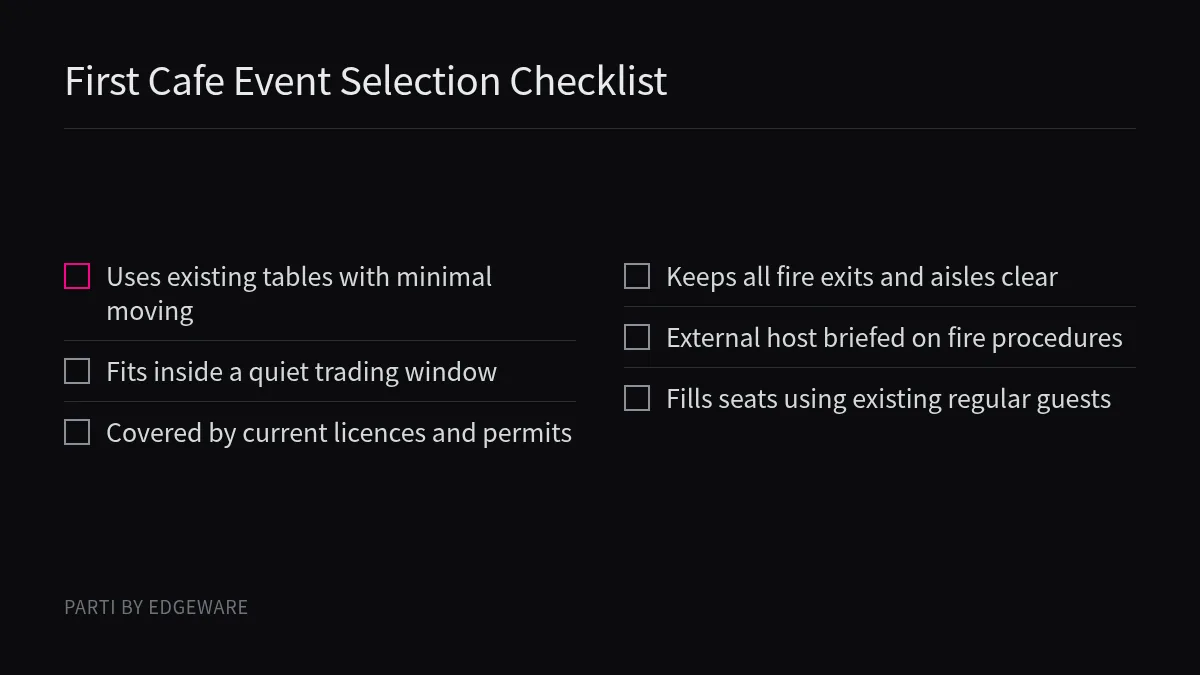
A six-point filter for your first booking
We do not know whether a creative workshop or an evening tasting will pay better in your neighbourhood, because that depends entirely on your regulars and your street. We do think every small operator should test their room with a low-setup event before buying extra chairs or filing permit paperwork. If you want to see how we are thinking about flexible room planning as we research our own space, visit our room concept page.
- Can your on-shift staff reset the room quickly? Pick a format that uses your existing tables first so your closing shift does not turn into a moving crew.
- Does it sit inside a dead trading window? Schedule the event right after you normally close or during your quietest afternoon block so it never cannibalises regular coffee sales.
- Does it avoid new licensing paperwork for test one? Run your first session during daytime or early evening hours without alcohol sales or late hot food past 11pm, so you can test the room flow before applying for a notice.
- Do all escape routes and exits stay completely clear? Check that extra coats, bags, display boards, or shifted chairs do not narrow the path to the door.
- Have you briefed any outside host on fire procedures? If a guest teacher or organiser is running the session, walk them through your fire safety procedures and escape routes before guests arrive.
- Can your existing regulars fill the first few seats? Start with a topic your daily customers already ask about at the counter rather than trying to recruit a brand-new audience from scratch.
Conclusion
Start with a format that leaves your tables in place and needs no licence. Once the reset feels easy, try rearranged workshops or licensed nights.
About Parti
Parti by Edgeware is Edgeware's first industry solution. We are designing a café where one room can serve several uses, reset by hand between them. We have not published how long a reset takes, because we have not tested it. That is a design aim, not a result. The first café is planned for Hangzhou and is not open. See the room and how the floor connects. This guide is for people who run a café, studio or event space. It is general information, not legal advice, and your own contract and local rules decide.
Sources
- GOV.UK: Fire safety risk assessment, small and medium places of assembly: Official fire risk assessment duties and capacity definitions for small and medium assembly premises in England.
- GOV.UK: Temporary Events Notice (England and Wales): Official rules, limits, fees, and notice periods for temporary licensable activities in England and Wales.