What does a fit-out quote often leave out?
Contractor quotes rarely include every project cost. Missing items bring surprise extras and late handovers. This guide shows what quotes leave out and how to check.
Published
A fit-out quote often leaves out landlord consents, statutory approvals, utility upgrades, waste removal, site welfare, out-of-hours labour, and end-of-lease reinstatement. It also hides real costs inside provisional sums and exclusions, making different contractor proposals hard to compare.
Once you know where gaps hide in a proposal, you can ask each bidder to price the same scope before you sign.
Which items are often missing from a quote?
Two quotes for the same space can show very different totals. One bidder leaves out site setup and utility work. We check the exclusions list first.
Quotes frequently omit utility upgrades, site welfare facilities, restricted access costs, out-of-hours working rates, and full design drawings. Contractors list these under exclusions or assumptions, shifting the cost and coordination risk back to you once work starts on site.
Site duties, utilities, and working hours
When you read a proposal, jump straight to the exclusions and assumptions page. A low total often means the contractor has priced only the visible joinery and finishes while leaving out the conditions needed to build them.
In Great Britain, under the Construction (Design and Management) Regulations 2015 (CDM 2015), a commercial client is any individual or organisation carrying out a construction project as part of a business. According to the HSE guidance for commercial clients1, client duties apply in full: you must make suitable arrangements for managing the project, appoint designers and contractors (including a principal designer and principal contractor where more than one contractor is involved), allow sufficient time and resources for each stage, provide pre-construction information to every designer and contractor bidding or appointed, and make sure suitable welfare facilities are provided for the duration of the construction work. You must also ensure the principal contractor or contractor prepares a construction phase plan before that phase begins, and that the principal designer prepares a health and safety file. If planned work lasts longer than 30 working days with more than 20 workers at any one time, or exceeds 500 individual worker days, the project is notifiable to HSE in writing and the notice must be displayed in the site office. If a quote excludes site welfare or pre-construction coordination, the bill still lands on your desk.
Mains services are another common gap. In England and Wales, the RICS Code for leasing business premises2 (1st edition, February 2020, effective 1 September 2020) notes that altering services such as electricity and gas can be expensive, so a tenant should always ensure the property has adequate mains services in good order, and check for restrictions on working hours or noise emissions. Other places have different rules, and your own contract and local authority decide what applies to your site.
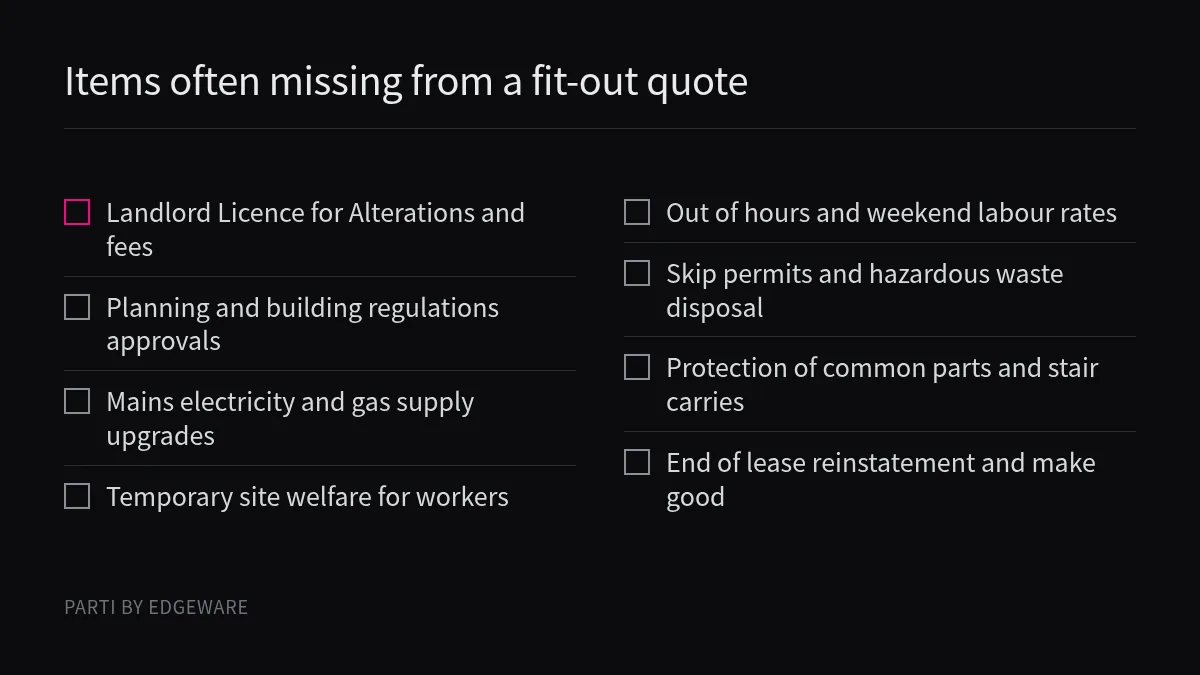
Check every quote for these often-omitted items: * Mains electricity and gas upgrades, plus meter connections. * Temporary site welfare facilities for the construction phase. * Out-of-hours or weekend labour required by building noise limits. * Loading bay restrictions, stair carries, and protection of common parts.
To line up proposals cleanly, see our guide on how to compare shop fit-out quotes.
What is a provisional sum?
A provisional sum looks like a firm price on the spreadsheet. It is only a stand-in figure, and the final invoice can jump once work begins.
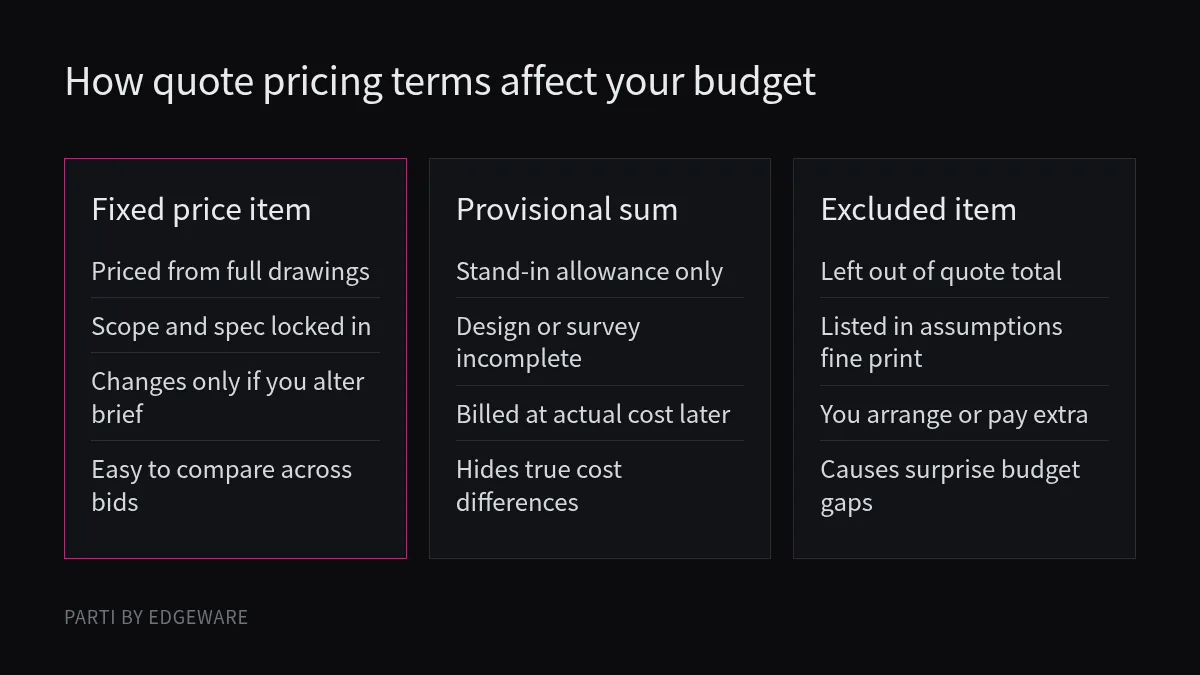
A provisional sum is an allowance a contractor puts into a quote when the design or site condition is not fixed enough to price firmly. You pay the actual cost once the work is specified, which may exceed the allowance.
Why contractors use allowances and how to close them
Contractors use provisional sums when you ask for a price before the drawings, material choices, or site surveys are complete. Rather than guessing high and losing the job, a bidder puts in a round number so the total adds up. Another bidder might put in half that allowance for the exact same line item, making their bottom line look cheaper without saving you a penny when the final account arrives.
We cannot know from a quote alone whether a provisional sum is generous or far too low unless we see the specification behind it. The only reliable fix is to turn provisional sums into fixed prices before signing the contract, or at least force every bidder to carry the exact same allowance.
| Quote term | What it means on your invoice | How to handle it before signing |
|---|---|---|
| Fixed price item | Priced against a drawing and specification; changes only if you alter the brief. | Check that the specification matches what you want built. |
| Provisional sum | An unconfirmed allowance for work not yet fully designed or surveyed. | Complete the survey or design now, or set an identical allowance across all bids. |
| Client supply | You buy and deliver the item; the contractor may or may not install it. | Confirm in writing who unloads, stores, insures, and installs the item. |
| Excluded item | Not in the contract price at all; you arrange or pay for it separately. | Ask the contractor to price it as an option so you see the true budget. |
When an allowance cannot be closed before work starts, agree in advance how the contractor will show you open-book supplier quotes and what margin applies. You can read more in our guide on how to keep fit-out changes honest.
What about consents, make good and waste?
Building work sits inside a lease and local rules. Contractors rarely price landlord approvals, waste permits, or end-of-lease strip-out unless you ask them to.
Quotes usually exclude landlord licence fees, planning and building control applications, and end-of-lease reinstatement. They may also limit waste removal to standard builders' rubble, leaving you to pay extra if hazardous materials like asbestos are found or skips need permits.
Landlord licences, statutory checks, and reinstatement
In England and Wales, as explained in Russell-Cooke's guide to a licence for alterations3, a commercial tenant usually needs the landlord's written permission before carrying out works. A Licence for Alterations is a supplemental legal document recording that consent. Even minor non-structural fit-out works (transforming a shell into a functional space with fixtures, branding, signage, and electrical wiring) typically require compliance with licence obligations covering consents, quality standards, timeframes, and reinstatement. Ahead of consent, the tenant must produce full plans, drawings, and specifications for the landlord's approval, and the landlord may need to notify its building insurers. Major structural works may also require planning permissions and considerations under the Building Safety Act 2022 for mixed-use buildings. Regulatory checks around alterations include the impact on the Energy Performance Certificate rating, fire precautions under the Regulatory Reform (Fire Safety) Order 2005, and whether materials contain or risk disturbing asbestos.
The RICS Code (section 8.2) states that where a landlord intends to prohibit certain alterations or require a licence before they take place, the tenant should be notified at the outset to obtain early professional advice. If you need planning permission for a proposed use, the RICS Code notes you should allow at least eight to ten weeks (sometimes longer) for the application to be processed, and check compliance with the Equality Act 2010, Health and Safety Acts, Environmental Protection Acts, and fire and access rules. Under section 7.2, if repairing obligations are limited to the initial condition, a schedule of condition is normally required and the parties should agree who pays for it.
At the end of the lease, landlords usually require you to reinstate the property and make good any damage. A fit-out quote prices putting walls and counters in, not taking them out years later, yet the way fixtures are built affects future strip-out and waste costs.
How do you ask for the missing items?
Spotting gaps in a quote is only half the job. You need a calm, written way to get every contractor pricing the same list.
Send every bidder an identical schedule of clarifications before you pick a winner. Ask them to price excluded items as line-by-line add-ons, replace provisional sums with fixed specifications, and confirm in writing who handles welfare, waste, utilities, and approvals.
Turning exclusions into a like-for-like sheet
Do not try to resolve missing items over the phone. Put your questions into a shared table so each contractor replies against the same headings, and attach any pre-construction information you hold about the building, its mains services, and the landlord's rules. When you plan how the layout and services fit together, looking at how our space planning ideas organise zones can also help you brief contractors clearly before they price.
Use these questions to flush out hidden extras before you sign: * Which items in our brief are currently priced as provisional sums, and what drawings or site checks do you need from us today to make them fixed prices? * Have you included temporary site welfare, protection of common areas, and all waste removal and skip permits in the main total? * What working hours have you assumed, and what is the extra cost if the landlord or council restricts noisy work to outside normal hours? * Who is producing the full plans, specifications, and post-completion certificates required for the landlord's Licence for Alterations and building regulations? * Does the electrical and plumbing price include connecting to the existing mains meters, or have you assumed the incoming supply is already upgraded?
Once the replies come back, update your comparison sheet so every column covers the same scope. For more interview prompts before you appoint a builder, read what you should ask a shopfitter before you sign.
Conclusion
Read the exclusions before the total. Ask every bidder to price the same missing items in writing before you sign the fit-out contract.
About Parti
Parti by Edgeware is Edgeware's first industry solution. We are designing a café where one room can change how it is used by changing the props, with no rebuild of the room. Counters, tables and displays are meant to be carried in and out again by hand, so less is built into the walls and floor and less is left to take down when a lease ends. That is a design aim, not a tested result. The first café is planned for Hangzhou and is not open. See the room and how the floor connects. This guide is for people about to commission a fit-out. It is general information, not legal advice, and your own contract and local rules decide.
Sources
- HSE: Commercial clients, roles and responsibilities (CDM 2015): Explains commercial client duties for project management, pre-construction information, and site welfare in Great Britain.
- RICS: Code for leasing business premises, England and Wales (2020): Sets out standards on alterations, landlord consent, planning timeframes, and checking mains services.
- Russell-Cooke: Understanding a licence for alterations: Details landlord consent, plans, safety regulations, timeframes, and reinstatement obligations in England and Wales.