What should you ask a shopfitter before you sign?
Shopfitters rarely format their quotes the same way. Vague paperwork breeds surprise extras and late handovers. These questions help you compare bids fairly before signing.
Published
Before signing with a shopfitter, ask for a line-by-line scope, a dated programme, a clear split on landlord and council approvals, a written rule for pricing changes, proof of insurance, and a commitment on post-handover defects and safety files.
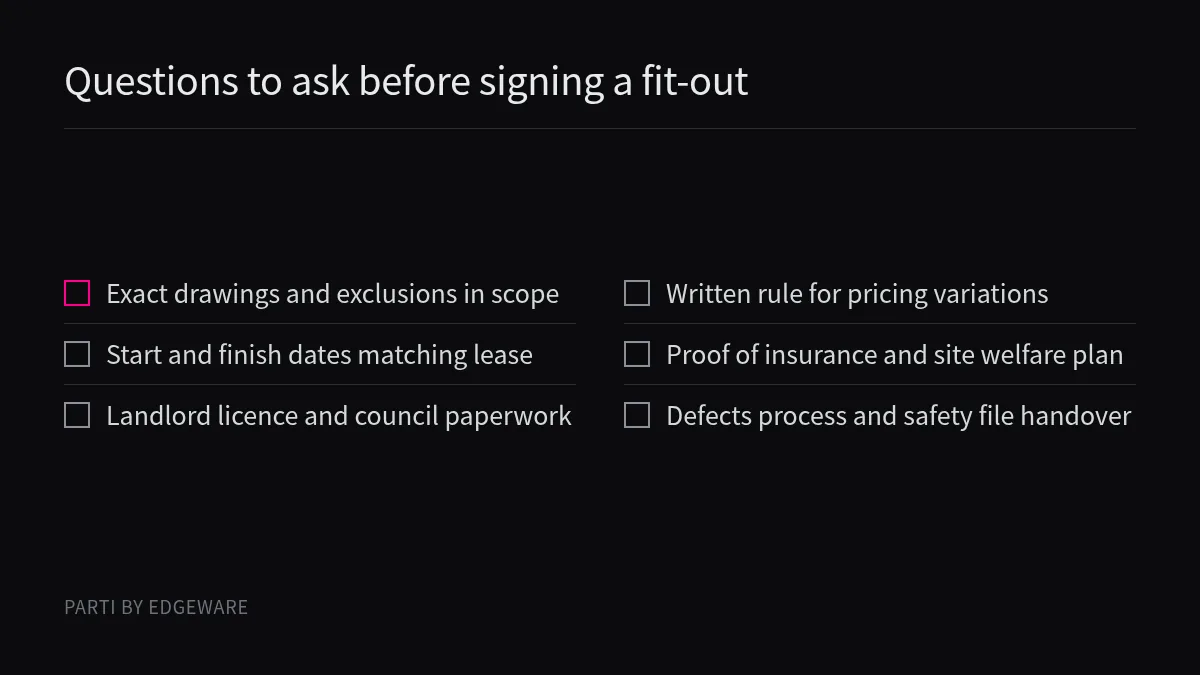
Asking the right questions early saves you from awkward disputes once the walls are open. We group the conversation into four areas so you can put every contractor on the same footing.
What should the scope and programme say?
Two quotes with the same bottom line can hide very different allowances. Missing items and loose dates turn into delays the week you start.
Ask the shopfitter to list every drawing, specification, and exclusion in the scope, confirm site welfare and safety plans, and give a programme with start and completion dates that match the timeframes in your lease and landlord consent.
When you lay two bids side by side, the totals tell you very little until you check what each contractor actually priced. We cover the line-by-line review in our guide on how to compare shop fit-out quotes, and you can also check what a fit-out quote often leaves out. In your meeting with the shopfitter, push for specifics on both the physical work and the site management.
In Great Britain, under the Construction (Design and Management) Regulations 2015 (CDM 2015), a commercial client is any individual or organisation carrying out a construction project as part of a business. According to the HSE guidance for commercial clients1, commercial clients must appoint designers and contractors while making sure they have the skills, knowledge, experience, and organisational capability for the work. If the project involves more than one contractor, you must appoint a principal designer and a principal contractor in writing. You also have to allow sufficient time and resources for each stage, provide pre-construction information to every designer and contractor bidding or appointed, make sure suitable welfare facilities are provided for the duration of the construction work, and ensure the principal contractor or single contractor prepares a construction phase plan before that phase begins. Where planned work lasts longer than 30 working days and involves more than 20 workers at any one time, or exceeds 500 individual worker days, the project is notifiable to HSE in writing and a copy must be displayed in the site office.
Questions to pin down scope and competence
* Drawings and specifications: Which exact drawing revisions and material schedules is this price based on, and what have you excluded? * Skills and capability: Can you show your team's skills, knowledge, experience, and organisational capability for a job of this type, and who will run the site day to day? * Welfare and safety plan: How will site welfare facilities be set up from day one, and when will we see the construction phase plan before work starts? * Programme milestones: How do your start date, critical trade handovers, and completion date fit within our landlord's deadlines? * Insurance cover: What insurance policies do you carry for the works and public liability, and can we see the certificates before we sign?
Who handles landlord paperwork and inspections?
Waiting for building approval while paying rent hurts. If neither you nor your contractor owns the paperwork, your site sits locked and idle.
Ask the shopfitter which drawings, specifications, and risk inputs they will supply for your landlord's licence for alterations, who checks council approvals for the planned use, and how their schedule fits the start and completion deadlines in that consent.
Most commercial tenants cannot simply walk in and start knocking down partitions or wiring up equipment. In England and Wales, as explained in Russell-Cooke's guide to a licence for alterations2, a tenant with a commercial lease usually needs the landlord's written permission before carrying out works, documented in a Licence for Alterations supplemental to the lease. Even minor non-structural fit-out works (transforming a shell unit by installing fixtures, branding, signage, and electrical wiring) commonly require this licence to cover consents, quality standards, timeframes, and reinstatement. Ahead of consent, the tenant must produce full plans, drawings, and specifications for the landlord's approval, and the landlord may need to notify its building insurers. The contractor or surveyor also needs to give input on regulatory risks: whether the works affect the Energy Performance Certificate rating, whether fire precautions under the Regulatory Reform (Fire Safety) Order 2005 are implemented, and whether materials contain asbestos or risk disturbing existing asbestos. The licence typically sets a deadline to start works (after which consent ceases unless extended) and a deadline for completion.
In Queensland, Australia, the Queensland Small Business Commissioner's commercial lease tips3 note that every council has different planning laws and every building has specific permitted uses for that address; a tenant is usually responsible for having council approval for relevant activities (such as permitted use, onsite or outside dining, grease traps, and parking) before operating. Other places have different rules, and your own contract and local authority decide what applies to your site.
Splitting the approval tasks clearly
| Task or requirement | Question for your shopfitter | Why it matters before signing |
|---|---|---|
| Full plans and specifications | Are the drawings needed for the landlord's licence included in your fee? | Approved plans get annexed to the licence before you can start. |
| Fire, asbestos, and energy checks | Will you give written input on asbestos, fire precautions, and energy ratings? | Landlords and insurers ask for these details before signing off. |
| Local council approvals | Which trade drawings do you provide for our council and grease trap applications? | Prevents a gap where the designer and builder both assume the other did it. |
| Licence deadlines | Can you meet the start and completion deadlines written into the landlord's consent? | Missing the start window can cause the landlord's consent to lapse. |
How are changes priced and approved?
Every fit-out uncovers something behind a wall or ceiling. Without a written rule for variations, a minor tweak turns into an argument over money.
Ask the shopfitter for a written variation process before you sign: nobody starts extra work without a written instruction, every change shows a breakdown of labour, materials, and time impact, and you both know who can sign it off.
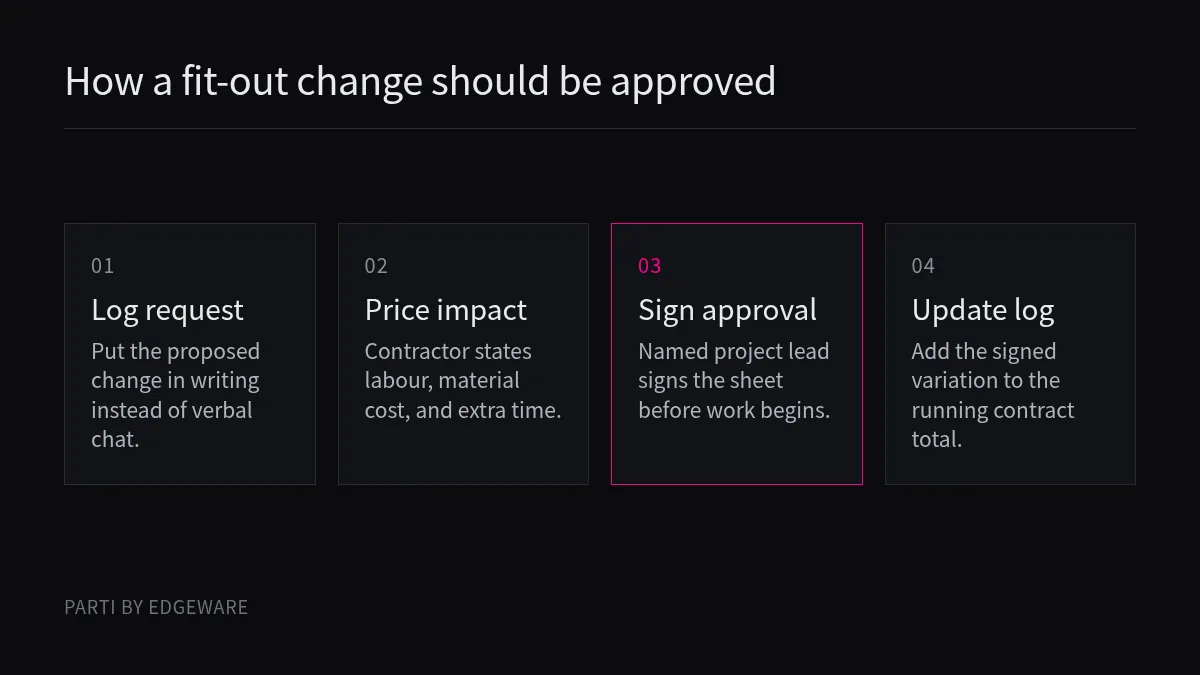
Almost every commercial project changes between signing the contract and opening the doors. Maybe a supplier discontinues a tile, or you open a service riser and find pipes in the wrong place, or you rethink a counter layout while browsing ideas for your space planning. Changes themselves do not ruin budgets; unpriced verbal instructions on site do. For a closer look at managing this once builders are on the floor, read our guide on how to keep fit-out changes honest.
Before you sign the main contract, ask the shopfitter to walk you through how they handle a change from the moment someone spots an issue to the moment it hits the invoice. Honest contractors welcome this question because they do not want unpaid extras at the end of the job any more than you want surprise bills.
Four rules to agree before day one
- Written instructions only: Agree that site conversations are not instructions. Ask what form or email format the contractor uses to log a variation request.
- Pricing before execution: Ask whether they commit to giving you a fixed price (or a clear daywork rate and material margin) before the tool touches the wall, except in genuine safety emergencies.
- Programme impact stated upfront: A change that costs very little in materials can still hold up a handover if it delays an inspection or has a long lead time. Ask them to state any time extension on the same sheet as the cost.
- Named decision makers: Clarify who on your side has authority to sign a variation, and who on their side issues it. If your site supervisor asks a carpenter to move a socket, does that count, or must it go through the project manager?
If a contractor brushes this off and says they just sort things out at the final account, treat that as a warning sign. Sorting things out at the end removes all your bargaining power and leaves you guessing what the project actually costs while it is running.
What happens after handover?
Handing over the keys is not the end of the job. Snags appear once staff start working, and your lease carries long-term obligations.
Ask how defects are reported and fixed after handover, what warranties and safety files you will receive at completion, and how the finished works affect your lease duties on maintenance, condition reports, and end-of-lease make good.
When the dust settles and you plug in your equipment, small faults show up: a door catches, a drain runs slow, or a circuit trips. You also have paperwork duties to your landlord and under safety rules that cannot wait until you close the business years later.
In Great Britain, under CDM 2015, a commercial client must ensure that the principal designer prepares a health and safety file for the project, and that it is revised as necessary and made available to anyone who needs it for subsequent work at the site. In England and Wales, once works under a Licence for Alterations are completed, a tenant may be obliged to notify the landlord and provide necessary compliance documents; the lease and licence also govern reinstatement obligations to reinstate the property and make good damage at the end of the lease term. In Queensland, the Small Business Commissioner advises checking before entering a lease whether all existing structures, fixtures, and plant and equipment are in good working order, who must repair or maintain them, and whether the tenant must make good the premises at the end of the lease (backed by a condition report including photos signed by both lessor and tenant). The Commissioner also highlights diarising scheduled maintenance, such as for air conditioners and grease traps.
Handover and aftercare checklist to ask your builder
* Snagging and defects window: How do we log defects after completion, who is our contact once the site team leaves, and how quickly do you return to fix urgent issues versus minor cosmetic snags? * Health and safety file and certificates: When will the health and safety file, electrical and fire certificates, and as-built drawings be handed over so we can satisfy the landlord's licence conditions? * Plant and equipment manuals: Will you give us the maintenance schedules for new air conditioning, extraction, or grease traps so we can diarise servicing as required by our lease? * Condition photos and make-good notes: Can your team help us record the pre-start condition and document exactly what was installed, so there is no confusion over what belongs to the landlord and what we must reinstate at lease end?
Conclusion
Put these questions to every shortlisted shopfitter in writing. Comparing their answers side by side matters just as much as comparing their prices.
About Parti
Parti by Edgeware is Edgeware's first industry solution. We are designing a café where one room can change how it is used by changing the props, with no rebuild of the room. Counters, tables and displays are meant to be carried in and out again by hand, so less is built into the walls and floor and less is left to take down when a lease ends. That is a design aim, not a tested result. The first café is planned for Hangzhou and is not open. See the room and how the floor connects. This guide is for people about to commission a fit-out. It is general information, not legal advice, and your own contract and local rules decide.
Sources
- HSE: Commercial clients, roles and responsibilities (CDM 2015): Official Great Britain guidance on commercial client duties, contractor competence, welfare, and health and safety files.
- Russell-Cooke: Understanding a licence for alterations: Legal overview for England and Wales covering landlord consent, plans, regulatory compliance, timeframes, and reinstatement.
- Queensland Small Business Commissioner: Tips when entering a commercial lease: Practical checklist for Queensland tenants on council approvals, condition reports, maintenance, and make-good duties.