Can you take shop fittings with you when you move?
Paying for a shop fit-out hurts when you have to abandon it at the end of a lease. Planning ahead lets you keep what you bought.
Published
Whether you can take shop fittings when you move depends on your lease, your licence for alterations, and whether each item can be removed without wrecking the building. Free-standing furniture usually leaves with you, while fixed works follow reinstatement rules.
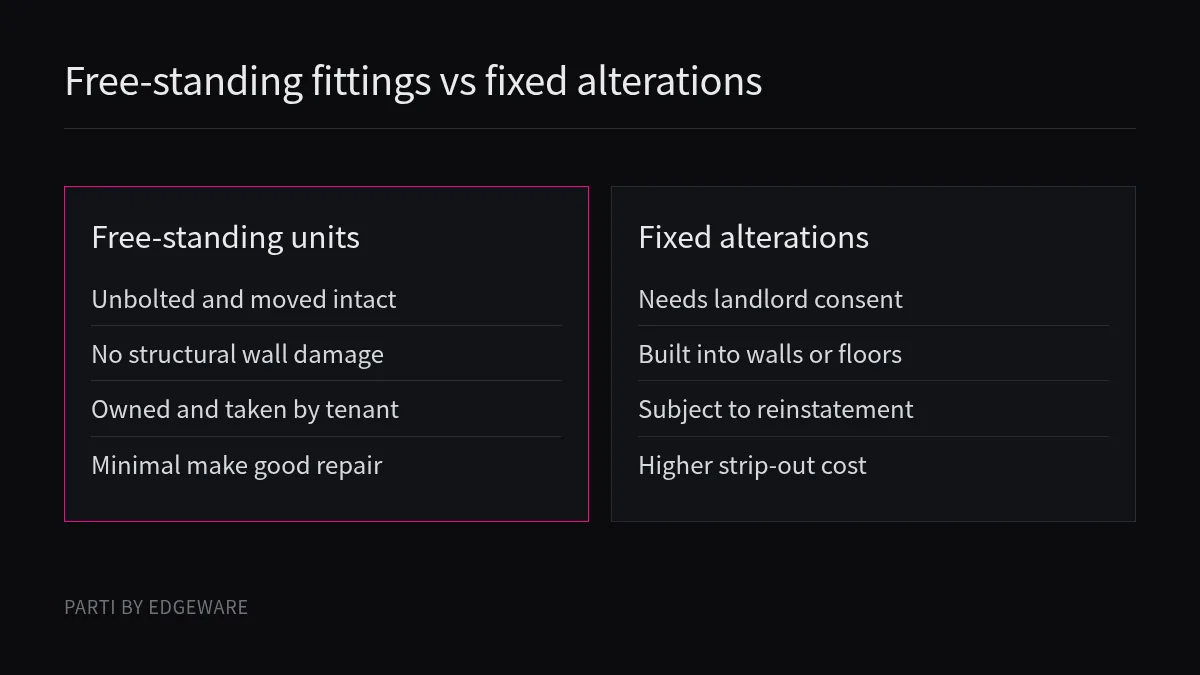
Before you unscrew a counter or hire a van, check both the legal paperwork for the tenancy and the physical joints holding your pieces together.
What counts as yours and what counts as the landlord's?
Tenants often assume everything they paid for belongs to them. Lease terms and alteration licences frequently say otherwise at handback, catching owners by surprise.
What belongs to you versus the landlord is set by your lease and any licence for alterations. Many leases require tenants to remove their installed fixtures and partitions at the end, though a landlord may want structural works to remain.
In Queensland, Australia, the Queensland Small Business Commissioner's make good guidance1 explains that a make good clause sets out the tenant's obligation to return the premises to its original condition or the condition specified in the lease. Under Section 3 of Schedule 1 of Queensland's Property Law Act 2023, a standard term requires the tenant to return the premises in the same or better condition as at the start, excluding reasonable wear and tear and specified disasters, though Section 139 lets the parties agree to exclude those standard terms and set their own make good conditions. Common make good terms in Queensland include removing all tenant-installed fixtures, partitions, joinery, installations, flooring, and ceiling finishes, restoring an open floor plan, and returning air conditioning, fire, and hydraulic systems to their original state. The Commissioner also warns that disputes often break out when one party removes something of value that was added by the other party, or when there is little evidence of the premises' condition at the start of the lease, which almost always affects the return of the lease bond.
In England and Wales, rules around alterations and handback are documented differently. According to Russell-Cooke's guide to a licence for alterations2, tenants usually need the landlord's written permission before carrying out changes, recorded in a supplemental legal document called a Licence for Alterations. Minor non-structural works, often called fit-out works, include installing fixtures, branding, signage, and electrical wiring, whereas major works involve structural changes such as removing or replacing walls, doors, or staircases. The landlord will usually seek an obligation for the tenant to reinstate the property and make good any damage at the end of the term, though for structural works a landlord may prefer for the alterations to stay. Both the lease and the Licence for Alterations must be checked so their reinstatement clauses do not contradict each other.
Also in England and Wales, the RICS Code for leasing business premises3 notes that if a tenant's repairing obligations are limited to the initial condition of the premises, a schedule of condition will normally be required. Other places have different rules, and your own contract and local authority decide what applies to your shop, so get legal advice before removing fixed items.
Questions to check before touching fixed joinery
| Item or work | Where to check the rule | Typical end-of-lease position |
|---|---|---|
| Loose tables, chairs, plug-in racks | Purchase receipts and initial condition report | Removed by the tenant before handover |
| Tenant-installed joinery and partitions | Lease make good clause and Licence for Alterations | Often removed by tenant and damage repaired, unless agreed otherwise |
| Items present when you moved in | Initial schedule of condition or condition report | Left in place as part of the premises |
| Major structural changes (walls, doors) | Licence for Alterations and lease reinstatement terms | Reinstated by tenant, or kept in place if the landlord prefers |
How do you design fittings so they can be removed?
Custom built-ins shaped to one awkward wall rarely survive a move. Paying joiners to scribe panels into plaster means paying twice when you leave.
Design fittings as free-standing, modular pieces instead of built-in joinery. Keep units small enough to pass through standard doorways and lifts, use reversible mechanical fixings instead of glue, and avoid cutting into the building's base walls, floors, or services.
When you fit out a shell in England and Wales, the RICS leasing code points out that leases of a unit in a multi-let building often prohibit structural and external alterations while allowing internal non-structural alterations with landlord consent. In a lease of an entire building, a landlord should not normally prohibit or require consent for internal non-structural alterations that do not harm the character, value, structural stability, statutory compliance, or energy efficiency performance of the building, provided the tenant carries out the work without damage and gives written details. Designing your shop around free-standing units keeps more of your spend away from the building structure and reduces the repair work needed when you leave.
In our view, the hardest part of designing for removal is accepting visible gaps between a cabinet and an uneven wall instead of scribing timber and mastic into the plaster. Once a counter is glued to the masonry or wired directly into concealed wall chases, taking it out becomes a demolition job. If you are pricing up systems that unbolt and reassemble, see our guide on what to check before buying modular shop fittings. We also think about clean disconnection in our own research on how Parti approaches floor and room connections.
Design choices that survive a move
- Choose free-standing counters, shelving bays, and display tables over built-in joinery fixed into structural walls.
- Use mechanical fasteners such as bolts, machine screws, and brackets that can be undone with hand tools, and avoid construction adhesives.
- Size every module so it fits through the narrowest doorway, corridor turn, stairwell, or goods lift on both your old and new sites.
- Protect edges and corners with durable finishes, since corners take the brunt of trolley loading and van transit.
- Keep electrical and plumbing connections accessible so qualified tradespeople can disconnect appliances and lighting without opening up walls.
- File the assembly drawings, part lists, and alteration plans annexed to your licence so the next team knows how each piece comes apart.
How do you move and refit them?
Taking a shop apart in a rush breaks panels and loses brackets. Without a clear sequence, you risk missing lease deadlines and forfeiting your deposit.
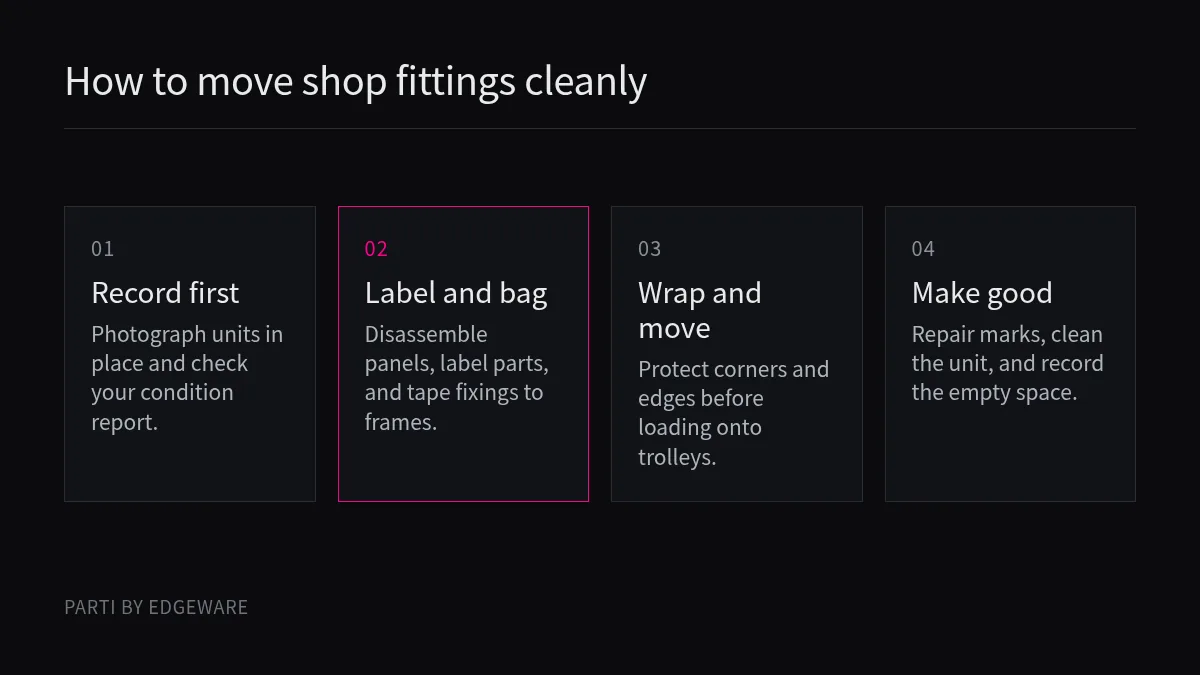
Photograph every unit in place before disassembly, label each panel, and bag fixings with their matching piece. Protect corners for transport, repair any wall or floor marks to match your condition report, and check compliance before refitting at the new site.
In Queensland, the Small Business Commissioner notes that not completing make good obligations on time may lead to additional rent or penalties. Tenants there generally have two ways to meet their make good obligations if outlined in the lease: physically carrying out or managing the works (often required to be done to a professional standard), or negotiating a cash settlement with the lessor instead of doing the physical work. Preparing a condition report early and talking to the lessor to clarify what they want done can prevent a fight over the security deposit.
On the new site, refitting fixed items means checking the rules before your builders start. In England and Wales, Russell-Cooke notes that before consent is granted under a Licence for Alterations, the tenant produces full plans, drawings, and specifications for the landlord's approval, and the landlord may need to notify its building insurers. The licence usually sets a timeframe to start the works and a deadline to complete them, and requires compliance with rules such as the Regulatory Reform (Fire Safety) Order 2005, checking the impact on the Energy Performance Certificate rating, and checking whether work disturbs existing asbestos. The RICS code also notes that altering mains services such as electricity and gas can be expensive, and that if planning permission is needed for a proposed use in England and Wales, a tenant should allow at least eight to ten weeks (and sometimes longer) for the application to be processed. For a wider timeline covering notices, utilities, and handover, read our checklist for moving a shop.
Step-by-step dismantling and refit sequence
- Photograph the whole shop and each unit in place before a single tool comes out, and compare the space against your entry schedule of condition.
- Disassemble units in reverse build order, label every panel on a hidden face, and tape bagged screws, pins, and brackets directly to the frame they came from.
- Wrap vulnerable surfaces and corners, and use enough people and lifting gear to move heavy counters without twisting the frames.
- Patch, clean, and restore the vacated unit so it matches the condition required by your lease, then photograph the empty room from the same angles as your entry report.
Where do used fittings come from?
Moving to a larger floor plan or a different layout leaves gaps your old kit cannot fill. Buying every additional display brand new stretches the budget.
Used shop fittings come from your own earlier sites, outgoing tenants negotiating a lease handover, shop clearance sales, and second-hand commercial equipment dealers. Always confirm that an outgoing tenant actually has the landlord's permission to sell or leave fixed items.
One source of second-hand joinery and shelving is the unit you are moving into, or another shop closing down nearby. As the Queensland Small Business Commissioner points out, while lessors often seek neutral spaces to appeal to future tenants, tenants value their investments in premises upgrades and see ripping out a working fit-out as counterproductive. Similarly, in England and Wales, Russell-Cooke observes that for some alterations, a landlord may actually prefer for the works to remain at the end of the term. Because physically stripping out partitions and joinery costs money and time, an outgoing tenant and a landlord may be open to leaving usable pieces in place if the incoming tenant wants them and all parties record the agreement in writing.
Be careful before paying an outgoing tenant for fixtures still attached to the walls. The Queensland Commissioner specifically lists the removal of something of value added by the other party as a common trigger for lease disputes. Until you check the lease and the landlord's written position, you do not know whether that counter or lighting rig belongs to the departing tenant or has already become part of the landlord's property. The RICS code also warns that leases normally require tenants to comply with all legislation at their own cost, including health and safety, fire regulations, and disability access rules. When you buy used counters, shelving, or electrical display cases from clearance auctions or other shops, check that the materials and wiring meet current safety rules in your area and that you have a clear paper trail showing who owns them and who has to remove them at the end of your new lease. If you have surplus units from your old shop that will not fit the new layout, see our guide on whether to sell or reuse old shop fittings.
What to verify before taking on second-hand fittings
- Proof of ownership: check with the landlord in writing if you are buying or taking over items left behind in a rented unit.
- Future make good liability: confirm whether adopting an earlier tenant's partitions or joinery makes you responsible for removing them when your own lease ends.
- Physical condition and parts: check that modular frames are straight, all brackets and pins are present, and the supplier still makes replacement parts.
- Safety and compliance: have a qualified professional check any second-hand electrical wiring, lighting built into cabinets, and fire safety implications before installation.
Conclusion
Check your lease and alteration licence before you build or strip out, and favour free-standing modules so your investment moves when you do.
About Parti
Parti by Edgeware is Edgeware's first industry solution. We are designing a café where one room can change how it is used by changing the props, with no rebuild of the room. Counters, tables and displays are meant to be carried in and out again by hand, so less is built into the walls and floor and less is left to take down when a lease ends. That is a design aim, not a tested result. The first café is planned for Hangzhou and is not open. See the room and how the floor connects. This guide is for tenants planning a move or a second site. It is general information, not legal advice, and your own contract and local rules decide.
Sources
- Queensland Small Business Commissioner: Make good: Explains commercial lease make good clauses, standard terms, typical removal items, and bond disputes in Queensland.
- Russell-Cooke: Understanding a licence for alterations: Covers when landlord consent is needed for fit-out works and how reinstatement obligations work in England and Wales.
- RICS: Code for leasing business premises, England and Wales (2020): Sets out professional standards on schedules of condition, non-structural alterations, compliance, and landlord consent.