Should you sell or reuse old shop fittings?
Shop moves often turn expensive joinery and shelving into scrap overnight. Losing your fit-out money hurts your next budget. This guide shows what to keep, sell, or leave behind.
Published
You should reuse freestanding, undamaged shop fittings that fit your next layout and electrical supply. Sell or give away surplus items early so buyers collect them before your lease ends, and always check your lease before removing anything fixed to the building.
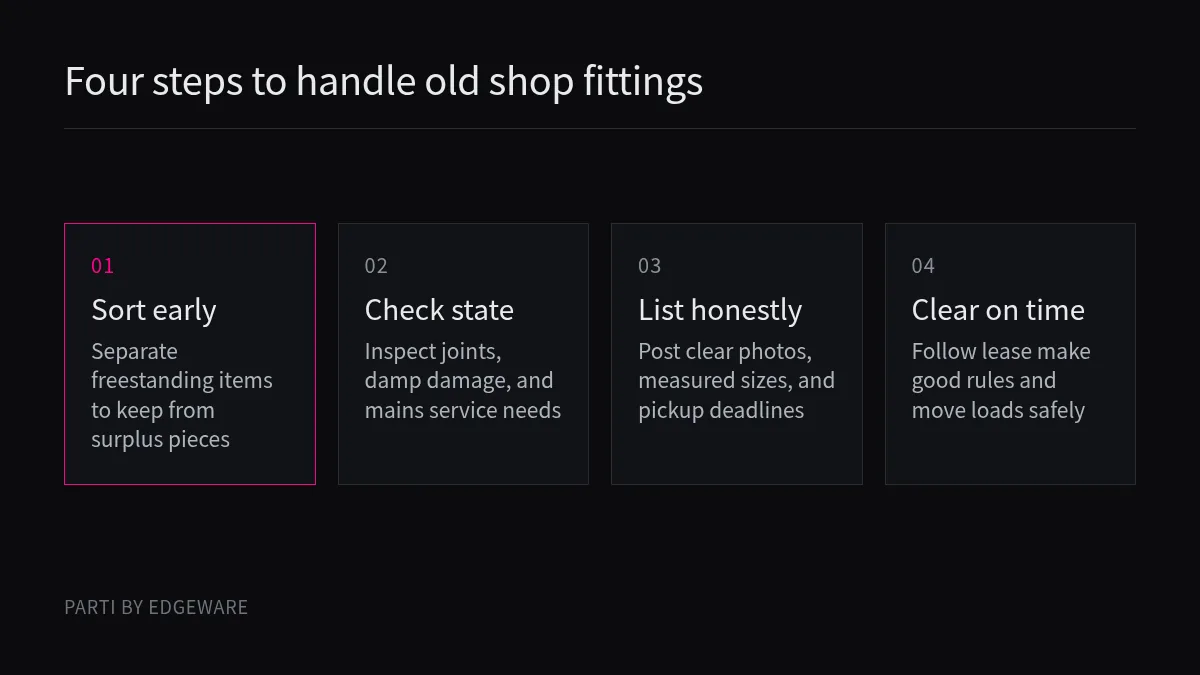
Sorting out your shop floor before the handover date saves storage fees and last-minute demolition bills. We start by separating what earns its keep at the next site from what needs a new owner right away.
Should you keep, sell or give away old fittings?
Every piece left in an empty shop costs time or money to shift. Sort your inventory into three piles early.
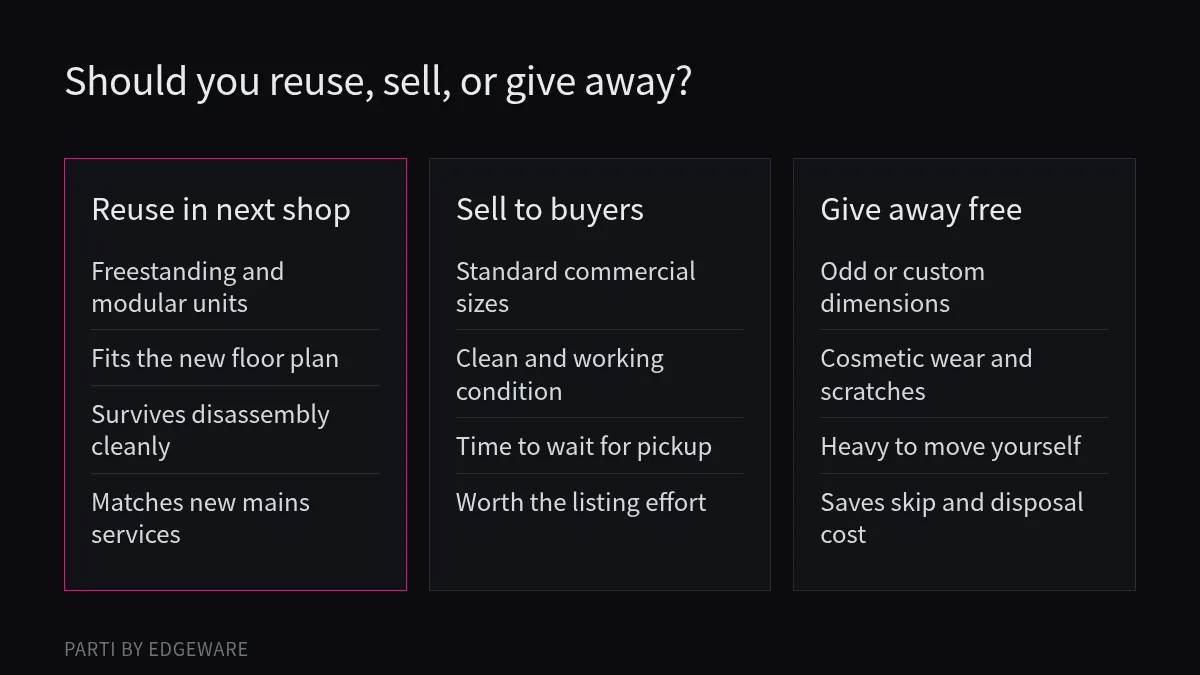
Keep freestanding fittings that match your next floor plan and survive disassembly. Sell clean, standard-sized counters and shelving if you have time to wait for buyers. Give away bulky or worn pieces so someone else takes them off your hands for free.
When you plan a move or open a second site, the urge to hoard every shelf and counter is strong because you remember what the original builder charged for them. The hard truth is that custom joinery built around a specific pillar or alcove rarely fits a second building without heavy carpentry. Before you hire a van, measure the new premises and look at our guide on whether you can take your shop fittings with you so you only pack items that are legally yours and physically worth shifting.
Comparing your three options
| Action | Best for which items | Main trade-off |
|---|---|---|
| Reuse in next shop | Freestanding counters, modular shelving, standard lighting tracks | You pay for removal, transport, and storage between leases |
| Sell to another business | Clean commercial sinks, standard display tables, undamaged racks | Takes staff time to photograph, measure, answer messages, and wait for pickup |
| Give away for collection | Odd-sized joinery, heavy tables with cosmetic wear, spare timber | Brings in no cash, though it saves skip hire and disposal labour |
We do not know what local second-hand buyers in your town will pay on any given week, and counting on resale cash to fund your new shop is risky. Treat any money from selling old fixtures as a bonus, not a budget line. Often the real saving comes from another café or retailer turning up with their own vehicle and lifting a heavy counter out of your way before the landlord inspects the room. If you are rethinking how your next space comes together, you can also look at how we approach our planned room concept while we test layouts that avoid fixed waste.
What condition checks matter?
Moving broken or warped fixtures means paying twice: once to haul them and once to dump them at the new site. Check every item under bright light before unbolting it.
Check structural joints, moisture damage around sinks and floors, levelling feet, and whether panels survive coming apart. For wired or plumbed items, have a qualified technician check the connections and verify that your next building has the right mains supply.
A counter that looks solid while bolted to a brick wall can twist or crumble the moment the fixings come out. Start at floor level, where mop water, coffee spills, and leaking pipes soak into particleboard and timber legs. If kickboards or base panels are swollen or flaking, the cabinet will rarely survive being lifted onto a trolley and strapped into a truck.
Physical and services checklist
* Fasteners and joints: Look at how the unit was built. Items held together with glue, nails, or buried screws often split during removal, while bolted frames or knock-down fittings come apart cleanly. * Hidden surfaces: Pull out drawers and look behind back panels for damp, mould, or pest damage that would stop you putting the unit into a clean food or retail area. * Levelling and castors: Check that adjustable feet still turn and castors roll without binding. Old shop floors are rarely flat, and seized feet make reinstallation frustrating. * Mains services at the new site: In England and Wales, the RICS Code for leasing business premises1 notes that altering services such as electricity and gas can be expensive, and advises tenants to ensure the property has adequate mains services in good order.
That point about building services catches many operators out. A heavy espresso bench, chilled display case, or heated cabinet is only worth keeping or buying if the next shop has the electrical phase, water pressure, drainage fall, or extraction route it needs. Other places have different rules, and your own contract and local authority decide what approvals and compliance checks apply when you install equipment in a new unit. If you are replacing worn pieces, read what to check before buying modular shop fittings so the next set handles future moves better.
How do you list and move them?
Vague listings attract time-wasters who arrive with a small car for a massive counter. Unplanned lifting hurts staff and damages walls. Write honest listings and plan the physical move carefully.
List items with clear photos of any scratches, exact overall dimensions you measured yourself, and your collection deadline. When dismantling and moving heavy counters, assess manual handling risks, use trolleys for pushing and pulling, and book loading access early.
When you list surplus tables, racks, or benches for sale or free pickup, your goal is a single smooth collection, not endless back-and-forth messages. Buyer no-shows happen when people guess the size from a wide-angle photo and realise on arrival that the unit will not fit through their doorway.
Writing an honest listing that clears the room
* Measure the real footprint: Use a tape measure to record total length, depth, and height, including protruding handles, taps, or sign brackets. State whether the piece comes apart or travels in one lump. * Photograph the flaws: Show water marks, missing shelves, chipped laminate, and raw edges where a counter met a wall. Honest photos stop buyers arguing on collection day when you are busy packing. * Set clear pickup rules: State the exact dates and hours buyers can collect, whether the item is already disconnected, which floor it is on, and that the buyer must bring their own lifting help and vehicle.
Whether your team is shifting fixtures to your new shop or moving them to the door for a buyer, protect people's backs and the landlord's corridors. In Great Britain, the Health and Safety Executive's brief guide to manual handling at work2 explains that employers must carry out duties under the Manual Handling Operations Regulations 1992 to reduce the risk of injury, using risk assessments for lifting, lowering, carrying, pushing, and pulling. Break large joinery down into lighter components before lifting, remove glass shelves and doors first, and use skates or sack trucks instead of carrying awkward loads down steps. Put the removal dates into your wider checklist for moving a shop so disconnection, buyer pickup, and final cleaning happen in a calm order.
What do you do if the lease says to remove them?
Ripping out joinery without reading your lease can cost you your deposit. Leaving fixtures behind can bring penalties. Check your make good clause first.
Read your lease's make good clause and check the initial condition report before removing or leaving any fittings. Talk to your landlord early: they may agree to keep useful installations or settle in cash instead of requiring full strip-out and repair.
At the end of a tenancy, your personal plans for reusing or abandoning old shop fittings meet the legal reality of handing back the building. What you see as a helpful counter left for the next tenant, a landlord may see as rubbish blocking an empty shell. Conversely, removing something fixed to the building without checking the contract can also cause trouble.
Understanding make good and reinstatement
In Queensland, Australia, the Queensland Small Business Commissioner's make good factsheet3 explains how these end-of-lease obligations work in practice:
* Standard vs agreed terms: Under Schedule 1 Section 3 of Queensland's Property Law Act 2023, a tenant is required at the end of a commercial lease to return the premises in the same or better condition as at the start, excluding reasonable wear and tear and certain insured disasters. However, Section 139 allows the lessor and tenant to exclude those standard terms and agree on specific make good conditions in the lease. * Refurbishment limits: Under Section 50B of Queensland's Retail Shop Leases Act 1994, a clause requiring a retail tenant to refurbish or refit the shop is void unless the lease gives general details of the nature, extent, and timing of the work. * Common strip-out duties: Make good clauses commonly require repairing occupancy damage, removing all tenant-installed fixtures, partitions, joinery, flooring, and ceiling finishes, restoring an open floor plan, returning base building services like air conditioning, fire, and hydraulic systems to their original state, and leaving the area clean. * Ways to settle: Tenants may physically carry out the work or negotiate a cash settlement with the lessor instead. Failing to finish on time can lead to additional rent or penalties, and disputes almost always affect the return of the tenant's security bond.
Talk to your landlord well before your lease expires. Look at the condition report from the start of the lease, clarify what the landlord actually wants removed or left in place, and get any agreement in writing. If you want to follow how we are thinking about lower-waste interiors and upcoming project updates, you can connect with our team as we develop the concept.
Conclusion
Sort fittings early, inspect their joints and service needs, write honest listings with real measurements, and agree on make good terms with your landlord.
About Parti
Parti by Edgeware is Edgeware's first industry solution. We are designing a café where one room can change how it is used by changing the props, with no rebuild of the room. Counters, tables and displays are meant to be carried in and out again by hand, so less is built into the walls and floor and less is left to take down when a lease ends. That is a design aim, not a tested result. The first café is planned for Hangzhou and is not open. See the room and how the floor connects. This guide is for tenants planning a move or a second site. It is general information, not legal advice, and your own contract and local rules decide.
Sources
- RICS: Code for leasing business premises, England and Wales (2020): Explains lease standards on alterations, condition schedules, and checking mains services before taking a lease.
- HSE: Manual handling at work, a brief guide: Outlines employer duties and risk assessment filters for lifting, carrying, pushing, and pulling loads safely.
- Queensland Small Business Commissioner: Make good: Details end-of-lease make good obligations, strip-out requirements, cash settlements, and bond dispute resolution in Queensland.