What to check before buying modular shop fittings?
Built-in joinery gets skipped at the end of a lease. That waste drains cash from your next shop. This checklist shows what to verify before buying.
Published
Before buying modular shop fittings, check that all pieces share one connection system, spare parts stay in stock, joints survive repeated disassembly, surfaces resist daily wear, and individual components are light enough for staff to lift and pack when you move.
Catalogues call almost everything modular. Sorting reusable systems from disposable flat-pack takes a few hard questions before you pay a deposit.
What does modular mean for shop fittings?
Furniture brochures stretch the word modular to cover any shelf with movable pins. When you sign a new lease, that loose label costs you money.
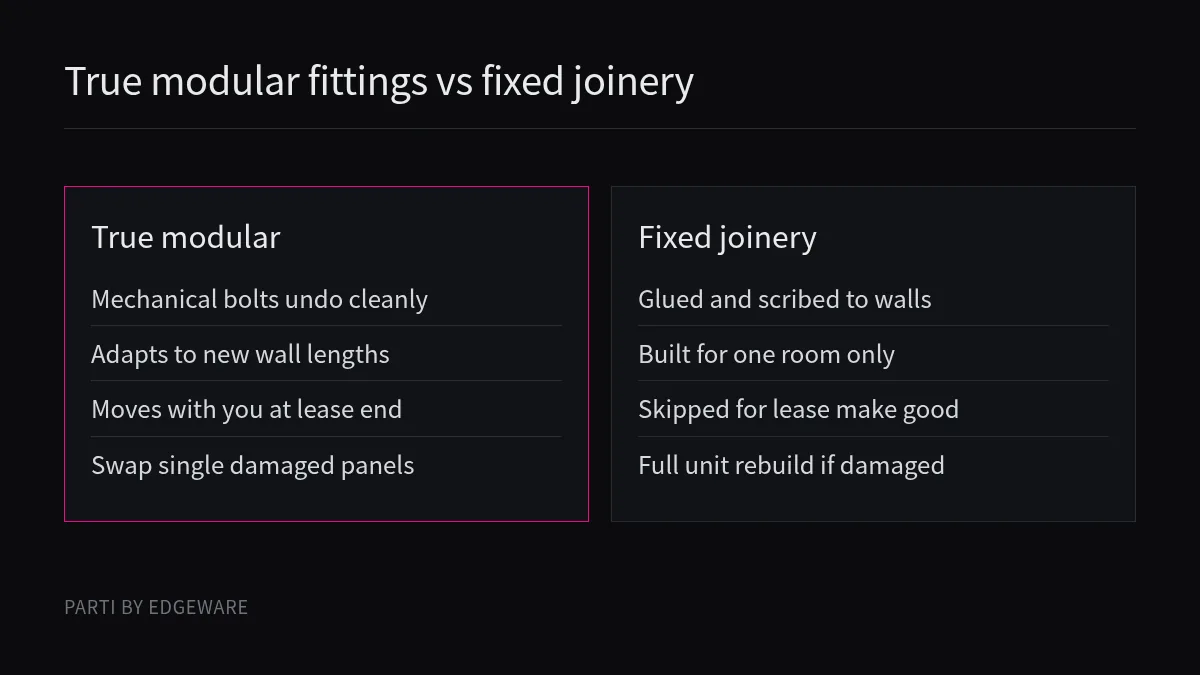
True modular shop fittings use standardised frames, shared connectors, and repeatable dimensions across shelves, counters, and rails. Every part disconnects without damage and recombines in a different room layout without cutting, gluing, or hiring a specialist joiner.
Many shopkeepers buy what looks like a flexible shelving system, only to discover at the end of the tenancy that the units were scribed to crooked walls or glued at the corners. If a carpenter has to cut a panel to make it fit your first room, that panel will rarely fit your second room. When we weigh up whether shop fixtures should be made locally or flat-packed, the deciding question is what happens on moving day.
Modular systems versus custom joinery
A genuine system separates the building from the display. It stands on its own feet or uses a minimum of wall fixings, and its pieces follow a strict geometric grid.
| Feature | True modular system | Fixed custom joinery |
|---|---|---|
| Connection method | Mechanical fasteners that undo cleanly | Glue, nails, or hidden cabinet screws into walls |
| Room adaptation | Add, remove, or rearrange bays to fit new walls | Built for one wall length and ceiling height |
| End of lease | Unbolted, packed, and moved to the next site | Demolished to meet lease make-good rules |
| Replacement | Swap a single scratched panel or bent bracket | Rebuild or refinish the whole unit on site |
Why does that distinction matter so much to a retail or hospitality tenant? In Queensland, Australia, the Queensland Small Business Commissioner's make good guidance1 notes that commercial leases commonly require tenants to remove all tenant-installed fixtures, partitions, joinery, and installations, and restore the premises to an open floor plan at the end of the term. Other places have different rules, and your own lease contract and local authority always decide what you must remove or leave behind. Either way, if you have to strip the shop back to bare walls, fittings that unbolt cleanly turn a demolition bill into moving stock for your next site.
What should you check for compatibility?
A starter kit looks neat on day one. Two years later, a discontinued bracket can turn a whole wall of shelving into scrap metal.
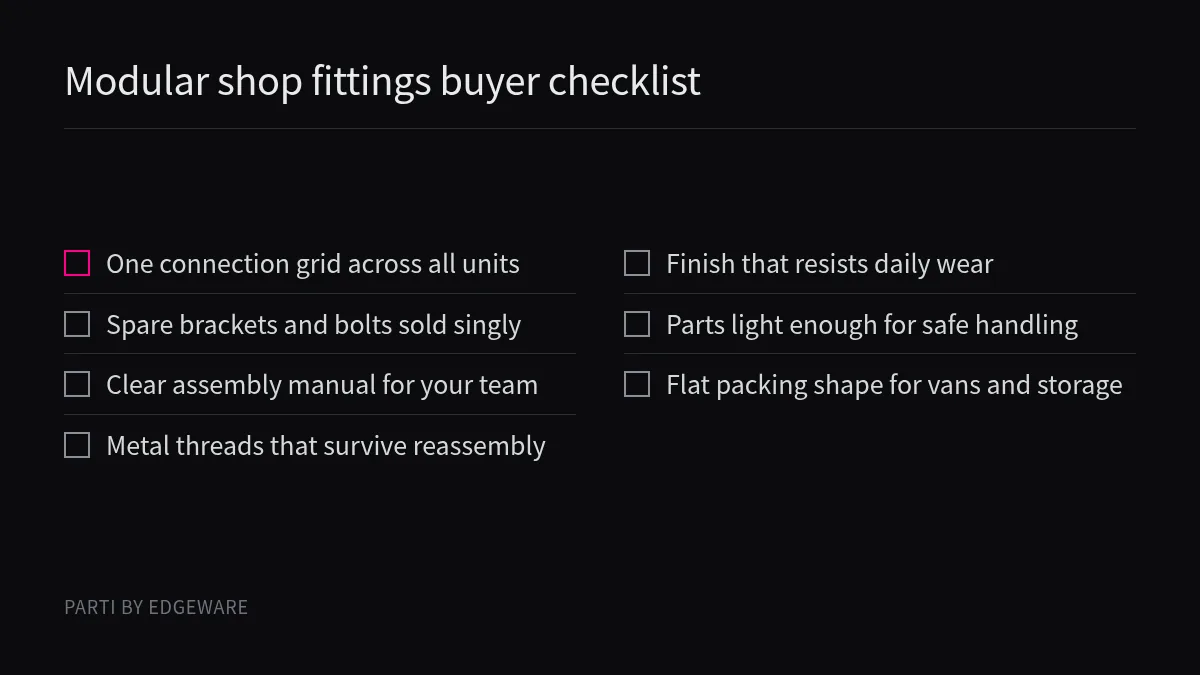
Check that one connection system runs across every counter, rail, and shelf, that the supplier stocks individual spare parts, and that clear assembly instructions exist. Ask whether new batches match older series before you commit your fit-out budget.
Before you order a full shop lot, test how the supplier handles small repeat orders and awkward corners. We look for four practical proofs that a range will still work when you open a second site or reconfigure your room layout for a seasonal shift.
The compatibility checklist
* One grid across different fixture types: Check whether wall bays, freestanding islands, and service counters share the same upright pitch and bracket style. If the counter uses one connector and the wall unit uses another, you cannot swap parts between front-of-house and storage when your floor plan changes. * Single-part ordering: Ask the vendor to quote you for a handful of spare connectors, levelling feet, and shelf pins on their own. If they only sell complete bays, losing a bag of bolts during a move will leave an entire bay unusable. * Written assembly instructions: Request the assembly manual before buying. Clear diagrams show you what tools are required, how many people a build takes, and whether your own team can rebuild the units without paying the vendor's installation crew every time. * Continuity across production runs: Ask how long the current profile has been in production and whether recent updates still fit older frames. We cannot know which supplier will still be trading years from now, so favouring plain mechanical joints over proprietary plastic clips reduces the risk of being stranded.
If your shop hosts workshops or evening gatherings, this same discipline applies when you choose furniture for a multi-use room. Shared parts mean fewer spares sitting in your back room.
What about load, finish and wear?
Fittings that look crisp in a showroom often sag under stock or chip the first time you take them apart with an Allen key.
Verify how the joints handle repeated unscrewing, whether the surface finish resists scratches and cleaning chemicals, and how heavy each component is for staff to lift. Avoid raw particleboard threads that strip after one dismantle.
A fitting that moves between shops lives a harder life than one bolted down once. It faces two kinds of stress: daily trade and the friction of being knocked down, stacked in a van, and rebuilt.
Joints that survive a second build
Look closely at where the fasteners bite. Wood screws driven straight into chipboard or MDF hold well the first time, then chew out the core when you undo and redo them. Metal-to-metal threads, threaded inserts, wedge slots, or bolt-and-nut connections handle repeated assembly far better. Ask to undo and refasten a sample joint in the showroom; if the coating flakes off around the bolt hole or the bracket binds, multiply that annoyance across fifty bays.
Surface finish and edge repair
Retail surfaces take wet cups, dragged crates, and daily wiping. Powder-coated metal, solid timber, and high-pressure laminate with thick edge banding each age differently. Ask two questions: what happens when an edge gets knocked in transit, and can a local tradesperson touch it up? A finish that can be sanded, oiled, or spot-repaired keeps looking respectable in shop number two. A thin paper foil over low-grade board will peel once moisture gets into a chipped corner.
Weight and manual handling
Heavy sections are not automatically better. Your staff have to carry every upright, shelf, and counter carcass from the van into the unit, often up steps or through narrow doors. In Great Britain, the Health and Safety Executive's brief guide on manual handling at work2 explains that employers have duties under the Manual Handling Operations Regulations 1992 to assess and reduce the risk of injury from lifting, lowering, carrying, pushing, and pulling. Even if a complete counter is heavy, a good modular design breaks down into individual panels and frames that one or two people can lift and carry safely using sensible risk filters.
What happens when you move?
Moving day arrives fast once a lease ends. If your fittings take longer to dismantle than to build, your removal bill climbs fast.
Plan how the fittings pack onto pallets or vans, label every connector bag by bay, and check your lease rules before unbolting anything from the walls. Clean removal prevents damage claims and protects your security deposit.
Before you touch a screwdriver, read your lease and check whether you can take shop fittings with you when you move. In Queensland, the Small Business Commissioner notes that under the Property Law Act 2023 standard terms, a tenant must return the premises in the same or better condition as at the start of the lease, excepting reasonable wear and tear, unless the lease sets out different make good conditions. The Commissioner also points out that disputes over make good almost always affect the return of the tenant's security deposit, especially where there is little evidence of the original condition or disagreement over removal damage.
Packing and transport checks
When you evaluate a system before buying, walk through the exit in reverse:
* Flat stacking: Do the frames fold or come apart into flat rectangles, or do they stay as bulky welded cages that fill a Luton van with empty air? * Captive versus loose hardware: Small pins, grub screws, and shims disappear on building sites. Systems with captive fasteners or a single bolt size across the whole build save hours of sorting on the floor of your new shop. * Wall fixing repair: Fewer wall anchors mean fewer holes to patch and repaint during make-good. Freestanding bays or rails that bridge across two wall points cut down the plastering bill when you hand back the keys. * Condition records: Take dated photos of the walls and floor before you install your system, and again once you lift it out. That simple habit backs you up if a landlord questions the state of the shell.
Conclusion
Check the joints, spare parts, component weight, and packing shape before you buy. Good modular fittings pay you back the day you move shop.
About Parti
Parti by Edgeware is Edgeware's first industry solution. We are designing a café where one room can change how it is used by changing the props, with no rebuild of the room. Counters, tables and displays are meant to be carried in and out again by hand, so less is built into the walls and floor and less is left to take down when a lease ends. That is a design aim, not a tested result. The first café is planned for Hangzhou and is not open. See the room and how the floor connects. This guide is for tenants planning a move or a second site. It is general information, not legal advice, and your own contract and local rules decide.
Sources
- Queensland Small Business Commissioner: Make good: Explains commercial lease make-good obligations, fixture removal rules, and bond disputes in Queensland.
- HSE: Manual handling at work, a brief guide: Outlines Great Britain employer duties and risk filters for lifting, carrying, pushing, and pulling at work.