What goes on a checklist for moving a shop?
Moving a shop can waste your last fit-out, and rushed handovers cost trading days. This checklist orders every step from notice to reopening.
Published
A shop moving checklist covers four stages: checking both leases and planning permissions before giving notice, completing make good and condition records at the old shop, securing landlord consent and checking mains services at the new shop, and sequencing the physical carry.
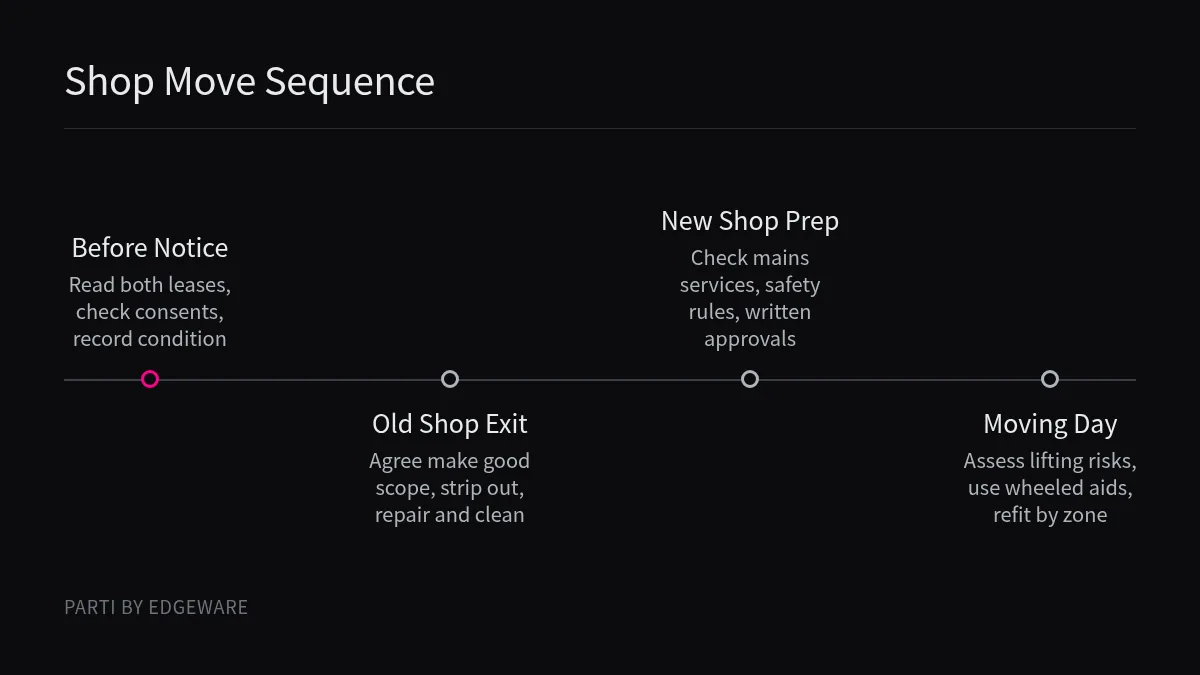
Getting the order right keeps you from paying rent on two idle sites while contractors wait for paperwork. Below, we walk through each phase of the move and the traps that hold up a handover.
What should you do before you give notice?
Giving notice before reading both leases traps you between a strict handback date and a new unit you cannot legally fit out yet.
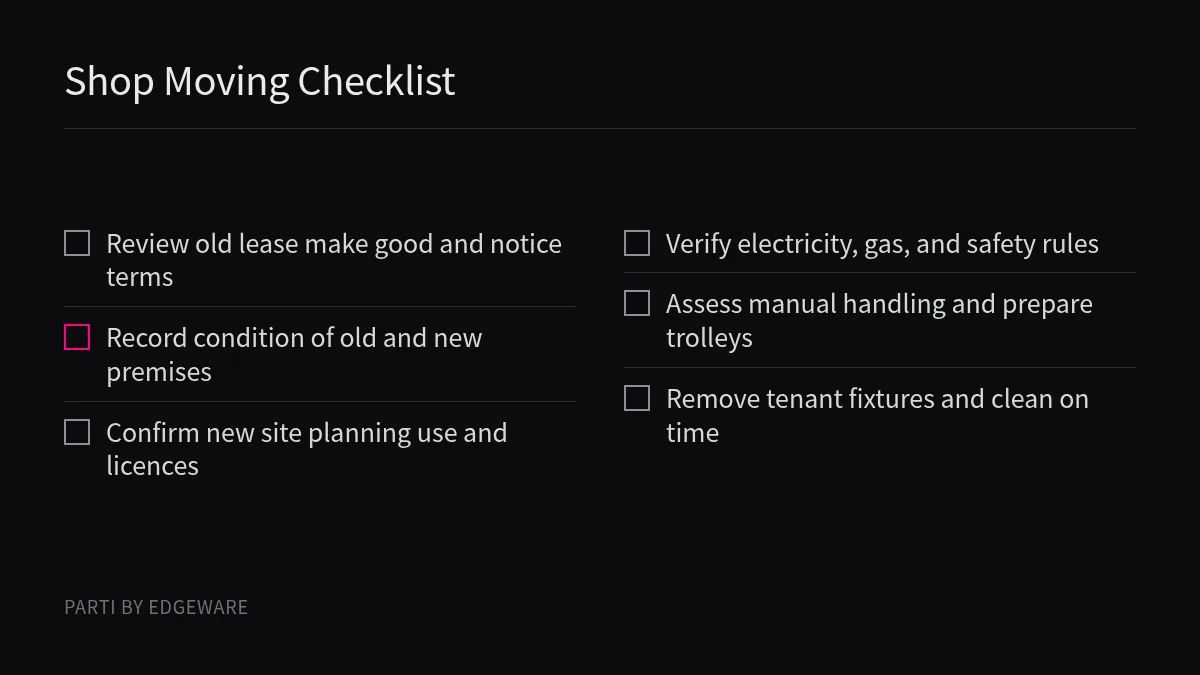
Before giving notice, read your current lease for make good obligations and sort which fittings can travel. At the new premises, check planning use, regulatory restrictions, and landlord licence requirements for alterations, then record the starting condition of both sites.
Check the exit terms on your current lease
Pull out your current lease and read the clauses covering the end of the term. In Queensland, the Queensland Small Business Commissioner's make good guidance1 notes that a make good clause sets out the tenant's obligation to return the property to its original condition, or as specified in the lease, when the term ends. Other places have different rules, and your own contract and local authority decide what applies to you. This is not legal advice.
Check whether your lease requires physical works or allows a cash settlement, and note the exact deadline. Under Queensland's Property Law Act 2023 Schedule 1 standard terms, a tenant must return the premises in the same or better condition as at the start, excluding reasonable wear and tear, specified disasters such as fire and earthquakes, and risks the lessor insured against, though section 139 lets the parties agree to replace those standard terms with specific make good conditions in the lease.
At the same time, walk the shop floor and list every counter, shelf, and light. Decide which shop fittings you can take with you and which ones are fixed to the building and must stay or be stripped out.
Clear the legal hurdles on the new lease
Do not trigger your exit until you know when the new shop can legally open. In England and Wales, the RICS Code for leasing business premises2 advises tenants to check that their proposed use complies with title covenants and planning law, and to verify there are no planning or regulatory limits on working hours or noise emissions. RICS states that if you need planning permission for your proposed use, you should allow at least eight to ten weeks, and sometimes longer, for the application to be processed.
* Alteration consents: Check whether the new landlord requires a formal licence before you start internal non-structural alterations or put up signage. * Schedule of condition: RICS notes that if your repairing obligations at the new site are limited to its initial condition, a schedule of condition is normally required, and both parties should agree who pays for it. Read our guide on writing a condition report before a fit-out before you sign.
What do you do at the old shop?
Leaving the old shop without agreeing on the scope of strip-out work invites bond deductions, holdover rent, and arguments over what was there first.
At the old shop, prepare a condition report, clarify exact make good tasks with the landlord early, and decide between doing the physical works or negotiating a cash settlement. Remove your installed items, repair occupancy damage, and clean the space on time.
Agree the make good scope early
In Queensland, the Small Business Commissioner advises preparing a condition report right away, even if you did not make one when the lease started, and negotiating issues early so your security deposit (bond) is released on time. Make good disputes almost always hold up the return of the bond. They usually happen because there is little or no evidence of the starting condition, the lease wording is vague, the parties disagree on the quality of the work, or someone removes something of value that the other party added.
Talk to your landlord or agent before you hire contractors to clarify what they expect. Check whether their requests match the lease. Also check that no one is confusing make good with redecoration: in Queensland, redecoration clauses cover maintenance like repainting walls or replacing carpets at set intervals during the lease, whereas make good applies at the end. And under Section 50B of Queensland's Retail Shop Leases Act 1994, a clause requiring a tenant to refurbish or refit a retail shop is void unless the lease gives general details of the nature, extent, and timing of the work.
| Approach to Make Good | How It Works (Queensland QSBC) | When to Consider It |
|---|---|---|
| Physically making good | Tenant carries out or manages the works, often required to be done by a professional or to a professional standard. | You have reliable contractors and clear scope in the lease. |
| Cash settlement | Tenant negotiates a payment with the lessor instead of doing the physical strip-out and repair works. | Time is tight, or the landlord plans to remodel the unit anyway. |
Strip out, repair, and hand back on time
Depending on your lease, common make good tasks in Queensland include:
* Repairing damage caused during your occupancy (staying on top of general wear and tear helps here). * Removing tenant-installed fixtures, partitions, joinery, installations, flooring, and ceiling finishes. * Restoring the shop to an open floor plan, including taking down walls you added. * Returning base building services like air conditioning, fire, and hydraulic systems to their original state. * Leaving the whole premises clean and tidy.
For items you remove, plan early whether you will sell or reuse your old shop fittings. Missing your completion deadline can lead to extra rent or penalties. If you hit a stalemate with little evidence of original condition, mediation lets both sides negotiate a settlement without a judge handing down a decision.
What do you do at the new shop?
Signing for a new unit only to find weak power mains or delayed landlord approvals leaves you paying rent on an empty shell.
At the new shop, verify that electricity, gas, and mains services are adequate and in good order, confirm health, safety, fire, and disability access compliance, and secure written landlord approval or give required notices for internal alterations and signage.
Check mains services and building compliance
Before you order equipment or move heavy counters into the new unit, inspect the building's infrastructure. In England and Wales, RICS points out that altering services such as electricity and gas can be expensive, so tenants should always make sure the property has adequate mains services in good order.
RICS also notes that leases normally require tenants to comply with all legislation at their own cost. When you take the lease, you need to check that the premises comply with health and safety requirements, fire regulations, and access requirements under disability legislation (in England and Wales, RICS cites the Equality Act 2010, the Town and Country Planning Acts, the Health and Safety Acts, and the Environmental Protection Acts). Taking advice from a chartered surveyor and solicitors before you commit saves you from inheriting a compliance bill you did not budget for.
Get alteration and signage approvals in writing
How much freedom you have to refit the new shop depends on the building type and your lease terms. Under the RICS Code in England and Wales:
* Whole building leases: A landlord should not normally prohibit or require consent for internal non-structural alterations that do not harm the building's character, value, structural stability, statutory compliance, or energy efficiency. However, the landlord will still require you to do the work properly without causing damage or nuisance, and to give written details. * Units in multi-let buildings: It is common to ban structural and external alterations (except shop fronts, where appropriate) while allowing internal non-structural work under landlord control. Some landlords only ask for written notice of details; others require prior approval. Where consent is required for internal non-structural alterations or signage size and appearance, RICS states tenants should ask that approval not be unreasonably withheld or delayed. * Newly built premises: If you take on direct or indirect responsibility for repairs in a new build, RICS states you should be given suitable protection against inherent construction defects for an appropriate period.
How do you keep the move short?
A slow move bleeds cash: you pay staff who cannot trade, risk back injuries during rushed lifting, and lose regulars while the doors stay shut.
To keep a shop move short, overlap your new shop approvals with your old shop wind-down, assess manual handling risks before lifting day, use mechanical aids for pushing and pulling heavy fixtures, and assemble freestanding furniture in zones.
Assess lifting, carrying, and pushing risks first
Shop moves involve awkward counters, espresso machines, and stacked stock. In Great Britain, the HSE brief guide on manual handling at work3 (INDG143, which helps employers meet their duties under the Manual Handling Operations Regulations 1992) explains how to reduce the risk of musculoskeletal disorders and injury. Rather than asking staff to lift whatever is in front of them on moving night, run a risk assessment ahead of time.
HSE's guidance lines up with L23 Appendix 1 and uses simple risk filters to separate low-risk tasks from heavy work across four areas:
- Lifting and lowering: Check weights and how far loads are held from the body before anyone lifts.
- Carrying operations: Look at the route between the shop floor and the van, clearing steps or tight corners.
- Pushing and pulling: Use wheeled trolleys, skates, and sack trucks so staff push or pull loads instead of carrying them, applying HSE's Risk assessment of pushing and pulling (RAPP) tool (INDG478) or Manual handling assessment charts (the MAC tool, INDG383) where tasks look demanding.
- Handling while seated: Keep packing and sorting stations set up so team members are not twisting under load while sitting.
Sequence the pack, carry, and refit
We do not know your exact floor plan or how far apart your two sites sit, so we cannot give you an hour-by-hour schedule. What works across small retail moves is separating building works from furniture moves. Finish wet trades, electrical work, and dust-making jobs at the new shop before a single piece of equipment leaves the old shop.
Label every crate and freestanding unit by the zone it belongs to in the new layout, drawn on a floor plan ahead of time. Move back-of-house shelving and dry storage first while the front counter at the old shop trades through its final day. Bring the service bar and point-of-sale kit across last, roll them into place on clean floors, and plug into pre-tested sockets. That leaves your old unit completely clear for the final make good clean and landlord inspection.
Conclusion
Check both leases before giving notice, agree on make good early, clear new site services and consents, and plan the physical carry safely.
About Parti
Parti by Edgeware is Edgeware's first industry solution. We are designing a café where one room can change how it is used by changing the props, with no rebuild of the room. Counters, tables and displays are meant to be carried in and out again by hand, so less is built into the walls and floor and less is left to take down when a lease ends. That is a design aim, not a tested result. The first café is planned for Hangzhou and is not open. See the room and how the floor connects. This guide is for tenants planning a move or a second site. It is general information, not legal advice, and your own contract and local rules decide.
Sources
- Queensland Small Business Commissioner: Make good: Explains Queensland commercial lease make good clauses, options, common strip-out tasks, and how to avoid bond disputes.
- RICS: Code for leasing business premises, England and Wales (2020): Sets out England and Wales standards on repair schedules, alteration consents, planning checks, and mains services.
- HSE: Manual handling at work, a brief guide: Outlines Great Britain employer duties and risk filters for lifting, carrying, and pushing or pulling loads.