Can you fit out a rented shop without drilling?
Drilling into rented shop walls often triggers expensive end-of-lease repair bills. Paying twice for one fit-out hurts your cash flow. Here is how to build without holes.
Published
Yes, you can fit out a rented shop or café without drilling by using freestanding units, floor-standing rails, and furniture held stable by its own weight. For anything that must attach to the building, get written landlord consent before starting work.
Planning a non-invasive layout protects your security deposit and speeds up your opening. Four practical questions will help you set up your space, talk to your landlord, and handle any unavoidable fixings.
Why do landlords care about holes in walls?
Landlords view every hole in a wall or floor as a risk to their building. Repairing unapproved alterations at lease end drains your deposit.
Landlords restrict wall drilling to protect the property's value, structural stability, fire safety, and energy performance. They also want a neutral space that is easy to re-let when you leave, which is why leases include strict make good obligations.
Protecting building value and compliance
When you take a commercial lease, the building owner is trusting you with an asset they need to rent out again in the future. In England and Wales, the RICS Code for leasing business premises1 states in section 8.1 that leases should give landlords control over alterations that is no more restrictive than necessary to protect the value of the premises and any adjoining or neighbouring premises. Section 8.3 of the same code notes that in a lease of an entire building, landlords should not normally prohibit or require consent for internal non-structural alterations that do not adversely affect character, value, structural stability, statutory compliance, or energy efficiency performance, though tenants must still carry out work properly without causing damage and give written details. Under section 8.4, if your shop is a unit in a multi-let building, the landlord may require you to obtain consent for internal non-structural alterations, provided that consent is not unreasonably withheld or delayed. Other places have different rules, and your own contract and local authority always decide what you can do.
Drilling into walls can also create hidden safety hazards. In England and Wales, legal guidance on commercial leases notes that building works can affect a property's Energy Performance Certificate rating, interfere with fire precautions under the Regulatory Reform (Fire Safety) Order 2005, or risk disturbing existing asbestos. Even a routine fit-out that involves electrical wiring or fixing items to walls can cross into regulated territory if you do not check what lies behind the plaster.
The cost of make good disputes
At the end of your tenancy, your landlord wants a clean shell that appeals to the next business. In Queensland, Australia, the Queensland Small Business Commissioner's make good guidance2 explains that while tenants value their investments in upgrades, lessors seek neutral spaces for future tenants and write make good clauses into the lease. Under the Property Law Act 2023 Schedule 1 standard terms in Queensland, a tenant must return the premises in the same or better condition as at the start of the lease, excluding reasonable wear and tear and specified disasters, unless the lease replaces those terms with specific make good conditions. Common make good requirements include:
- Repairing any damage caused during your occupancy.
- Removing all tenant-installed fixtures, partitions, joinery, installations, flooring, and ceiling finishes.
- Restoring the premises to an open floor plan, including removing walls.
- Returning base building services like air conditioning, fire, and hydraulic systems to their original state.
- Leaving the area clean and tidy.
If you drill dozens of anchor holes into brickwork or tiles, making good means paying a professional to patch, sand, and repaint whole sections, or negotiating a cash settlement with the lessor. Disputes over the quality of repairs or vague lease clauses almost always delay the return of your security deposit.
What can stand or hang without fixing into the building?
You still need shelves, counters, and menus to run a shop. Relying on wall brackets feels inevitable until you price the end-of-lease removal work.
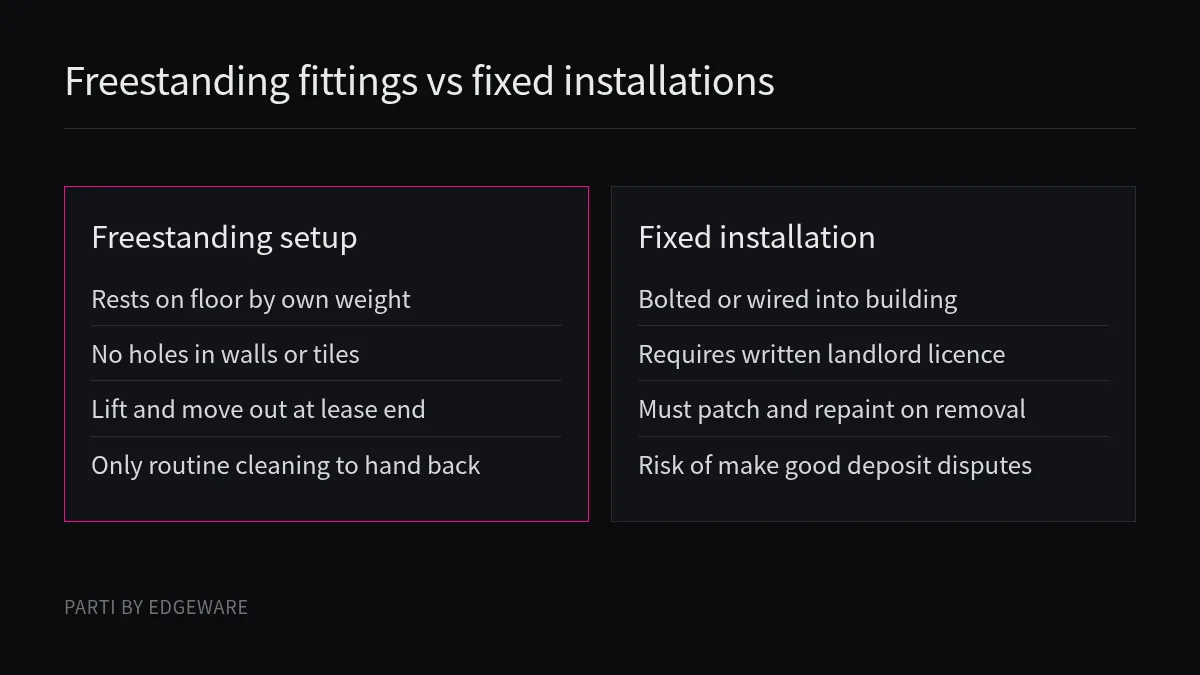
You can replace wall-mounted joinery with freestanding shelving units, heavy counters, floor-standing clothing rails, and weighted screens. Because these items rest on the floor and rely on their own weight for stability, they leave the building fabric untouched.
Relying on floor support and self-weight
When we look at shop interiors, we separate everything into two groups: items that borrow strength from the landlord's walls, and items that bring their own support. Freestanding furniture and joinery sit directly on the floor. A deep counter, an island display table, or a wide bookcase with a low centre of gravity stays upright through its own weight and footprint. If you want to divide a dining area from a service zone, hinged screens or planter boxes with wide bases can create visual privacy without a single screw going into the ceiling or floor slab.
For hanging stock, menus, or lighting, floor-standing frames and A-frame boards do the heavy lifting. You can run display rails that bridge between two weighted upright posts, or hang lightweight signs from a crossbar supported by floor stands. If you want to explore more ways to protect surfaces, read our guide on shop fittings that leave no mark. You can also see how we think about adaptable layouts on our room concept page.
| Fitting approach | How it stays stable | End-of-lease impact |
|---|---|---|
| Wall-mounted joinery | Masonry anchors or screws into wall studs | Requires removal, hole patching, sanding, and full wall repainting |
| Freestanding units | Wide base footprint and self-weight on the floor | Lift and carry out; only routine floor cleaning needed |
| Floor-standing frames | Connected uprights and crossbars resting on protective feet | Disassemble and pack away with no wall repairs |
Testing stability in your own space
We cannot tell you whether a specific freestanding shelf will wobble on your shop floor, because every old building has uneven boards or sloping tiles. Before you open to customers, test every unit in place:
- Push gently against the top corners of tall shelving to check for tipping or rocking.
- Place heavier stock or equipment on the lowest shelves to keep the centre of gravity down.
- Put protective pads under furniture feet so heavy units do not scratch timber or crack floor tiles.
- Keep freestanding screens and signboards clear of fire exits and disability access routes so your layout stays compliant with health and safety rules.
What should you ask the landlord first?
Assuming a freestanding fit-out needs zero communication is a common trap. Surprises during a landlord inspection can still trigger a breach of lease dispute.
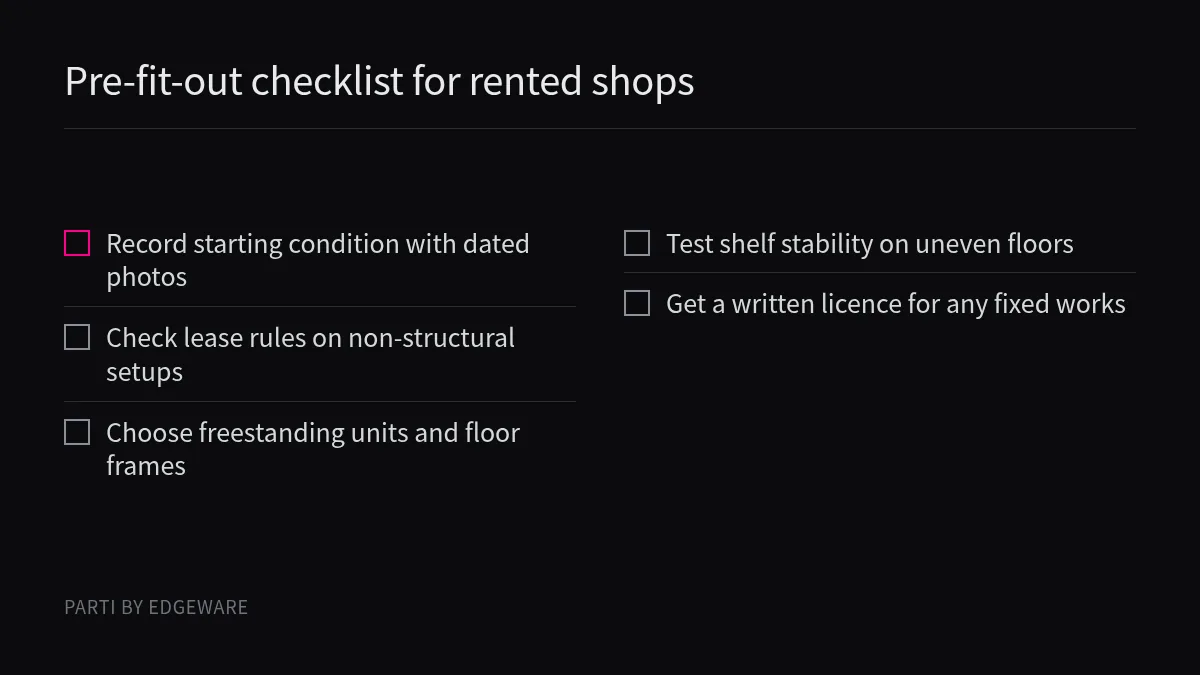
Before moving anything in, ask your landlord to agree on a detailed schedule of condition, clarify whether your non-structural setup needs written notification or approval, and confirm the exact make good expectations for the end of the lease.
Recording the starting condition
Even if you never pick up a drill, you can still be blamed for pre-existing wall holes, cracked tiles, or scuffed paint left by the previous tenant. In Queensland, the Small Business Commissioner points out that limited or no evidence of the condition of the premises at the start of the lease is a primary cause of make good disputes. In England and Wales, the RICS lease code (section 7.2) notes that if a tenant's repairing obligations are to be limited to the initial condition of the premises, a schedule of condition is normally required, and both parties should agree on who pays for it.
Before you bring in a single table, walk the shop with your landlord or agent. Take dated photographs of every wall, floor surface, ceiling tile, and power outlet. Put this schedule of condition into writing and attach it to your lease agreement so nobody has to rely on memory years later.
Questions to put in writing before you start
Leases differ on how much control the landlord keeps over internal setups. In England and Wales, RICS guidance explains that where part of a building is let, some landlords allow tenants freedom to make internal non-structural alterations and just require notification of the details, while others require prior approval. In Queensland, section 50B of the Retail Shop Leases Act 1994 states that a clause requiring a tenant to refurbish or refit a shop is void unless the lease includes general details of the nature, extent, and timing of the requirements.
To avoid misunderstandings, send your landlord a clear written list of questions and keep their replies:
- Does placing freestanding counters and shelving require formal written notification under our lease?
- Are there any floor loading limits, fire safety routes, or access requirements under legislation like the Equality Act 2010 that our layout must follow?
- Do you have restrictions on window displays or freestanding signage inside the shopfront?
- Can we sign off on a joint condition report this week before our equipment arrives?
- At the end of the lease, if we have not altered the walls or floors, does our make good obligation only require leaving the space clean and tidy, or is a scheduled redecoration like repainting still expected?
What do you do about the parts that must be fixed?
Few cafés or shops can avoid every single wall or service connection. Plumbing an espresso machine or wiring an illuminated sign requires physical alterations.
For parts that must be fixed into the building, apply for a formal licence for alterations before work starts. Submit full plans and specifications, check building and safety compliance, and agree in writing whether the fixtures must be removed later.
Getting a formal licence for alterations
When you have to attach equipment, run new electrical wiring, or alter plumbing, do not rely on a casual phone call with the property manager. In England and Wales, Russell-Cooke's guide to a licence for alterations3 explains that tenants with a commercial lease usually need the landlord's written permission before carrying out any works. A Licence for Alterations is a supplemental legal document that records this consent and defines the scope, conditions, and requirements for the works. Even minor non-structural fit-out works, such as installing fixtures, branding, signage, and electrical wiring, commonly require this licence to cover quality standards, timeframes, and reinstatement rules. If a tenant carries out alterations without required consent, they are in breach of the lease, though parties who agree on the suitability of the works can sometimes formalise consent afterwards through a retrospective licence. For a deeper walkthrough of this paperwork, see our guide on getting landlord consent for shop alterations.
Note that altering services such as electricity and gas can be expensive. RICS guidance advises tenants to check that mains services are adequate and in good order before taking the lease, and to allow at least eight to ten weeks (or longer) if planning permission is needed for a proposed use.
Defining scope, timescales, and reinstatement
When you apply for written consent to fix items to the building, prepare a complete package for your landlord and their surveyor or insurer:
- Provide full plans, drawings, and specifications showing the exact extent of the proposed fixings, which will be annexed to the licence once approved.
- Check regulatory compliance with your contractor or surveyor, including the Construction (Design and Management) Regulations 2015 (CDM 2015) for construction projects, the Building Safety Act 2022 for mixed-use buildings, fire safety rules, energy performance ratings, and asbestos risks.
- Watch the clock: a licence for alterations commonly states that consent ceases if you do not start work within a set timeframe from the date of the licence, and it will also set a completion deadline and a duty to notify the landlord when finished.
- Clarify reinstatement and removal rights in advance. Your licence and your lease should match without contradicting each other on whether you must strip out the fixed work and patch the walls at the end of the term, or whether the landlord prefers a structural improvement to stay. When you plan your exit, read our guide on taking your shop fittings with you so you do not remove something the landlord legally claims or leave behind items that trigger a penalty.
Conclusion
Use freestanding furniture wherever possible, record the shop's starting condition, and get written consent for every fixed part before a tool touches the wall.
About Parti
Parti by Edgeware is Edgeware's first industry solution. We are designing a café where one room can change how it is used by changing the props, with no rebuild of the room. Counters, tables and displays are meant to be carried in and out again by hand, so less is built into the walls and floor and less is left to take down when a lease ends. That is a design aim, not a tested result. The first café is planned for Hangzhou and is not open. See the room and how the floor connects. This guide is for tenants who are weighing a shop or café fit-out. It is general information, not legal advice, and your own contract and local rules decide.
Sources
- RICS: Code for leasing business premises, England and Wales (2020): Explains landlord controls on alterations, multi-let consent rules, and schedules of condition in England and Wales.
- Queensland Small Business Commissioner: Make good: Covers commercial lease make good clauses, condition reports, and ways to avoid security deposit disputes in Queensland.
- Russell-Cooke: Understanding a licence for alterations: Details when commercial tenants in England and Wales need written permission for minor fit-outs and major works.