How do you choose furniture for a multi-use room?
One room for coffee, classes and evening talks sounds efficient until heavy tables turn every changeover into hard labour. This guide shows how to pick pieces that move.
Published
Choose furniture for a multi-use room by starting with who moves it and where unused pieces go. Pick items staff can grip, lift, or wheel safely, check that stored stacks never block fire exits, and test one sample before ordering a set.

A room that changes jobs during the week needs furniture selected for the transition, not just the finished photo. Walking through four practical questions will save your team's backs and keep your floor compliant.
What should furniture in a multi-use room be able to do?
Catalogue photos show one setup. Buying for a single look leaves you stuck when an evening booking needs open floor. Judge what pieces do between bookings.
Multi-use furniture needs to serve at least two layouts, wipe clean fast between uses, move quietly across your floor, and survive frequent handling without loosening joints or scratching surfaces.
Match pieces to your actual schedule
Start by writing down the two or three jobs your room performs most often. If you are planning a café layout for daytime coffee and evening events, the tables that hold laptops at noon may need to line the wall as a drinks station at night, or fold away completely for rows of chairs. When you also hope to run a class or training session in a café, people will need flat work surfaces that join together without wobbling or leaving wide gaps.
Instead of buying specialist items for every single event type, look for simple shapes that combine well. Rectangular tables with straight legs sit flush against each other for a workshop boardroom, then split apart into small café pairs. Round tables soften a room for conversation, yet they cannot butt together into a long work bench and often take up more awkward corners when pushed aside.
Check how surfaces, feet, and joints hold up
Standard dining furniture is built to sit in one spot for years. Multi-use furniture gets lifted, tilted, stacked, and bumped through doorways several times a week. That extra handling shows up fast in three places:
* Joints and frames: Welded frames or solid bolted brackets cope better with constant lifting than light screws driven into particleboard, which work loose once staff start dragging tables by the top. * Floor contact and noise: Hard plastic glides screech on tile or timber and wake up the whole room when someone shifts a chair during a talk. Check that feet can take replaceable felt or rubber pads that suit your exact floor surface. * Edges and finishes: Stacked chairs rub against the seat below them, and folding tables knock corners when leaned against a wall. Pick finishes that wipe clean after coffee spills and have protective bumpers where stacked frames touch.
We admit we cannot tell you whether timber, steel, or polypropylene will last longest in your venue without seeing how your team works and what your floor is made of. That is why checking the physical details of how a piece is built matters more than the style label on the brochure.
How do weight and storage change the choice?
Extra seats fit easily on paper. When two tired staff clear the room alone, heavy furniture becomes a hazard. Weight and storage decide.
Pick furniture that matches the strength of the staff actually working the shift, using wheeled dollies or folding frames where needed, and measure your storage zone before buying so stacked pieces have a dedicated home.
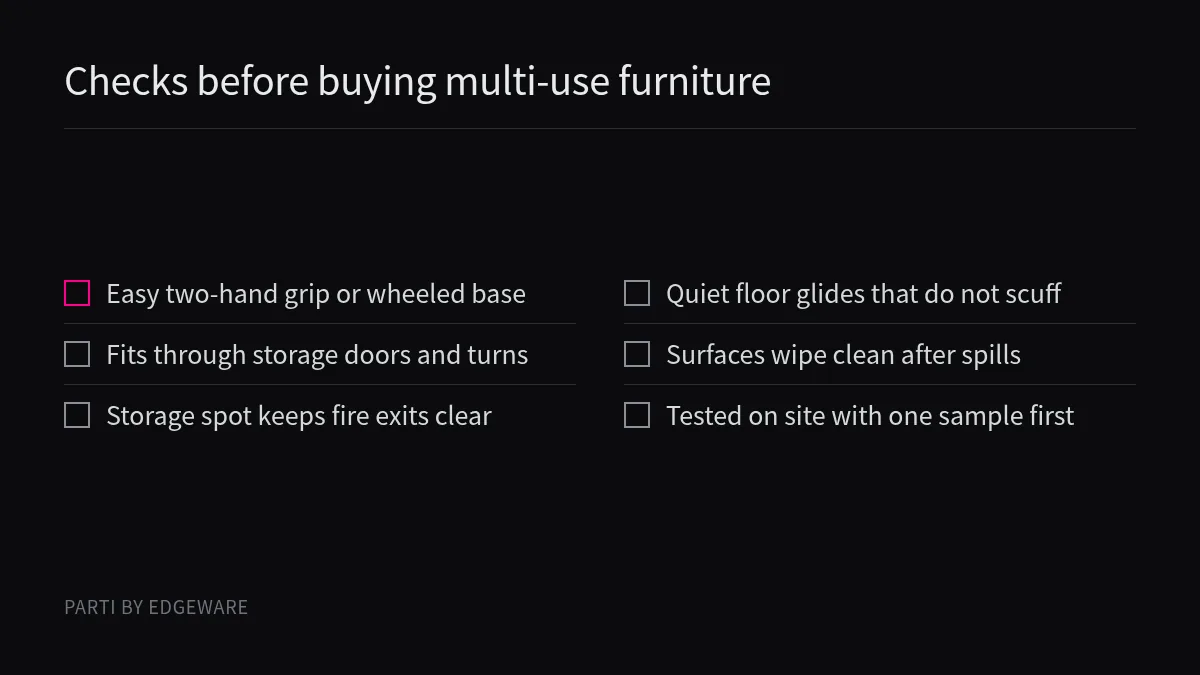
Look at who moves the furniture and how
Before you fall in love with a solid oak communal table, ask who closes the shop on a wet Tuesday night. In Great Britain, the Health and Safety Executive provides a brief guide to manual handling at work1 to help employers reduce the risk of musculoskeletal injury under the Manual Handling Operations Regulations 1992. Other places have different rules, and your own contract and local authority decide what applies to your premises, yet the physical questions are the same everywhere.
In Great Britain, the HSE simple manual handling risk filters2 explain that the law does not set specific weight limits, and that low-risk assumptions depend on the load being easily grasped with both hands, held close to the body, and moved in a stable posture without twisting the torso. Under those Great Britain guidelines, a more detailed assessment is needed if lifting is more frequent than one lift every two minutes, if the task is done by a team, if the load is awkward to grasp, or if a worker is carrying a load further than about 10 m without resting (or up to 20 m when carried securely on the shoulder without lifting it first). The same HSE filters note that seated two-handed handling within the close zone has filter values of 5 kg for men and 3 kg for women, and that pushing or pulling on wheels is likely to be low risk when the load is easily controlled, the torso stays largely upright, the hands stay between hip and shoulder height, and the distance moved without a pause is no more than about 20 m on a level floor without constricted spaces or trapping hazards.
For a café or studio operator, those points translate directly into buying criteria:
| Feature to check | Why it hurts during a changeover | What to look for instead |
|---|---|---|
| Grip points | Wide tabletops with sharp under-edges force bent wrists and awkward holds | Hand cut-outs, smooth rounded rails, or folding frames that lock shut |
| Moving method | Carrying stacks across a long room tires staff and blocks their view | Wheeled chair dollies or flip-top tables on locking castors with handles between hip and shoulder height |
| Team lifts | Tables that need two people cannot be moved when one person works alone | Smaller tops that one person can tilt and roll, then clip together in place |
Measure storage before you order
Stacking chairs and folding tables still occupy floor area when not in use. Measure the cupboard, alcove, or back corridor where spare pieces will live during your lowest-seating layout. Check the footprint of a chair stack on its dolly, the doorway width it must roll through, and any thresholds or steps along the route. If a trolley has to bump over a step, you are back to lifting by hand.
How do you keep exits and sightlines clear?
Where do spare chairs go when a talk ends? Spares in a hallway can trap people in an emergency. Plan routes and sightlines first.
Keep every escape route, exit door, and corridor completely clear of stacked chairs or parked tables during every layout, and pick table heights and chair backs that let seated guests see speakers and exit signs.
Keep spare furniture out of escape routes
When a room flips from a seated workshop of forty people to an open yoga floor or a quiet morning coffee service, the unused furniture has to go somewhere safe. The temptation in a tight venue is to stack chairs in the back hallway, behind a curtain, or beside the secondary exit door.
In England and Wales, the Home Office guidance on fire safety risk assessment for small and medium places of assembly3 covers premises such as clubs, community centres, and halls accommodating up to 60 people (small) or up to 300 people (medium). Under that guidance, the responsible person (such as the employer, occupier, or manager with control of the premises) must carry out a fire risk assessment, keep general fire precautions in place to protect relevant persons, and inform temporary or contract workers of the risks and fire safety procedures. When your room layout changes three times a week, your fire risk assessment needs to cover every one of those layouts, not just the morning café setup.
Set two strict house rules when choosing and placing multi-use furniture:
* Never use corridors or exit areas as overflow storage: If a stack of chairs or a folded table does not fit inside a dedicated storage room or a marked safe zone inside the main room, you are buying too many pieces for the building. * Check swing paths and aisle widths in every mode: Draw your café mode, class mode, and talk mode to scale, showing both the furniture in use and the exact spot where the leftover items sit.
Protect sightlines across the room
Height matters as much as footprint. High-backed booths and tall shelving partitions can make a morning café feel cosy, yet they block the view of a projector screen or speaker as soon as you host an evening talk. Low-backed chairs, counter stools that tuck fully under a bar, and standard table heights keep the room visually open so guests can see a presenter, staff can monitor the floor from the counter, and everyone can spot exit doors immediately. As we explore modular room layouts for our own planned concept on the Parti room page, keeping the centre of the floor clear of fixed tall barriers is one of the simplest ways to let a room serve more than one purpose.
What should you try before you buy?
Ordering a full set from a specification sheet is a gamble. Chairs that pinch fingers or wobble are an expensive mistake. Trial one sample first.
Order or borrow a single sample of the chair and table first, and have the staff who will actually run changeovers test lifting, folding, stacking, cleaning, and sitting on your own floor.
Run a real changeover test with your team
Manufacturers test furniture in laboratories, not in your café late at night. Before committing to a full order, buy one chair and one table, or visit a showroom with a member of the staff who will actually set up your events. Taking the same deliberate approach as when you review what to check before buying modular shop fittings, put the sample through the exact motions it will face every week:
* Fold and lock mechanism: Ask two different team members to fold and unfold the table without instructions. Check whether catches pinch fingers, whether the mechanism needs awkward bending under the tabletop, and whether it locks firmly both open and closed. * Lift, tilt, and roll: Have the person who usually works the closing shift move the piece across your actual floor, through the storage doorway, and into its parked spot. Watch whether they have to twist their back or hold the load away from their body. * Stacking and unstacking: If testing chairs, ask the supplier to let you stack and unstack several at once in their showroom. Notice how high the stack gets before lifting the top chair above elbow height becomes awkward. * Sit and work test: Sit in the chair at the table for an hour with a laptop and a notebook. A seat that feels fine for a quick espresso can feel punishing halfway through an evening workshop. * Spill and scrape check: Wipe coffee and marker pen off the sample surface, and drag the chair across a spare piece of your flooring to hear the noise and look for black scuff marks.
Write down the setup map
Once you choose pieces that pass the test, photograph each room layout and the packed storage zone. Pin those photos inside the storage cupboard so new staff, agency workers, and event hires know exactly how the furniture stacks and which doors must stay clear.
Conclusion
Start with your staff's safe handling, measure your storage space, keep every exit clear, and test one sample piece on your floor before ordering.
About Parti
Parti by Edgeware is Edgeware's first industry solution. We are designing a café where one room can serve several uses, reset by hand between them. We have not published how long a reset takes, because we have not tested it. That is a design aim, not a result. The first café is planned for Hangzhou and is not open. See the room and how the floor connects. This guide is for people who run a café, studio or event space. It is general information, not legal advice, and your own contract and local rules decide.
Sources
- HSE: Manual handling at work, a brief guide: Explains employer duties and practical guidance for reducing manual handling injury risks in Great Britain.
- HSE: Simple manual handling risk filters: Sets out Great Britain filter conditions for low-risk lifting, carrying, pushing, pulling, and seated handling.
- GOV.UK: Fire safety risk assessment, small and medium places of assembly: Official fire risk assessment guidance for responsible persons running small and medium assembly venues in England and Wales.