How do you plan a pop-up teardown day?
Closing night finishes and the crew is exhausted. Without a clear sequence, packing eats your budget and weekend. This guide maps out your teardown day.
Published
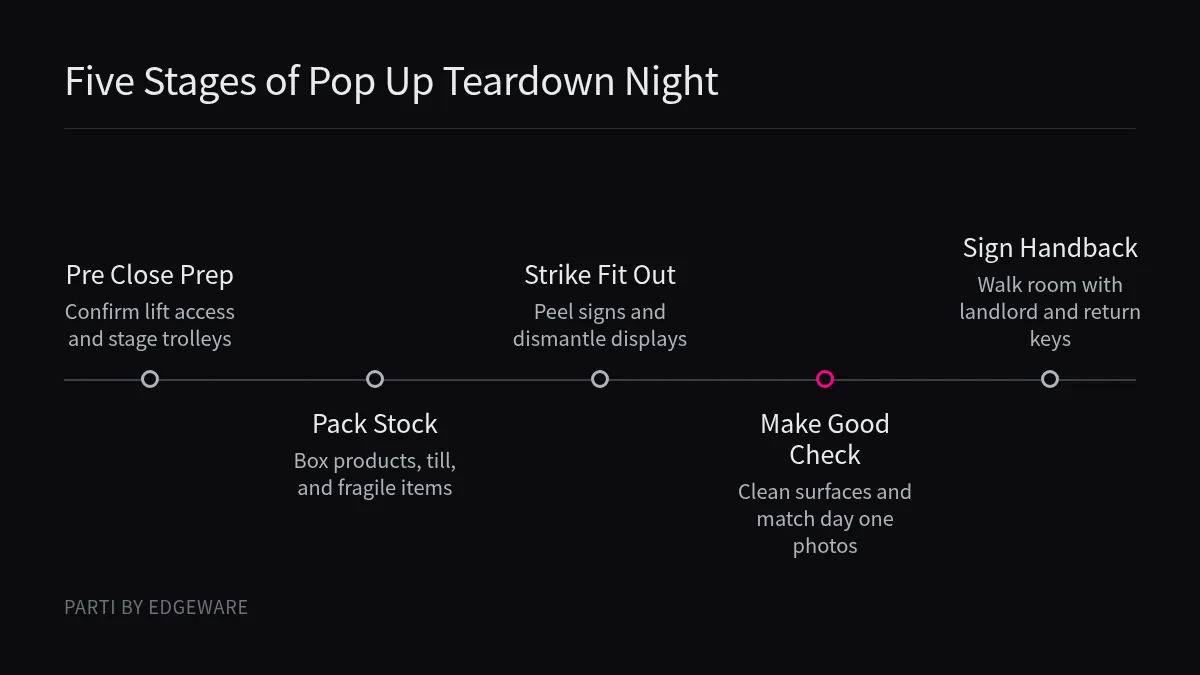
Plan a pop-up teardown day by confirming your building access window and lift rules, assigning manual handling roles with trolleys, packing stock before dismantling fixtures, checking floors and walls against your day-one condition report, and completing a signed handback inspection.

Getting out cleanly takes as much preparation as opening morning. Four practical questions below break the night into steps you can hand to your team.
Why does teardown need its own plan?
Most organisers spend weeks planning the opening and leave the exit to guesswork. That rushed final night is where damages, penalties, and injuries happen.
Teardown needs its own plan because tired teams work against a strict move-out clock, where missed make-good duties or left-behind fixtures can trigger extra rent, penalties, or deposit disputes with the landlord.
When you plan a pop-up in the UK, Square UK's guide to opening a pop-up shop1 points out that a temporary shop can run for a single day, a few days, weeks, or months, and that beyond rent you have to factor in store fit-out, furniture, display units, signage, point of sale equipment, staffing, and health and safety risk assessments. All of those items have to leave the building in a fraction of the time it took to set them up. If you are still weighing formats, our guide on whether to choose a pop-up or a short lease compares how those commitments work in practice.
In Queensland, Australia, the Queensland Small Business Commissioner's make good factsheet2 explains that a make-good clause refers to the tenant's obligation to return the property to its original condition, or as specified in the lease, at the end of the term, and warns that not completing make-good obligations on time may result in additional rent or penalties. Other places have different rules, and your own contract and local authority decide what applies to your venue.
What goes wrong without an exit sequence
When everyone starts pulling down displays at once, fragile stock gets crushed under heavy timber and tools go missing. Teams often pack the tape and cleaning sprays into the first van bag, then realise at midnight they still need both. Reversing your pop-up shop fit-out checklist gives you a working order:
* Pack unsold inventory, cash drawers, and card readers first while the shop lighting is still clear. * Peel signage and take down light display props before anyone brings trolleys onto the shop floor. * Dismantle shelving and furniture in reverse assembly order, keeping screws and brackets in labelled bags. * Sweep, wipe, and photograph the empty unit only after the last box sits in the loading bay.
What time and access do you actually have?
Your lease end time is rarely the same as the time a van can park outside. Shopping centres and high streets restrict when goods move.
Check your venue contract for the exact teardown window, goods lift booking, loading bay rules, and building quiet hours, then plan lifting, carrying, pushing, and pulling tasks so nobody handles heavy displays alone.
Before the last customer leaves, walk the route from your unit to the kerb. A ground-floor vacant shop on a high street operates differently from an alcove in a station or a unit inside a shopping centre. Check four logistical bottlenecks with building management in writing ahead of time:
* Access hours: Confirm when you must stop trading, when the main doors lock, and whether night security needs names for everyone on your teardown crew. * Loading bay and parking: Ask where your van can wait, whether parking restrictions change in the evening, and if the bay is shared with other tenants. * Lifts and corridors: Check whether you need to book a service lift, pad the lift walls, or avoid passenger escalators. * Quiet hours: Ask if power tools, hammering, or rolling cages are banned after a certain hour because of upstairs residents or neighbouring businesses.
Planning safe manual handling
Teardown happens when people are tired and rushing to get home. In Great Britain, the Health and Safety Executive publishes HSE guidance on manual handling at work3 to help employers reduce the risk of musculoskeletal injury from lifting, lowering, carrying, pushing, and pulling under the Manual Handling Operations Regulations 1992. Even if you staff your pop-up with friends and family, treat the heavy shifting like a proper workplace task.
Break tall display units into lighter parts before moving them. Use wheeled skates, sack trucks, or trolleys so the team pushes loads along flat routes instead of carrying them down corridors. Assign pairs for awkward boards or tables, keep pathways clear of Bubble Wrap and loose cables, and decide who is in charge of stopping the lift if a load shifts.
What do you check on the floor and walls?
Once the furniture is out, the empty room shows every scuff and tape mark. Guessing what was already there on day one causes arguments.
Compare the empty room against your day-one condition report and lease terms, checking for removed fixtures, wall adhesive marks, floor scratches, base building services, and left-behind rubbish before calling the landlord to inspect.
According to the Queensland Small Business Commissioner's factsheet on make good, common make-good terms in a lease include repairing damage caused during occupancy, removing tenant-installed fixtures, partitions, joinery, installations, flooring, and ceiling finishes, restoring an open floor plan, returning base building services such as air conditioning, fire, and hydraulic systems to their original state, and leaving the area clean and tidy. Some leases ask for nothing more than a clean premises, while others require repainting or removing a full fit-out.
In Queensland, Schedule 1 of the Property Law Act 2023 includes standard terms requiring the tenant to return premises in the same or better condition as at the start of the lease, excluding reasonable wear and tear, specified disasters such as fire and earthquakes, and risks the lessor insured against, though section 139 allows both parties to exclude those standard terms and agree on specific make-good conditions in the lease. Section 50B of the Retail Shop Leases Act 1994 also states that a clause in a retail shop lease requiring a tenant to refurbish or refit the shop is void unless the lease gives general details of the nature, extent, and timing of the requirements.
Side-by-side floor and wall check
Pull out the photos and notes you took before moving in. If you want a template for next time, read our guide on why to write a condition report before a fit-out. Walk the perimeter under full lighting and check each surface against your agreement:
| Area to inspect | What to look for at teardown | Typical remedy before handback |
|---|---|---|
| Walls and columns | Vinyl residue, blu-tack stains, pinholes, or chipped paint from leaning racks | Warm soapy water, citrus adhesive remover tested on a hidden spot, or agreed touch-up paint |
| Floors and skirting | Black rubber wheel marks, tape lines, dragged timber scratches, or loose temporary floor tiles | Remove all floor tape, buff out rubber scuffs, and vacuum corners and thresholds |
| Ceiling and lighting | Cable ties, fishing line, temporary hooks, or moved track spotlights | Snip all ties, remove hooks, and point lights back to their handover positions |
| Base services and back room | Blocked fire exits, altered air-conditioning settings, or full rubbish bins | Bag and remove all trade waste from site unless the venue provides dedicated skips |
We admit you cannot know ahead of time how strict an unfamiliar landlord or centre manager will be about a tiny scuff mark, so photographing every wall next to your move-in photos is your best protection.
What do you hand back, and to whom?
Locking the door and posting the keys through a letterbox leaves you open to claims for damage that happened after you left.
Walk the empty space with the landlord or centre manager, sign a dated handback record with matching photos, return all keys and passes, and agree early on whether any remaining issue is fixed physically or by cash settlement.
The Queensland Small Business Commissioner notes that disputes over make good almost always affect the return of the tenant's bond (security deposit). Those disputes commonly happen because there is limited or no evidence of the premises' condition at the start of the lease, the make-good clauses are vague or ambiguous, the parties disagree over the quality of the work, or someone removes something of value added by the other party.
Physical repair versus cash settlement
If you run out of time to fix a damaged wall on teardown night, the Queensland guidance notes two main ways leases handle make-good obligations:
* Physically making good: You carry out or manage the required works yourself, which leases often require to be done by a professional or to a professional standard. * Cash settlement: You negotiate a cash sum with the lessor instead of doing the physical work yourself.
Talk to the landlord early if something cannot be finished before your access window closes. Clarify what they want done, check whether their request matches the lease, and keep a written record of what you hand over: keys, fobs, loading bay passes, meter readings if applicable, and time-stamped photos of the swept room. If we are designing future modular spatial concepts at Parti, you can follow our research updates on the Parti room page. If a disagreement still arises where start-of-lease evidence is thin, the Queensland commissioner highlights that mediation lets both sides negotiate a solution without a judge handing down a decision.
Conclusion
A calm teardown starts before you open. Book your loading window, pack stock first, check every surface against day-one photos, and sign off handback in person.
About Parti
Parti by Edgeware is Edgeware's first industry solution. We are designing a café where one room can serve several uses, reset by hand between them. We have not published how long a reset takes, because we have not tested it. That is a design aim, not a result. The first café is planned for Hangzhou and is not open. See the room and how the floor connects. This guide is for brands, makers and organisers running a short event. It is general information, not legal advice, and your own contract and local rules decide.
Sources
- Square UK: How to open a pop-up shop: Covers UK pop-up durations, setup categories, equipment, staffing, and health and safety considerations.
- Queensland Small Business Commissioner: Make good: Explains commercial lease make-good obligations, common terms, bond disputes, condition reports, and cash settlements.
- HSE: Manual handling at work, a brief guide: Outlines Great Britain employer guidance on lifting, lowering, carrying, pushing, and pulling risks.