Should you choose a pop-up or a short lease?
Picking the wrong agreement for a short retail run drains your setup budget and eats your weekend in teardown. Here is how to match the contract to your schedule.
Published
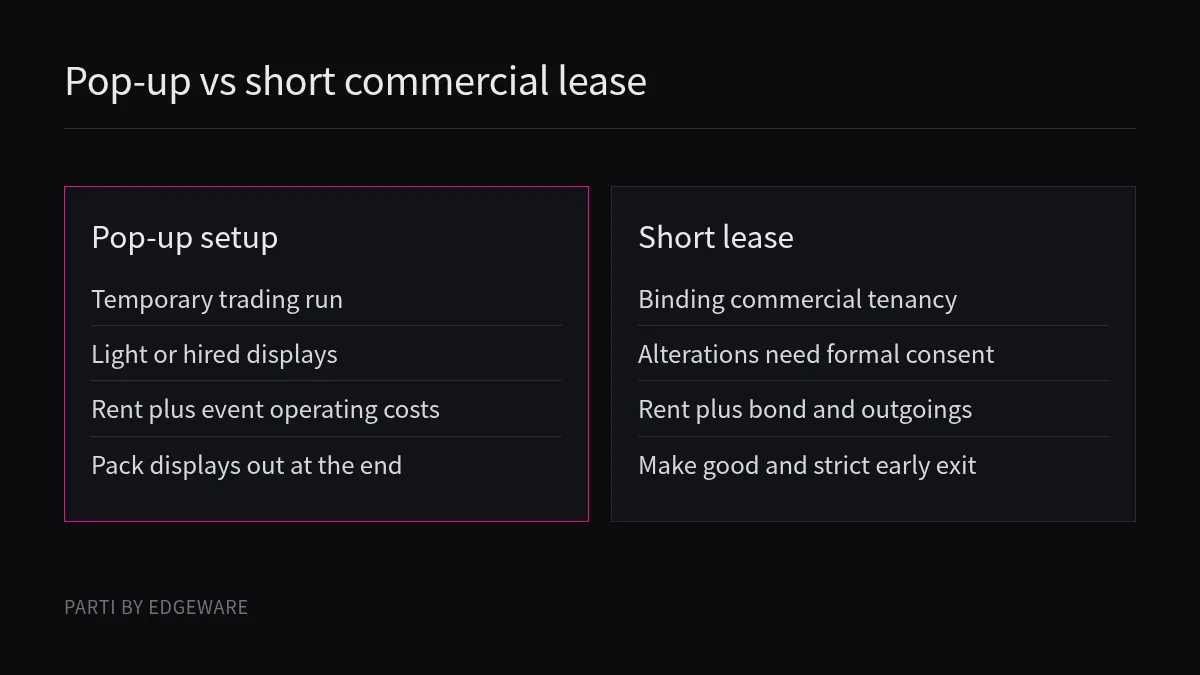
Choose a pop-up when you want a short, temporary trading run with light display setup and lower commitment. Choose a short commercial lease when you need dedicated premises for longer, and are ready for repair, outgoings, and make-good obligations.

Before you sign for keys or move stock in, compare what each route means in practice, what you commit to on paper, and how much building work the space expects.
What is the difference between a pop-up and a short lease?
Both options put your products in front of customers in a physical space, yet they work on very different expectations about permanence and property rules.
A pop-up is a temporary in-person shop inside a standalone unit, another store, an event stand, or an outdoor stall, with no plan to stay. A short commercial lease is a binding tenancy with formal obligations over repairs, outgoings, and handback.
How a pop-up works in practice
In the UK, Square UK's pop-up shop guide1 defines a pop-up as a temporary in-person shopping setup usually housed in a bricks-and-mortar environment, though it can also be space inside a larger shop, a trade stand at an event, or an outdoor setup similar to a market stall. You can run one for a day, a few days, weeks, or months. The whole point is that there is no intention of making it permanent.
Square UK notes that brands use this format to sell seasonal lines, launch a range so shoppers can touch the product, test a new location, or give an online store a short physical presence without the long-term commitment of renting, fitting out, and staffing permanent premises.
How a short commercial lease differs
A commercial lease is a legally binding property contract. In Queensland, Australia, the Queensland Small Business Commissioner's commercial lease tips2 note that short-term leases with a total duration of three years or less (including any options) are protected under section 185(b) of the Land Title Act 1994, while leases over three years can be registered with Titles Queensland. Even a short lease brings formal property law into play, and in Queensland a retail shop lease can be deemed to have been entered into as soon as the tenant pays rent or takes possession, even before the document is signed (section 11 of the Retail Shop Leases Act 1994). Other places have different rules, and your own contract and local authority always decide how an agreement is classed.
| Feature | Temporary pop-up | Short commercial lease |
|---|---|---|
| Typical venue | Vacant shop, shelf or space inside a store, event stand, or outdoor stall | Dedicated unit in a shopping centre, high street building, or commercial property |
| Intended duration | A day, a few days, weeks, or months, with no plan to stay | Fixed term (for example, up to three years in Queensland) with strict key dates |
| Core appeal | Test a market or launch a range with lower financial commitment | Control of premises with defined renewal, repair, and alteration rules |
What does each ask you to commit to?
Rent is only the headline figure. The real drain on a short project comes from the extra cost categories and the legal strings attached to leaving.
A pop-up asks you to cover rent plus setup and operating categories like displays, signage, payment kit, insurance, and risk assessments. A commercial lease adds binding obligations for bonds, outgoings, scheduled maintenance, compliance with legislation, and strict rules against ending early.
Cost categories on a pop-up
According to Square UK, pop-up rent aligns with the desirability of the location and the size of the space: a central London spot can cost £1,000 a day or more, whereas a miniature pop-up consisting of a single shelf or countertop box inside an existing store can come as cheap as £1 a day. Beyond rent, Square UK lists the extra cost categories you need to budget for, especially in a standalone unit:
- Store fit-out, furniture, and display units
- Signage and marketing
- Staffing (where UK minimum wage laws apply if you hire people rather than relying on friends and family)
- Point of sale equipment, tills, and card or mobile payment devices (Square UK notes its Square Reader is £19 + VAT)
- Insurance, such as public liability insurance
- Health and safety risk assessments
If you are checking what paperwork applies before opening day, read our guide on whether you need a licence for a pop-up shop.
Commitments inside a commercial lease
A commercial lease asks for heavier legal and financial commitments. In Queensland, the Small Business Commissioner tells prospective tenants to check several points before agreeing:
- Bond and guarantees: Who holds the commercial lease bond, how it transfers if the agent or lessor changes, and whether a personal guarantee is required (along with the guarantor's exposure).
- Outgoings and rent adjustments: Outgoings are operating costs the lessor reasonably incurs and passes on to the tenant in addition to or as part of rent, often due quarterly with an annual audited statement date (usually September 30 in Queensland). You also need clarity on how rent adjusts during the term and what happens if you cannot pay, including whether you could be locked out.
- Ending early: The Commissioner warns that ending a lease early is rarely as simple as handing back the keys, and breaking a lease early carries legal ramifications.
- Compliance and planning: In England and Wales, the RICS Code for leasing business premises (2020)3 notes that leases normally require tenants to comply with all legislation at their own cost, and if you need planning permission for a proposed use you should allow at least eight to ten weeks (sometimes longer) for the application to be processed.
How much fit-out does each expect?
When you only have a short window to trade, spending days painting walls, altering wiring, and ripping it all out again ruins the economics of the event.
A pop-up lets you keep fit-out light by hiring shelving, asking the landlord to include fixtures, or bringing homemade displays. A commercial lease regulates alterations, signage, and repairs, and often requires you to make good the premises at the end.
Keeping pop-up setup light
In Square UK's guide, store fit-out and display for a pop-up can be done cheaply or even in a homemade way if a laid-back feel suits your brand, provided you do not scrimp on safety and the result still reflects well on your business. You can also hire shelving or negotiate with the landlord to include existing fixtures, and produce your own signage. That keeps weekend setup and teardown manageable. To plan your packing and build order in detail, use our pop-up shop fit-out checklist.
Alterations, services, and make-good in a lease
Under a formal lease, touching the building involves strict rules. In England and Wales, the RICS Code states that leases should contain tenant repairing obligations appropriate to the length of the term, the condition of the premises, and the financial terms. If your repairing obligation is limited to the initial condition, a schedule of condition is normally required, and both sides should agree who pays for it. The Queensland Small Business Commissioner similarly advises having a condition report with photos signed by both lessor and tenant, and checking whether all existing structures, fixtures, and plant and equipment are in good working order and who must repair or maintain them.
For alterations and fit-out under the RICS Code in England and Wales:
- Leases should give landlords control over alterations and changes of use that are no more restrictive than necessary to protect the value of the premises and any adjoining or neighbouring premises of the landlord.
- If a landlord intends to prohibit certain alterations or require a licence before they take place, the tenant should be notified at the outset so they can take early professional advice.
- In a lease of a unit in a multi-let building, it is common to prohibit structural and external alterations (apart from shop fronts, where appropriate) and allow internal non-structural alterations either with written notice to the landlord or with landlord consent that is not to be unreasonably withheld or delayed.
- Where landlords want the right to approve the size and appearance of signage, tenants should ask for a provision that approval will not be unreasonably withheld or delayed.
- Altering mains services such as electricity and gas can be expensive, so tenants should check that adequate mains services are already in place and in good order, alongside fire and disability access compliance.
At the end of the term, Queensland's Commissioner highlights the make-good question: whether you must return the premises to a specified state. If your plans change and you need to exit before the end date, see our guide on what happens to your fit-out if you leave a lease early.
How do you choose?
Legal checks and handback duties eat into trading time faster than expected. Local council turnaround and the landlord's draft contract differ, so run a strict sequence before you commit.
Start with your trading duration and whether the building already has the permitted use and working utilities you need. If you need speed and minimal teardown, pick a pop-up arrangement; if you take a lease, get legal advice and a signed condition report first.
A five-step sequence to decide
- Check the permitted use and council rules first: Both the Queensland Commissioner and the RICS Code in England and Wales emphasise that the tenant is usually responsible for checking planning laws, permitted use, and restrictions on hours or noise. If a change of use in England and Wales takes at least eight to ten weeks for planning permission, a short project cannot wait for it.
- Audit utilities and existing fixtures: Check whether electricity, gas, lighting, and shelving are already working. If you can borrow the landlord's shelving or roll in freestanding displays, a pop-up works immediately.
- Price every cost category, not just rent: List fit-out, signage, marketing, staffing, POS equipment, public liability insurance, and health and safety risk assessments for a pop-up, then compare that against a lease's rent plus quarterly outgoings, bond, legal fees, and scheduled maintenance.
- Check your exit and make-good exposure: Ask what happens if sales are slow and you want to leave early, and what you must strip out on the final Sunday night.
- Take professional advice before paying or taking keys: In Queensland, paying rent or taking possession can bind you to a retail shop lease even without a signature, and lessors must give retail shop lease tenants a disclosure statement at least seven days before the agreement is entered into. Have a solicitor or surveyor check the terms first.
As we research and design how people set up and host short gatherings, you can also explore how we think about flexible event formats in our planning notes.
Conclusion
Match your agreement to your build time: choose a pop-up for fast, freestanding runs, and sign a short lease only after checking outgoings and make-good rules.
About Parti
Parti by Edgeware is Edgeware's first industry solution. We are designing a café where one room can serve several uses, reset by hand between them. We have not published how long a reset takes, because we have not tested it. That is a design aim, not a result. The first café is planned for Hangzhou and is not open. See the room and how the floor connects. This guide is for brands, makers and organisers running a short event. It is general information, not legal advice, and your own contract and local rules decide.
Sources
- Square UK: How to open a pop-up shop: Covers UK pop-up formats, durations, daily rent examples, and non-rent cost categories.
- Queensland Small Business Commissioner: Tips when entering a commercial lease: Explains Queensland lease bonds, outgoings, make-good reports, early exit risks, and three-year lease rules.
- RICS: Code for leasing business premises, England and Wales (2020): Sets out England and Wales standards on repairs, schedules of condition, alterations, signage, and planning timelines.