What goes on a pop-up shop fit-out checklist?
Short retail events run on tight clocks. Late paperwork or unclear venue rules eat your budget and your weekend. This checklist orders the job cleanly.
Published
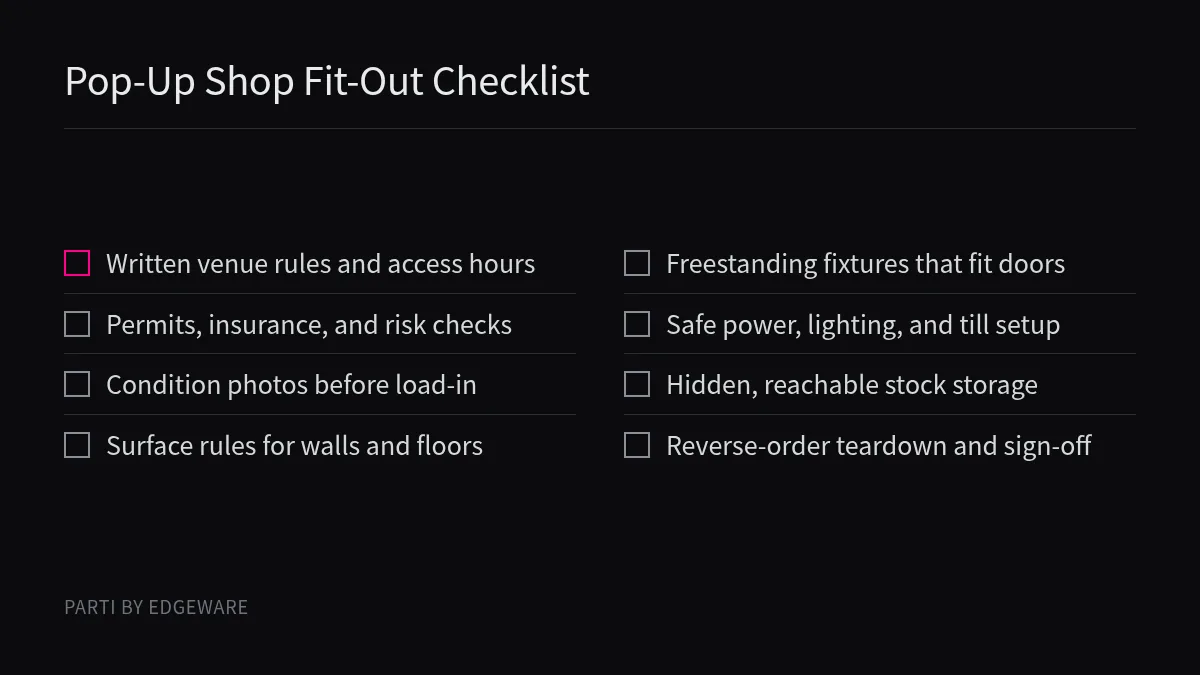
A pop-up shop fit-out checklist covers four stages: settling venue rules, permits, and cost headings in writing before load-in, agreeing what can touch walls and floors, planning freestanding fixtures and safe utilities, and booking a reverse-order teardown with a condition sign-off.

A pop-up only trades for a short run, so the build has to go up fast and come out without a dispute. The four questions below follow the job in the order it happens.
What should you settle before load-in?
Walking into a venue without written rules turns setup day into an argument. You lose trading hours while waiting for answers. Settle the terms first.
Before load-in, get written agreement on access hours, included shelving, signage approval, and health and safety duties. Budget across rent, fit-out, signage, marketing, staff, payment gear, insurance, and risk assessments, and apply early for any temporary event notices or planning permissions.
Start with the budget and the paperwork before you pack a van. In the UK, Square's guide to opening a pop-up shop1 notes that a pop-up can run for a day, a few days, weeks, or months, in a standalone shop, a space inside a larger store, a trade stand, or an outdoor stall. Rent tracks the location and size: Square mentions £1,000 a day or more in central London, down to £1 a day for a single shelf or countertop box, and notes that pre-pandemic rents outside central London had fallen by 30 to 50 percent. If you are still weighing your format, read our guide on whether to choose a pop-up or a short lease.
On top of rent, Square groups the other costs to plan for into seven clear categories:
- Store fit-out, furniture, and display units (which you might build yourself, hire, or ask the landlord to include)
- Signage (where landlords often want the right to approve size and appearance)
- Marketing
- Staffing (remembering minimum wage laws apply if you hire people rather than leaning on friends and family)
- Point of sale equipment, tills, and card or mobile payment devices (Square cites £19 plus VAT for its own reader)
- Insurance, such as public liability insurance
- Health and safety risk assessments
Check your regulatory calendar early. In England and Wales, if your pop-up involves a licensable activity on unlicensed premises, such as selling alcohol, providing entertainment like music or dancing, or serving hot food or drink between 11pm and 5am, GOV.UK's Temporary Event Notice guidance2 states that an individual aged at least 18 must apply to the local council for a Temporary Event Notice (TEN) at least 10 clear working days before the event (or 5 to 9 clear working days for a late TEN) and pay a £21 fee. An event under a TEN must have fewer than 500 people at all times, including staff, and last no more than 168 hours (7 days). You must also display a copy of the notice where it can be easily seen and keep the notice in a safe place on site. We cover the wider permit rules in our guide on whether you need a licence for a pop-up shop. Other places have different rules, and your own contract and local authority decide what applies to your event.
Pre-load-in venue questions
- What are the exact load-in, trading, and teardown hours, and are there noise or working hour restrictions?
- Are utilities (electricity, gas, water) adequate and in good working order?
- Does the proposed use match the building's planning use class and title covenants?
What can touch the walls and the floor?
One stray drill hole or scuffed floorboard can cost you your deposit. Landlords guard their surfaces closely. Agree on every fixing before you build.
Check your agreement for rules on alterations before touching any surface. In multi-let buildings, structural and external changes are usually banned, and internal non-structural work often needs landlord consent. Photograph the room at load-in and agree a schedule of condition.
Treat the building shell with care, especially when you only rent part of a property. In England and Wales, the RICS Code for leasing business premises3 explains how commercial leases handle alterations, fit-out, and repairs. While a three-day pop-up uses a simpler agreement than a multi-year lease, landlords apply the same logic to protect the value of their property and any neighbouring premises.
| Lease or venue situation | Typical rule on alterations and surfaces (RICS Code, England and Wales) |
|---|---|
| Lease of an entire building | Landlords do not normally prohibit or require consent for internal non-structural alterations that do not harm the building's character, value, stability, statutory compliance, or energy performance, provided the tenant does the work properly without damage or nuisance and gives written details. |
| Unit in a multi-let building | Structural and external alterations are commonly prohibited (apart from shop fronts where appropriate). Internal non-structural alterations usually require landlord notification or prior consent (not to be unreasonably withheld or delayed). |
| Signage on the premises | Landlords often restrict signage. Where the landlord wants to approve the size and appearance, tenants should ask that approval not be unreasonably withheld or delayed. |
| Repairing obligations | To limit repairing duties to the initial state of the room, a schedule of condition is normally required, and both sides agree who pays for it. |
Before a single crate comes through the door, walk the room with the landlord or venue manager. Take clear photographs of the walls, floors, ceilings, windows, and lighting, and attach them to a written schedule of condition. Ask in writing what you may touch. If the venue forbids wall fixings or floor adhesives, your entire fit-out has to stand on its own feet. Even when a landlord allows internal work, you must carry it out without causing damage or nuisance to neighbouring units.
Surface check on arrival
- Photograph existing scuffs, holes, and floor wear with the venue contact present.
- Confirm where signage can hang and how it may be fixed.
- Check that fire exits, alarms, and disability access routes stay completely clear of your build.
What do the fixtures and the stock need?
Heavy counters that stick in the doorway ruin your schedule before you open. Exposed cables trip shoppers. Your display needs to carry in easily and stand safely.
Fixtures need to fit through the venue's entrance, stand securely without wall fixings when required, and match your brand. Keep mains services unaltered, cover all cables, check fire and disability access compliance, and tuck stock storage out of sight.
Square points out that a fit-out can be done on a small budget, even in a homemade way if a laid-back look suits your products, or by hiring shelving or negotiating with the landlord to include display units. Whatever you spend, Square warns not to scrimp on safety, and reminds sellers that homemade fittings and signage still have to reflect well on the brand because the shop shapes how people see your business. Freestanding display units that break down into flat parts suit a short run well, though the right weight and size depend on your venue's doors and lifts. That kind of modular room thinking is also what we are exploring for the room.
Check the utilities before you place your counters. The RICS code notes that altering services like electricity and gas can be expensive, so you should make sure the property already has adequate mains services in good order. Map your layout around the existing wall sockets so your point of sale equipment, card readers, and feature lighting plug in without trailing wires across walkways. You also have to ensure the setup complies with health and safety rules, fire regulations, and disability access legislation.
Fixture and stock layout rules
- Measure every doorway, corridor turn, and lift before building or hiring display units.
- Test every shelf and rail for stability once loaded with stock.
- Dedicate a hidden, reachable corner for backup stock so staff can restock without blocking the shop floor.
- Keep a short daily log while you trade: note what sold, what people asked for, and where the layout felt cramped.
What does teardown need?
Exhausted crews make mistakes on the last night. Lost bolts and rubbish left behind lead to landlord charges. Plan the exit before you even open.
Teardown needs a pre-agreed handback check with the venue, a reverse-order dismantling plan, labelled crates for reusable parts, materials to patch any marks, and a way to remove all rubbish and hired gear before your access window closes.
Treat teardown as a reverse build, not a rush for the van. Before you start pulling displays apart, confirm the handback inspection time with the landlord or venue manager so you know who is signing you out. We wrote a full companion guide on how to plan a pop-up teardown day if you want a hour-by-hour sequence for the final night.
Teardown sequence
- Pack remaining stock first and move it out of the way of the build crew.
- Unplug and box payment devices, tills, and lighting, coiling cables into labelled bags.
- Dismantle fixtures in the exact reverse order of setup, bagging screws and brackets with the panels they belong to so they go up faster next time.
- Separate hired shelving and furniture near the door for collection.
- Clean the floor, repair any marks your event caused, and Bag all rubbish to take with you.
- Walk the empty space with the venue contact, compare it against your load-in photographs and schedule of condition, take final photos, and get a written sign-off.
Conclusion
Settle the rules and permits in writing before you arrive, build freestanding displays that respect the room, and pack down in reverse order.
About Parti
Parti by Edgeware is Edgeware's first industry solution. We are designing a café where one room can serve several uses, reset by hand between them. We have not published how long a reset takes, because we have not tested it. That is a design aim, not a result. The first café is planned for Hangzhou and is not open. See the room and how the floor connects. This guide is for brands, makers and organisers running a short event. It is general information, not legal advice, and your own contract and local rules decide.
Sources
- Square UK: How to open a pop-up shop: Covers pop-up formats, UK rent examples, and the seven non-rent cost categories to budget for.
- GOV.UK: Temporary Events Notice (England and Wales): Explains when a pop-up in England and Wales needs a TEN, application deadlines, fees, and headcount limits.
- RICS: Code for leasing business premises, England and Wales (2020): Sets out commercial lease standards on schedules of condition, alterations, signage approval, utilities, and statutory compliance.