What goes on a pop-up opening day checklist?
Setup and teardown eat your weekend and budget when you guess the order of tasks. This time-ordered checklist gives you a clear sequence to copy.
Published
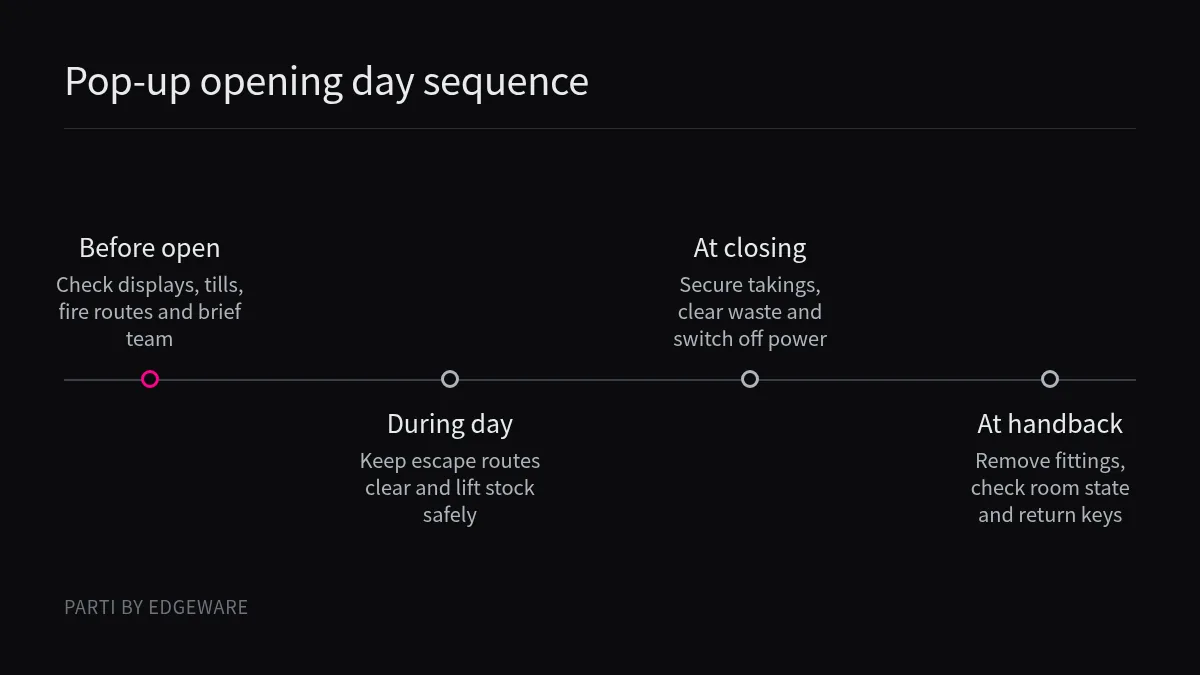
A pop-up opening day checklist covers four phases: checking stock, payments, fire routes, and manual handling before opening; keeping walkways clear and lifting safely during trading; securing cash, stock, and power at close; and returning the space as agreed at handback.

Each phase of the day gets its own short list below. Here is what to check from the morning walk-through to the final key handover.
What do you check before the doors open?
Morning setup gets chaotic fast. Checking payments, displays, fire precautions, and heavy lifting in order stops last-minute panic before your first customer walks in.
Before opening, check that display units and stock are in place, test tills and card readers, confirm fire precautions and brief everyone on procedures, and use safe manual handling for any heavy boxes remaining on the floor.
A pop-up is a temporary in-person shopping space in a standalone unit, inside a larger shop, at an event stand, or outdoors, running for a day, a few days, weeks, or months. In the UK, Square UK's pop-up shop guide1 lists store fit-out, display units, signage, staffing, point of sale and card or mobile payment devices, insurance and health and safety risk assessments among the things to plan. If you hire people in the UK, you are bound by minimum wage laws. Before you reach opening morning, our pop-up shop fit-out checklist covers the build preparation.
In England and Wales, fire safety law places duties on the responsible person, such as the employer or occupier in control of the premises. According to GOV.UK's fire safety risk assessment guidance2 for small places of assembly (up to 60 people) and medium places of assembly (up to 300 people) in England, fire precautions must be in place where necessary and reasonable, and you must inform temporary or contract workers of relevant risks, who the nominated competent persons are, and the fire safety procedures for the premises. Other places have different rules, and your own contract and local authority decide what applies to your event.
In Great Britain, the HSE brief guide to manual handling at work3 helps employers reduce injury risks under the Manual Handling Operations Regulations 1992, using simple risk filters for lifting, lowering, carrying, pushing, and pulling.
Pre-opening checklist items
- Store fit-out, furniture, and display units: Check that shelving and home-made or hired fittings are stable and reflect well on your brand without scrimping on safety.
- Signage and pricing: Confirm signs are visible and clearly placed before trading begins.
- Point of sale and card payment devices: Run a test check on tills, card payment machines, and mobile payment devices so you can get paid without delays.
- Fire risk assessment and precautions: Verify that the general fire precautions identified in your risk assessment, including measures for any flammable materials stored, are in place.
- Temporary staff and building co-ordination: Brief all staff and any outside or temporary workers on fire risks, nominated competent persons, and fire procedures, and co-ordinate with other responsible persons if you share a multi-occupied building.
- Manual handling for final stock: Apply risk filters for lifting, lowering, carrying, and pushing or pulling heavy stock boxes so nobody starts the day with a back injury.
What do you check during the day?
Once customers arrive, boxes and bags creep into walkways. A mid-day check covers escape paths, stock tidiness, and manual handling on the shop floor.
During the day, check that walkways and fire escape routes stay unobstructed, restock shelves without leaving cartons in public paths, handle replenishment boxes using safe lifting and carrying practices, and keep your payment point clear and working.
Trading hours bring deliveries, empty packaging, and shifting displays. If you operate in a compact footprint, our guide to pop-up shop ideas for a small space looks at how layout choices keep the floor workable. We do not know how busy your specific hour-by-hour trading will be, so we tie checks to tasks like restocking rather than fixed clock times.
When you share a building or adjoin other complexes, your daytime operations can affect neighbours. In England, the responsible person must co-operate and co-ordinate with other responsible persons in the building and inform them of significant risks and how those risks are controlled. Keeping your own unit orderly and keeping flammable packaging under control supports the precautions set out in your fire risk assessment.
Physical fatigue also builds up over a shift. Moving stock from a back corner or under-table storage involves repeated lifting, lowering, and carrying, or pushing and pulling cages and trolleys. Keeping the simple risk filters from the Great Britain manual handling guidance in mind stops staff from rushing heavy lifts in front of customers.
Daytime operational checks
- Escape routes and shared areas: Check that customer bags, queue barriers, and display stands have not drifted into fire escape routes or shared building corridors.
- Restocking pathways: Move one box at a time and clear empty cartons immediately so walkways stay open for relevant persons in the premises.
- Flammable packaging storage: Keep wrapping paper, cardboard, and any flammable materials tidy and away from ignition sources in line with your fire risk assessment.
- Lifting and lowering on the shop floor: Use safe lifting, lowering, and carrying filters when pulling stock from low shelves or high stacks, and ask another person for help with awkward loads.
- Pushing, pulling, and seated handling: Check that anyone pushing or pulling stock trolleys or handling items while seated at a till has a clear path and a low-risk setup.
- Point of sale readiness: Keep the till area uncluttered and check that mobile payment devices stay charged for the afternoon.
What do you check at closing?
Tired teams make mistakes at the end of a shift. A short closing list covers your takings, your stock, and the building before you lock up.
At closing, reconcile and secure cash and payment terminals, lock away high-value stock, clear rubbish and flammable packaging, switch off non-essential electrical equipment, and check that all fire exits and routes remain clear before locking up.
If your pop-up runs for several days, weeks, or months, nightly closing is distinct from final teardown. You are resetting the room so tomorrow morning's pre-opening check takes minimal effort, while leaving the premises safe overnight for the landlord and any adjoining occupiers.
In a multi-occupied building, what you leave plugged in or piled up overnight affects everyone else in the complex. Co-operating with other responsible persons in the building means leaving your part of the premises with fire precautions intact and no accumulated flammable waste.
End-of-day closing checklist
| Check area | What to do at closing | Why it matters |
|---|---|---|
| Point of sale and payments | Lock away tills, card readers, and mobile payment devices, and put cash away as your own procedure says. | Secures takings and keeps payment hardware ready for the next day. |
| Stock and displays | Cover or lock away small products and check that homemade or hired display units are stable. | Reduces the risk of overnight loss or unstable displays when you reopen. |
| Rubbish and flammable materials | Bag and remove waste packaging and store any flammable materials safely. | Reduces the likelihood of materials being involved in a fire. |
| Power and appliances | Switch off display lighting and non-essential plugs at the wall. | Removes unnecessary heat and ignition risks while the space is empty. |
| Doors, windows, and exits | Confirm internal fire doors and exit routes are clear of stacked stock before locking external doors. | Leaves escape routes clear for anyone still in the building. |
What do you hand back at the end?
The final night is where deposits and landlord goodwill are won or lost. A structured handback helps you close out the rental as agreed.
At the end of the pop-up, pack and remove all stock, signage, and hired or homemade fittings, check the unit against the condition you received it in, clear all waste, and hand back keys and access cards as agreed.
When your short rental finishes, every display unit, sign, and box of stock has to leave the building. For the full packing order and transport sequence, pair this list with our pop-up teardown day plan. You can also see how we think about physical space layout on our room page.
Teardown involves the heaviest lifting of the entire event. Carrying display furniture, shelving, and full stock crates out to vehicles is manual handling, and the HSE guide links it to musculoskeletal disorders. Pacing the pack-down and applying manual handling risk assessments for lifting, carrying, pushing, and pulling matters just as much on the way out as it did on arrival.
Final handback checklist
- Safe dismantling and load-out: Assess lifting, lowering, carrying, and pushing or pulling tasks before moving heavy furniture or hired shelving out of the unit.
- Complete removal of fittings and signage: Take down all temporary signage, display units, and point of sale equipment so nothing is left behind.
- Flammable substances and waste clearance: Remove all remaining stock, packaging, and any flammable substances from the premises.
- Co-ordination with building management: Let other responsible persons or building managers know your work and load-out are complete, especially if you used shared corridors or loading bays.
- Condition walk-through: Check walls, floors, and fixtures against the state you received them in under your rental agreement.
- Keys and access return: Hand back all keys, fobs, and passes to the landlord or host and confirm in writing that the space is returned.
Conclusion
Work through the four lists in order: before opening, during the day, at closing, and at handback.
About Parti
Parti by Edgeware is Edgeware's first industry solution. We are designing a café where one room can serve several uses, reset by hand between them. We have not published how long a reset takes, because we have not tested it. That is a design aim, not a result. The first café is planned for Hangzhou and is not open. See the room and how the floor connects. This guide is for brands, makers and organisers running a short event. It is general information, not legal advice, and your own contract and local rules decide.
Sources
- Square UK: How to open a pop-up shop: Covers UK pop-up formats, fit-out, payment devices, insurance, risk assessments, and minimum wage notes.
- GOV.UK: Fire safety risk assessment, small and medium places of assembly: Explains England fire risk assessment duties, responsible person roles, staff briefings, and multi-occupied building co-operation.
- HSE: Manual handling at work, a brief guide: Outlines Great Britain manual handling regulations and simple risk filters for lifting, carrying, pushing, and pulling.