What pop-up shop ideas work in a small space?
Small pop-up spaces clutter up fast. Setup and teardown eat your weekend and budget, so here is a practical sequence to copy.
Published
Small pop-up ideas work better when each one focuses on one activity: selling a tight range, running demonstrations, taking orders, or sharing a host business. Keep paths clear, use freestanding fixtures you carry in, and settle costs, permissions and safety before opening.

In a compact room, every piece on the floor has to earn its place. We break the decisions into four steps: what you do inside the space, how people move through it, what you put your goods on, and the paperwork that has to clear before the doors open.
What can a small pop-up sell or show?
Stuffing your entire catalogue into a tiny corner guarantees chaos. You spend hours unpacking crates nobody can reach, so pick one clear format instead.
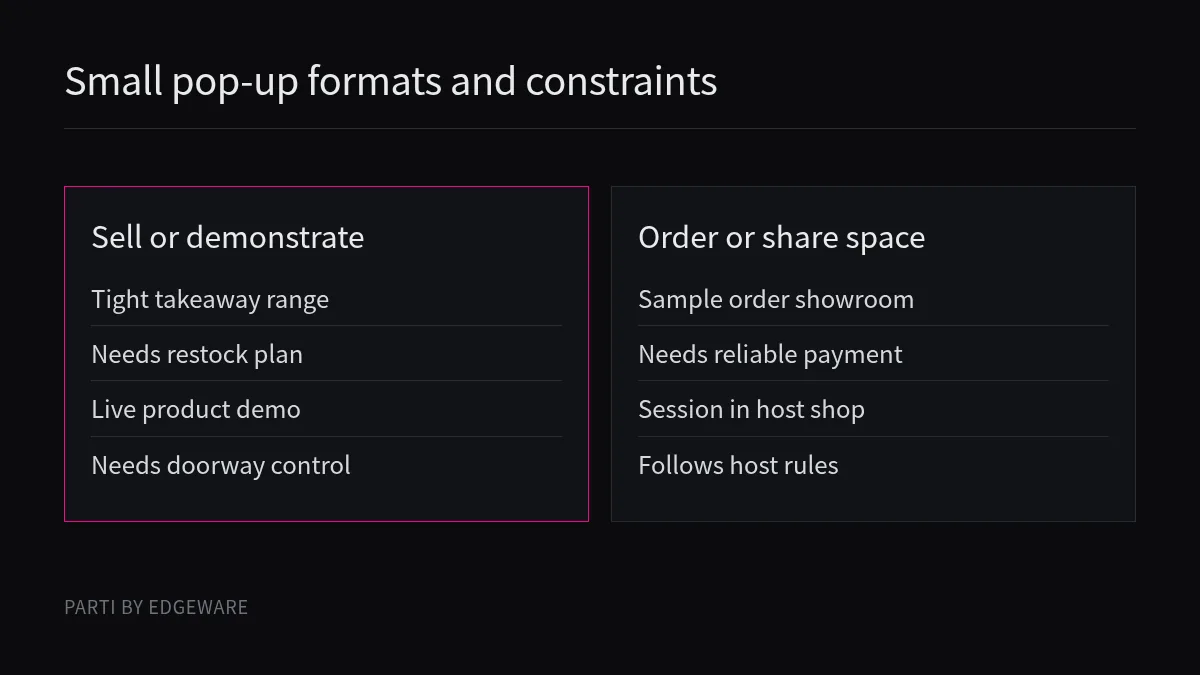
A small pop-up works best when you limit the format to one job: selling a focused range, demonstrating a hero item, taking pre-orders from samples, or hosting a short session inside an existing shop.
In the UK, Square UK's guide to opening a pop-up shop1 notes that a pop-up can be a standalone store you take over for a short period, space within a bigger commercial outlet or shop, a trade stand at an event, or an outdoor stall, and that miniature pop-ups can consist of a single shelf in a store or a countertop box. It also notes that you can set one up for a day, a few days, weeks or months. Choosing the right format comes down to matching what you want people to do with the physical limits of the room.
Four formats and their practical constraints
- Sell a tight, seasonal or new range: You bring only the items people can carry away immediately, which cuts backroom storage needs, though you must plan how to restock if a line sells out mid-afternoon.
- Demonstrate or sample a single concept: Letting visitors touch, test or see one focal product removes the need for deep shelving, yet it demands staff who can repeat the explanation all day without blocking the doorway.
- Run a showroom that takes orders: Displaying one sample of each variation so shoppers order for delivery eliminates stock boxes on site, which depends on your payment device and connection working all day.
- Host a short session inside another business: Borrowing a corner or table inside a complementary host venue puts you in front of the host's own customers, though you must work around the host's opening hours, noise limits and space rules.
| Format | Main constraint to plan for |
|---|---|
| Small retail range | On-site replenishment and bag storage |
| Live demonstration | Staff stamina and crowd bottlenecking |
| Sample and order point | Reliable payment and order capture |
| Space inside a host shop | Host rules, permissions and shared access |
We do not know whether a display-only format or a take-away stock format will convert better for your specific product until you test both with real passers-by. If you want to see how a compact footprint can be arranged for different daytime uses, look at our planned room concept.
How do you lay out a small footprint?
When a few browsers block the doorway, everyone else walks past. A cramped floor plan turns people away, so you need a layout that keeps feet moving.
Lay out a small space with one clear route in and out, an unobstructed walkway, a single counter or till point that does not block the entrance, and all spare stock stored out of sight.
When you only have a corner, an alcove or a compact room, the floor plan has to prevent bottlenecks before they start. People hesitate to step into a space if they cannot immediately see how they will step back out without squeezing past a stranger.
Five layout rules for a tight floor plan
* Set a clear way in and out: Keep the threshold completely open so passers-by can step inside without brushing against tables or waiting for someone at the till to move. * Keep a single unobstructed path: Arrange units around the perimeter or along one wall so visitors have a natural line of sight from the entrance to the focal display and back out. * Position the counter or till point off the doorway: Put your payment device and wrapping surface where a short queue will not spill across the threshold and stop new visitors from entering. * Hide reserve stock out of the walkway: Store spare boxes under draped tables, inside closed plinths, or in a designated back corner agreed with the host, never in the customer path. * Leave standing room at the focal point: If your format asks people to stop and test something, give that spot extra floor width so one conversation does not close the whole shop.
Before you load the van, run through a pop-up shop fit-out checklist so you know where every cable, crate and sign will sit on the floor plan.
What fixtures suit a short stay?
Heavy shopfitting ruins a weekend pop-up before you open. If you need power tools and patch-up paint on Sunday night, the fixtures are wrong.
Choose freestanding fixtures that you can carry in and out by hand, and never fix anything to walls or floors unless the host or landlord agrees in writing beforehand.
In the UK, Square UK notes that store fit-out, furniture, display units and signage are key cost categories to consider alongside rent, and that you may be able to build displays yourself, hire shelving, or negotiate with your landlord to include them, while reminding organisers not to scrimp on safety. Whatever route you pick, plan to leave the space as you found it, as your agreement with the host sets out.
Five fixture choices for a short stay
- Freestanding folding tables and trestles: They pack flat into a car or small van, set up without tools, and give you instant surface area plus hidden under-table storage when covered.
- Carry-in shelving units and crate stacks: Modular boxes or lightweight freestanding shelves let you build vertical display height without drilling into the host's plasterboard or masonry.
- Countertop display boxes or single-shelf trays: As Square UK points out for miniature pop-ups, a single shelf or countertop box can hold a micro-range inside another store without heavy teardown work.
- Weighted freestanding signage: Use freestanding boards (where the venue allows them) or tabletop signs rather than taping or screwing boards to painted walls.
- Pre-agreed wall or floor fixings only: Never drive screws, nails or heavy adhesives into walls or floors unless the landlord or host venue has explicitly agreed to those fixings and the repair method.
If you are weighing up whether to rent display units for the weekend or put together your own kit, read our guide on whether to hire, buy or build pop-up fixtures.
What do you settle before opening?
Turning up with stock and a table is only half the job. Overlooked insurance, missing payment kit or an unapproved activity can shut you down early.
Before opening, settle your budget across fit-out, signage, marketing, staffing, payment equipment, insurance and risk assessments, and secure any required local licences for alcohol, entertainment or late-night food.
In the UK, Square UK lists the main cost and planning areas on top of rent, especially for a standalone unit: store fit-out and display units, signage, marketing, staffing (keeping in mind minimum wage laws if you hire people), point of sale and card or mobile payment devices, insurance such as public liability insurance, and health and safety risk assessments.
If your pop-up involves regulated activities, you also have legal notices to sort out. In England and Wales, GOV.UK's Temporary Event Notice guidance2 states that you need a Temporary Event Notice (TEN) if you want to carry out a licensable activity on unlicensed premises, or if the activity is not included in the terms of an existing licence. Other places have different rules, and your own contract and local authority decide what applies to your event.
Pre-opening checklist for costs and England and Wales licensing
* Confirm all non-rent cost categories: Check off fit-out, signage, marketing, staffing, point of sale equipment, public liability insurance, and health and safety risk assessments as listed by Square UK. * Check if your activity is licensable (England and Wales): Under GOV.UK rules, licensable activities include selling alcohol, serving alcohol to members of a private club, providing entertainment (such as music, dancing or indoor sporting events), and serving hot food or drink between 11pm and 5am. * Respect TEN size and duration caps (England and Wales): Your event must have fewer than 500 people at all times (including staff running the event) and last no more than 168 hours (7 days), with at least a 24-hour gap between separate consecutive events. * Apply on time and pay the fee (England and Wales): You must be at least 18 to apply as an individual (not an organisation), pay a fee of £21, and apply at least 10 clear working days before the event (or between 5 and 9 clear working days before for a late TEN). * Stay within annual quotas and display the notice (England and Wales): An individual can get up to 5 TENs a year (including up to 2 late TENs), or up to 50 TENs (including up to 10 late TENs) if holding a personal alcohol licence; a single premises can have up to 15 TENs for no more than 21 days total per year, and you must keep the TEN in a safe place on site and display a copy where it can be easily seen.
For a fuller breakdown of licences and permissions, check our guide on whether you need a licence for a pop-up shop.
Conclusion
Pick one focused format, keep the walkway clear, bring freestanding fixtures you can carry out, and settle your risk assessments and licences before opening day.
About Parti
Parti by Edgeware is Edgeware's first industry solution. We are designing a café where one room can serve several uses, reset by hand between them. We have not published how long a reset takes, because we have not tested it. That is a design aim, not a result. The first café is planned for Hangzhou and is not open. See the room and how the floor connects. This guide is for brands, makers and organisers running a short event. It is general information, not legal advice, and your own contract and local rules decide.
Sources
- Square UK: How to open a pop-up shop: Covers pop-up formats, miniature shelf options, and the non-rent cost categories to budget for in the UK.
- GOV.UK: Temporary Events Notice (England and Wales): Sets out rules, fees, deadlines and headcount caps for licensable activities at temporary events in England and Wales.