Do you need a licence for a pop-up shop?
Short events move fast, and missed paperwork can shut down your stall after you paid for setup. This guide gives you a clear sequence to follow.
Published
Whether you need a licence depends on where you trade, what you sell, and how your venue is already licensed. Selling standard retail goods in an existing shop often uses the host's permissions, while alcohol, late hot food, or entertainment requires notices.

Every council and landlord sets its own conditions, and this guide is not legal advice. Before you build displays or pay a deposit, work through four practical questions to see which permissions apply to your event.
Does a pop-up shop need a licence?
Many founders assume a short event slips under the radar. Finding out on opening morning that your landlord or council requires permits ruins your weekend.
A pop-up shop does not have one single pop-up licence. Instead, your requirements depend on the premises type, your contract with the landlord or host, and regulated activities like serving alcohol, playing music, or trading on a public street.
Matching the format to the paperwork
In the UK, Square UK's guide to opening a pop-up shop1 notes that a pop-up is a temporary in-person shopping setup, usually inside a bricks-and-mortar venue, lasting a day, a few days, weeks, or months. It can be a standalone store takeover, a space inside a bigger commercial outlet, a trade stand at an event, or an outdoor stall similar to a market. Because these formats look so different on the ground, local authorities and landlords treat them differently.
When you rent a single shelf, a countertop box, or a corner inside an active shop, the host business already controls the building. If you are planning on hosting a pop-up inside a café, your agreement with the host usually covers basic premises use, provided you only sell dry retail goods during normal daytime hours. When you take over a vacant shop on the high street or pitch a marquee outdoors, the responsibility shifts onto your shoulders. If you are still weighing whether to choose a pop-up or a short lease, remember that taking over an empty unit means handling your own insurance and safety paperwork.
Beyond council permissions, Square UK points out that standalone pop-up operators need to budget for public liability insurance, health and safety risk assessments, and minimum wage laws if hiring staff. Other places outside the UK have different rules, and your own contract and local authority always decide what you need to file.
| Pop-up format | Typical premises control | Main paperwork focus |
|---|---|---|
| Space inside an existing shop | Host business manages the building | Host agreement, public liability insurance, product safety |
| Vacant high street store takeover | You act as temporary occupier | Short-term lease or licence to occupy, fire risk assessment, activity licences |
| Trade stand at an organised market | Event organiser holds master permits | Exhibitor contract, stall risk assessment, specific food or alcohol notices |
When does a temporary event notice apply?
Pop-up organisers often add drinks or a DJ to draw a crowd. Doing that without checking local licensing deadlines can get your launch party blocked.
In England and Wales, you need a Temporary Event Notice (TEN) to carry out licensable activities on unlicensed premises, or when an existing licence does not cover them. This covers alcohol sales, entertainment, and late-night hot food or drink.
Licensable activities and hard limits
In England and Wales, GOV.UK's Temporary Events Notice guidance2 states that you must contact your local council for a TEN if you plan to carry out a licensable activity on unlicensed premises, or if that activity is not included in the terms of an existing licence. Licensable activities include:
* Selling alcohol * Serving alcohol to members of a private club * Providing entertainment, such as music, dancing, or indoor sporting events * Serving hot food or drink between 11pm and 5am
The rules in England and Wales set strict size and time limits on a TEN:
* You must be at least 18 to apply, and you can only apply as an individual, not an organisation. * Your event must have fewer than 500 people at all times, including staff running the event. * The event can last no more than 168 hours (7 days), and there must be at least a 24-hour gap between separate consecutive events you organise. * A single premises can have up to 15 TENs applied for in one year, up to a total event length of 21 days. * An individual can get up to 5 TENs a year (including up to 2 late TENs), or up to 50 TENs a year (including up to 10 late TENs) if holding a personal licence to sell alcohol.
Deadlines and objections
Applying is formally known as serving a notice, and it costs £21. You must apply at least 10 clear working days before your event, which does not include the day the council receives the application or the day of the event itself. You also have to send a copy to the police and environmental health at least 10 working days ahead, unless you apply online, in which case the council contacts them for you.
The latest you can apply for a late TEN is 5 clear working days before the event (and not earlier than 9 clear working days). The council cannot refuse a notice unless the police or environmental health object within 3 working days on grounds of crime and disorder, public nuisance, public safety, or risk of harm to children. If they object to a standard TEN, the council's licensing committee holds a hearing no later than 24 hours before the event. If they object to a late TEN, there is no hearing: the notice is invalid and you cannot hold the event. Once approved, you must keep your TEN in a safe place at the venue and display a copy where it can be easily seen.
What about food, alcohol and fire safety?
Packing temporary tables, stock cartons, and cables into a borrowed room creates hazards fast. Ignoring fire safety puts guests at risk and breaches legal duties.
Even when your pop-up does not need an entertainment or alcohol licence, fire safety rules still apply. In England and Wales, anyone with control of premises must carry out a fire risk assessment, coordinate with neighbours, and brief temporary staff.
Fire risk duties in shared and temporary spaces
When you set up a temporary shop, you are responsible for keeping people safe around your fixtures and stock. According to GOV.UK's fire safety risk assessment guide for small and medium places of assembly3 (which covers guidance for England under the fire safety Order applying in England and Wales), responsibility rests with the "responsible person". That includes the employer and any other person who has control of any part of the premises, such as an occupier. The guide covers small premises accommodating up to 60 people and medium premises accommodating up to 300 people, including community centres, village halls, temporary structures, and marquees or tents.
Where alterations are proposed to existing premises, they may also be subject to building regulations. We recommend building fire checks directly into your pop-up shop fit-out checklist before a single box arrives on site. Under the GOV.UK guidance, if you have control of part of a building or bring in outside help, your duties include:
* Carrying out a fire risk assessment and putting general fire precautions in place where necessary, to the extent reasonable and practicable. * Taking account of any flammable materials and substances you handle or store to minimise the likelihood of them being involved in a fire. * Informing non-employees, such as temporary or contract workers, of the relevant risks to them, who the nominated competent persons are, and the fire safety procedures for the premises. * Providing the employer of any outside agency staff working in your premises with clear information on risks and preventive measures, along with appropriate instructions for those workers. * Cooperating and coordinating with other responsible persons who have premises in the same building, informing them of significant risks you find and how you will control risks affecting their employees. * Before employing a child, providing a parent with clear information on the identified risks to that child and the protective measures in place.
If your premises are subject to a licence, the fire authority may review your risk assessment during the approval process. If you read the official guide and feel unable to apply it yourself, you should seek advice from a competent person.
Who should you ask?
Guessing which rules apply wastes hours of search time. Asking the wrong person in the wrong order leaves you waiting on approvals while rent ticks.
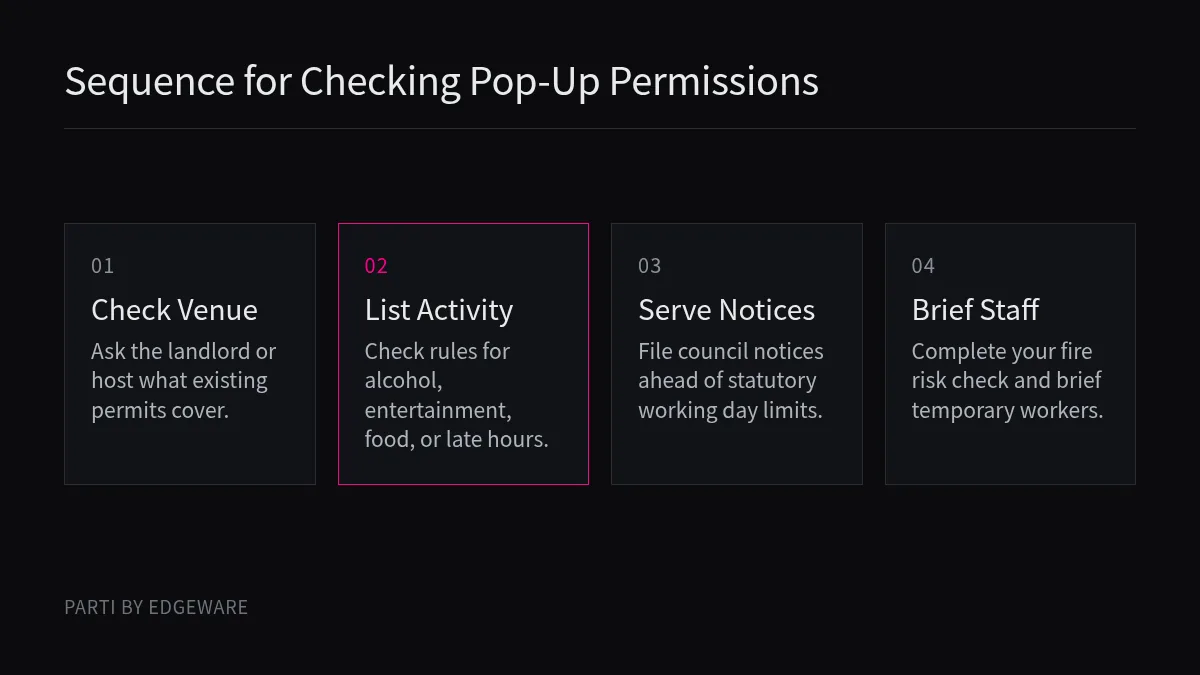
Start with the landlord, host venue, or market organiser to confirm what their existing licences and insurance already cover. Next, contact the local council's licensing, environmental health, and fire safety teams with your exact dates, headcount, and activity list.
A practical sequence before you sign
We do not know the specific bylaws of your town or the terms of your venue's head lease, so you should never rely on generic assumptions. Instead, ask the people who hold the paperwork in a logical order before you pay for fabrication or transport.
- Ask the venue host or landlord first. Request the building's existing premises licence summary, permitted use class, maximum occupancy, and existing fire risk assessment. Ask whether your planned activities (such as serving complimentary drinks, playing background music, or bringing in temporary heaters) are allowed under their insurance and head lease.
- Ask the event organiser if you are booking a stall. If you are trading at a market or exhibition hall, ask what master licences the organiser holds, what public liability cover they require from exhibitors, and when they need your stall risk assessment.
- Contact your local council licensing and environmental health teams. Give them the postcode, your operating hours, maximum attendance including staff, and whether you plan to sell food, serve alcohol, or put on entertainment. In England and Wales, remember the 10 clear working days deadline for a standard TEN.
- Brief your staff and contractors before setup morning. Share the building's fire procedures, emergency exits, and nominated competent persons with every temporary worker, freelancer, and neighbouring occupier on the floor.
If you are planning how your team will coordinate local events and pop-ups, take a look at our ways to connect with Parti as we research future space designs.
Conclusion
Check your venue's existing permissions first, apply to your local council ahead of statutory deadlines, and brief everyone on fire safety before setup begins.
About Parti
Parti by Edgeware is Edgeware's first industry solution. We are designing a café where one room can serve several uses, reset by hand between them. We have not published how long a reset takes, because we have not tested it. That is a design aim, not a result. The first café is planned for Hangzhou and is not open. See the room and how the floor connects. This guide is for brands, makers and organisers running a short event. It is general information, not legal advice, and your own contract and local rules decide.
Sources
- Square UK: How to open a pop-up shop: Explains UK pop-up formats, typical setup costs, insurance considerations, and risk assessments for temporary retail.
- GOV.UK: Temporary Events Notice (England and Wales): Official rules, headcount limits, fees, and working-day deadlines for licensable activities in England and Wales.
- GOV.UK: Fire safety risk assessment, small and medium places of assembly: Official guidance on responsible person duties, temporary workers, and shared buildings in England and Wales.