Should shop fixtures be made locally or flat-packed?
Buying shop fixtures means weighing workshop joinery against flat-packed parts. Bulky freight and tight doorways cause install-day surprises. This guide covers what to ask first.
Published
Choose between local-made and flat-pack fixtures by asking how each option handles lead times, design changes after ordering, site access, assembly labour, repairs, and end-of-lease removal. Neither approach is always faster or cheaper, so match the method to your space.
The right answer depends on your doorway widths, your site crew, and what your lease says about leaving the unit at the end. Walking through four practical questions will show you where the effort and cost actually sit on your project.
What is the difference between local-made and flat-pack?
Labels like bespoke and modular get thrown around loosely in quotes. If you do not define how pieces arrive, you cannot price site work.
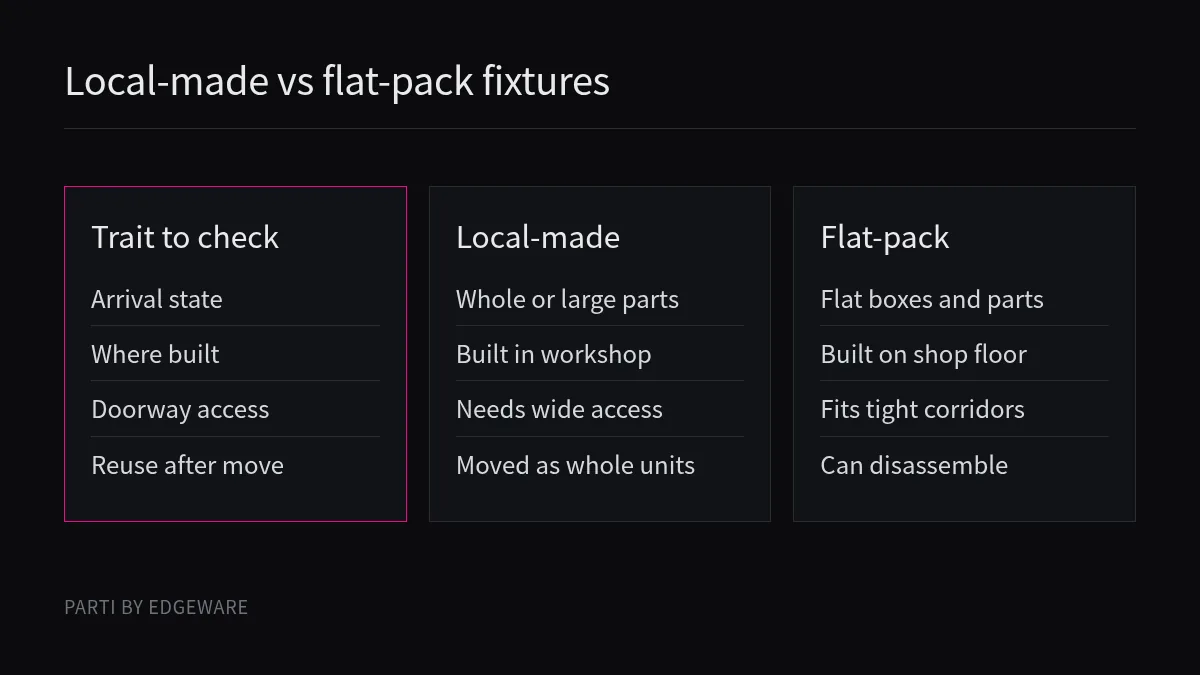
Local-made fixtures are usually built to order in a nearby workshop and delivered as whole units or large sections. Flat-pack fixtures are produced in standard or repeatable parts, packed flat in cartons or crates, and assembled on site.
Where the labour happens
The main difference between the two methods is where the assembly work takes place and how much tailoring to the room is required on installation day. A local workshop builds pieces to the measurements on your drawings, finishes them on the bench, and sends them out largely complete or in large joined sections. That keeps much of the cutting, gluing, and finishing inside a workshop, while shifting the effort to moving big, finished objects into your building.
Flat-pack fixtures take the opposite route. Panels, frames, and hardware travel in flat cartons or crates and get put together inside the shop. If you are looking at repeatable systems, our guide on what to check before buying modular shop fittings covers the connection and finish details worth reviewing before you commit.
| Trait to ask about | Local-made workshop fixtures | Flat-pack fixtures |
|---|---|---|
| How they arrive | Whole units or large pre-built sections | Flat boxes, panels, and hardware kits |
| Where assembly happens | Mostly in the workshop before dispatch | Mostly on the shop floor after delivery |
| Fit to uneven walls | Often scribed or built to site measurements | Standard sizes, with filler panels if needed |
| Moving to a new site | Moved as whole pieces if they clear doorways | Can often be taken apart or reconfigured |
Neither column is automatically cheaper or faster. A nearby workshop may have a full order book, while a catalogue flat-pack item may sit in a warehouse waiting on a missing bracket. Ask each supplier how the item leaves their door and what stays for your crew to finish.
How do lead times and changes compare?
Schedules slip when wall dimensions shift or stock runs out. Assuming one method is always quicker can leave a shop empty on opening week.
Do not assume either route is faster. Ask each supplier for their current production queue, stock availability, and transit schedule, and ask what happens if you need to change a measurement or finish after the order is placed.
Questions to ask before you pay a deposit
Lead time is made of several blocks: drawing sign-off, material sourcing, workshop or factory production, packing, and delivery. A flat-pack supplier might ship from stock, or they might make batches to order with a long queue. A local joiner might start next week, or they might wait on a sheet material or hardware delivery. We cannot know which option will land first without asking both suppliers to break down their dates in writing.
In Great Britain, commercial clients have formal duties over project time and coordination. Under the HSE guidance for commercial clients under CDM 20151, a commercial client is any individual or organisation carrying out a construction project as part of a business, and must allow sufficient time and resources for each stage of the project and provide pre-construction information to every designer and contractor bidding for or appointed to the work. Other places have different rules, and your own contract and local authority decide what applies to your site.
To keep control of your programme, put these points to every supplier before signing:
- Is this fixture in stock now, made to order from standard parts, or drawn and built from scratch?
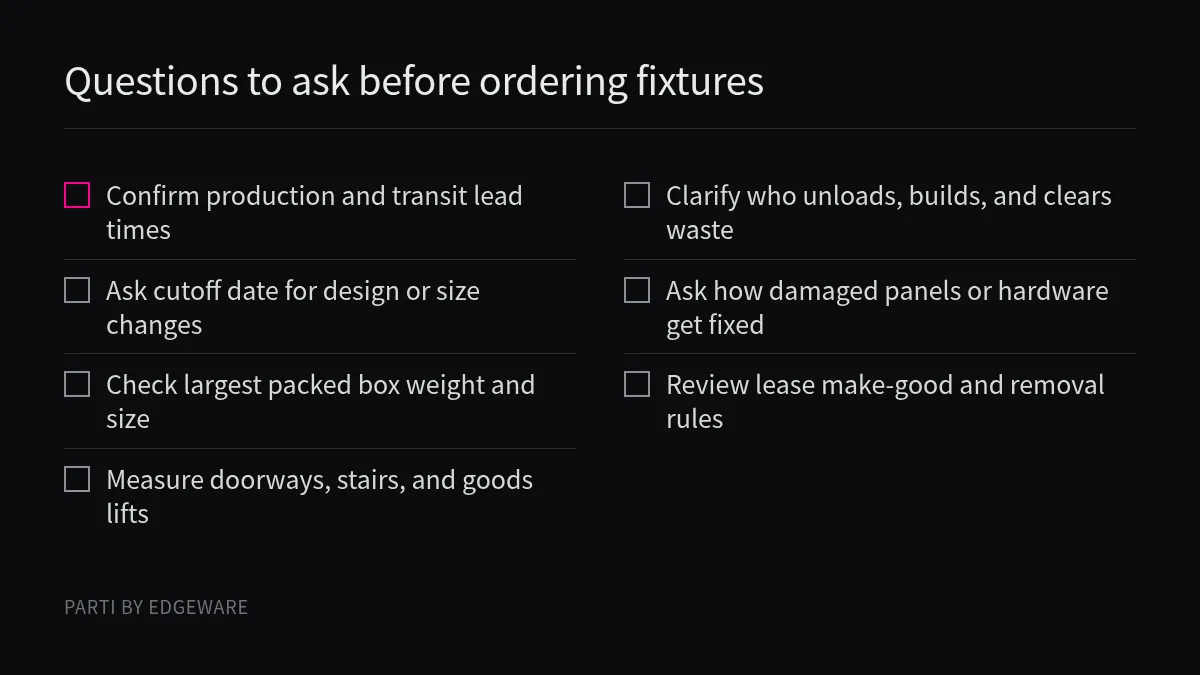
- When is the cutoff date for changing a dimension, colour, or cable cutout after we pay the deposit?
- If a site wall moves after plastering, can the piece be altered in the workshop or on site, and who carries that cost?
- If a single panel arrives damaged, how long does a replacement part take to reach the site?
When you line up bids from a joiner and a systems supplier, make sure you are comparing the same scope of design and site work; our guide on how to compare shop fit-out quotes walks through how to spot missing lines.
How do delivery and assembly compare?
A counter that looks fine on a drawing can jam in a stairwell. Missing the link between packing and installation ruins handover day.
Local-made units often arrive assembled, reducing on-site build time but demanding wide doors, lifts, and careful carrying. Flat-pack fixtures pass through tight corridors and stairs in smaller boxes, but require on-site space, tools, and time to assemble and level.
Moving, lifting, and building on site
How a fixture travels determines what happens at the kerb and inside your unit. Large pre-built joinery needs clear vehicle unloading, wide doors, shallow turns, and sometimes a goods lift. Flat-pack cartons are smaller and easier to wheel through narrow doors or carry upstairs, yet they multiply the number of boxes your team has to unload, unpack, assemble, and clear away as packaging waste.
Both methods involve physical handling by workers on delivery and install day. In Great Britain, the HSE brief guide on manual handling at work2 explains the problems associated with manual handling and helps employers carry out their duties under the Manual Handling Operations Regulations 1992, noting simple risk filters for lifting, lowering, carrying, pushing, and pulling operations. Whether your contractors are carrying a complete counter off a tail-lift or pushing stacks of flat-pack cartons on a trolley, the route from the lorry to the final spot in the shop needs to be planned before delivery day.
Walk the delivery path with a tape measure and ask these practical questions:
- What are the packed dimensions and weight of the largest single piece or box?
- Who unloads the vehicle, and does the quote cover bringing items past the front door to the room of use?
- How much clear floor area do installers need to unbox and build flat-pack units without blocking other trades?
- Who takes away pallets, crates, and cardboard at the end of the shift?
If you want to break down freight, access, and site labour lines in more detail, read our guide on where the cost goes when shipping shop fixtures.
How do you choose?
Picking fixtures just for opening day ignores repairs, layout shifts, and lease end. Tearing out built-in joinery later can drain your deposit.
Choose by matching the fixture to its lifespan and your lease. Check how damaged parts are repaired, whether units can move to a new site, and what your lease requires for make-good or redecoration during and after your tenancy.
Repairs, relocation, and the end of the lease
Think past the first week of trading. High-traffic cafés and shops scuff edges, dent panels, and wear out hinges. With a local workshop, repairing a damaged section usually means calling the original maker back to refinish or replace a built-in part. With a flat-pack or repeatable system, you might swap out a single panel or bracket, provided the supplier still stocks that range. Ask both types of supplier whether spare parts and finishes are kept available over time.
Your lease also shapes this choice. In Queensland, Australia, the Queensland Small Business Commissioner make good factsheet3 explains that a make good clause refers to the tenant's obligation to return the property to its original condition (or as specified in the lease) at the end of the lease term. Common make good terms include repairing damage caused during occupancy and removing all tenant-installed fixtures, partitions, joinery, installations, flooring, and ceiling finishes, and disputes over make good almost always affect the return of the tenant's bond (security deposit). The same factsheet distinguishes make good from redecoration clauses, which require maintenance or upgrade works at specified intervals during the lease term, and notes that under Section 50B of the Retail Shop Leases Act 1994 a clause requiring a tenant to refurbish or refit the shop is void unless the lease includes general details of the nature, extent, and timing of the requirements.
If your lease requires you to strip out every fixture you install at the end of the term, freestanding or demountable units that can be unbolted, flat-packed, or lifted into a van give you a chance to reuse your investment at a second site rather than paying to smash and dump fixed joinery. As we study how food and retail spaces get set up and taken down in our own spatial planning research, we find it helps to decide piece by piece: use local workshop joinery where a counter must fit an awkward corner or plumbing run, and consider demountable or flat-pack pieces where you want easy access and reuse later.
Conclusion
Ask suppliers about lead times, changes, access, repairs, and lease strip-out before ordering. Often the most practical fit-out mixes local joinery with flat-pack pieces.
About Parti
Parti by Edgeware is Edgeware's first industry solution. We are designing a café where one room can change how it is used by changing the props, with no rebuild of the room. Counters, tables and displays are meant to be carried in and out again by hand, so less is built into the walls and floor and less is left to take down when a lease ends. That is a design aim, not a tested result. The first café is planned for Hangzhou and is not open. See the room and how the floor connects. This guide is for tenants and project leads buying furniture and displays. It is general information, not legal advice, and your own contract and local rules decide.
Sources
- HSE: Commercial clients, roles and responsibilities (CDM 2015): Explains Great Britain commercial client duties on project time, resources, and pre-construction information.
- HSE: Manual handling at work, a brief guide: Outlines employer duties and risk filters for lifting, carrying, pushing, and pulling in Great Britain.
- Queensland Small Business Commissioner: Make good: Details commercial lease make good, redecoration clauses, fixture removal, and bond return in Queensland.