How do you host a pop-up inside a café?
Running a café leaves no spare afternoon to rebuild your dining room for a weekend guest. This guide gives you a repeatable way to host pop-ups cleanly.
Published
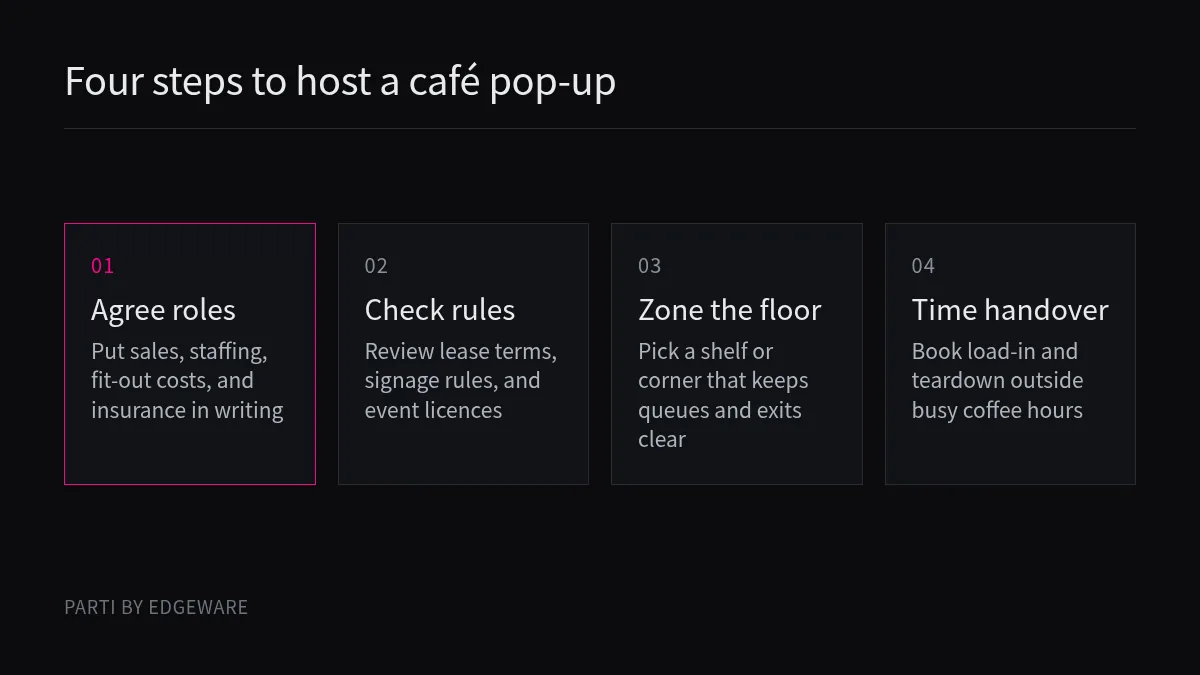
To host a pop-up inside a café, agree in writing who sells, pays, and insures, pick a footprint that keeps walkways clear, check your lease and local council rules on alterations or temporary events, and book strict load-in and teardown times.

When one room serves coffee at eight and hosts a guest maker by noon, the hardest part is rarely the display itself. It is deciding where the café stops and the guest begins before the first box comes through the door.
Who is the host and who is the guest?
Sharing a counter sounds friendly until a card reader fails or a vase breaks. Put the split of money, kit, and cover in writing first.
The café is the venue host and the pop-up operator is the visiting trader. Before anyone loads in, write down who processes sales, who pays for fit-out, staffing, and marketing, and whose public liability insurance covers the guest setup.
In the UK, Square UK's pop-up shop guide1 notes that a pop-up can be a space within a bigger commercial outlet or shop, and lists the typical costs beyond rent: store fit-out, furniture and display units, signage, marketing, staffing, point of sale equipment and card payment devices, public liability insurance, and health and safety risk assessments. Even for a weekend corner inside your café, every item on that list belongs to somebody. Leaving those lines unspoken is how two friendly businesses end up arguing at closing time.
We recommend a short written agreement before you announce the dates. You do not need a thick binder, just clear answers that both sides sign. Remember that if anyone hires people to work the stall, the UK guide notes that the employer is bound by minimum wage laws.
Responsibilities to put in writing
| Area | Café host role | Visiting pop-up role |
|---|---|---|
| Point of sale and tills | Keep café coffee orders on the main till | Bring own card payment device or agree commission split |
| Fit-out and display units | State which existing tables or shelves may be used | Supply extra freestanding racks and keep them safe |
| Staffing | Run the bar and normal table service | Staff the pop-up stall during agreed trading hours |
| Insurance and risk | Hold venue cover and check house walkways | Provide public liability insurance and a risk assessment |
| Signage and marketing | Approve where signs sit so they fit the room | Produce own signs and promote to existing customers |
If your guest wants to borrow your shelves, agree that upfront too; the same UK guide points out that a trader may hire shelving or negotiate with the host or landlord to include it, provided nobody scrimps on safety. For a fuller list of physical kit to check before opening morning, use our pop-up shop fit-out checklist.
How much floor does a pop-up display need?
Giving a guest half your seating kills your coffee trade, while a cramped corner hides their work. Match the footprint to your room and their goal.
A pop-up inside a café can run on anything from a single shelf or countertop box to a dedicated floor corner. Pick a footprint that leaves your coffee queue, server paths, and fire exits completely clear during peak hours.
In the UK, Square UK notes that miniature pop-ups can consist of a single shelf in a store or a countertop box, costing as little as £1 a day in rent, while a standalone space in central London can cost £1,000 a day or more. That range tells you something useful as a host: a guest does not need to take over your whole floor to test an in-person retail offer or launch a new range.
We do not know whether a countertop spot or a floor corner will convert better for your regular crowd until you try both, because every room has its own dead zones and bottlenecks. Start small on a first booking. Walk your floor at your busiest hour and mark the ground that nobody stands on while waiting for a flat white.
Three common footprints inside a café
- A single shelf or countertop box: Suits small packaged goods where the guest wants brand visibility without staffing the table all day.
- One freestanding table or rail: Gives the maker room to stand beside their product, talk to customers face to face, and take card payments on their own reader without blocking the bar.
- A zoned seating bay: Works for a weekend takeover or community events when you can spare a group of tables and want the pop-up to feel like a destination inside the café.
Whichever size you pick, look at the floor through a health and safety lens. Keep cables taped down or run off battery power, check that home-made display units will not tip if a customer leans on them, and check that wheelchair users and prams can still turn comfortably between your counter and the street door.
What do the landlord and the neighbours need to hear?
You rarely own the building outright, and your lease was written for a café. Check the paperwork before you promise a guest the keys.
Check your lease before inviting a trader in, because landlords often control alterations, signage, and changes of use. If the pop-up sells alcohol, plays entertainment, or serves late hot food in England and Wales, check whether you need a Temporary Event Notice.
In England and Wales, the RICS Code for leasing business premises2 explains that leases give landlords control over alterations and changes of use to protect the value of the premises and any adjoining or neighbouring premises. In a multi-let building, a landlord may require consent for internal non-structural alterations, and landlords often impose restrictions on the size and appearance of a tenant's signage. The code also notes that properties are subject to planning and regulatory restrictions, such as limitations on working hours or noise emissions, and that tenants must comply with health and safety, fire, and disability access rules under legislation like the Equality Act 2010. Other places have different rules, and your own contract and local authority decide what is allowed in your building.
If your pop-up moves beyond daytime retail into evening drinks, music, or late-night food, licensing rules kick in. In England and Wales, GOV.UK's Temporary Events Notice guidance3 states that you need a Temporary Event Notice (TEN) to carry out a licensable activity on unlicensed premises, or if the activity is not included in your existing licence. You can read more in our guide on whether you need a licence for a pop-up shop.
England and Wales Temporary Event Notice rules
- Covered activities: Selling alcohol, serving alcohol to members of a private club, providing entertainment (such as music, dancing, or indoor sporting events), or serving hot food or drink between 11pm and 5am.
- Size and length limits: Fewer than 500 people at all times (including staff running the event), lasting no more than 168 hours (7 days), with at least a 24-hour gap between separate consecutive events.
- Annual quotas: A single premises can have up to 15 TENs a year, up to a total of 21 days. An individual applicant (at least 18, not an organisation) can get up to 5 TENs a year, or up to 50 with a personal alcohol licence.
- Timing and fee: Apply to your council at least 10 clear working days before the event (or 5 to 9 clear working days for a late TEN, limited to 2 a year without a personal licence or 10 with one) and pay the £21 fee.
- Objections and display: The police or environmental health have 3 working days to object on grounds of crime, nuisance, public safety, or child harm; you must keep the TEN in a safe place at the venue and display a copy where it can be easily seen.
How do you start and end cleanly?
The fastest way to sour a café pop-up is a guest unpacking stock through the morning rush or leaving cardboard behind on Sunday night.
Run the pop-up on a shared schedule that keeps load-in and teardown outside your busy café service hours. Inspect the space together before opening and after pack-down so your room returns to its normal layout for the next morning.
Treat handover like a flight check. In England and Wales, the RICS lease code notes that when a tenant's repairing obligations are limited to the initial condition of the premises, a schedule of condition is normally required. You can borrow that exact habit on a miniature scale for your guest trader: take two phone photos of the corner before they set up, and check the wall paint and floor before they leave.
Handover rules that protect your café routine
- Lock the load-in window: Have the guest bring boxes in before the door opens for morning coffee, or during a quiet mid-afternoon lull, never while a queue is at the espresso machine.
- Keep back-of-house clear: Agree beforehand where empty stock crates and wrapping paper live during the day so they do not block your wash-up area or fire escape route.
- Set a hard teardown time: Use a clear pop-up teardown day plan so the guest packs down display units, removes signage, and takes their own rubbish off site before your staff lock up.
- Check the services: As the RICS code reminds tenants, altering electricity or gas is expensive and premises must stay safe; never let a guest overload your sockets with extra heaters or kettles without checking the circuit first.
Conclusion
Hosting a pop-up works when you settle the money, footprint, lease rules, and pack-down times in writing before the guest arrives.
About Parti
Parti by Edgeware is Edgeware's first industry solution. We are designing a café where one room can serve several uses, reset by hand between them. We have not published how long a reset takes, because we have not tested it. That is a design aim, not a result. The first café is planned for Hangzhou and is not open. See the room and how the floor connects. This guide is for people who run a café, studio or event space. It is general information, not legal advice, and your own contract and local rules decide.
Sources
- Square UK: How to open a pop-up shop: Lists UK pop-up formats, daily rent examples, and the main cost and safety categories to budget for.
- RICS: Code for leasing business premises, England and Wales (2020): Explains commercial lease rules on alterations, signage, planning compliance, and schedules of condition in England and Wales.
- GOV.UK: Temporary Events Notice (England and Wales): Sets out when a Temporary Event Notice is needed, application deadlines, fees, and premises limits.