Is a small room enough for a product launch?
Clearing a café or studio takes hours you may not have. This guide shows how to stage a small product launch cleanly.
Published
A small room works well for a product launch when you clear the floor around a single focal point, keep entry and exit paths unobstructed, and limit guest numbers to what your fire risk assessment and local permissions safely allow.

Before moving tables or plugging in display lights, you need a clear plan for what the room does best and where people will stand.
Is a small room a disadvantage?
Operators often worry that a compact floor plan looks cheap or cramped. Stuffing large stage sets into a tight room ruins sightlines. We can turn tight walls into an advantage.
A small room is an advantage when you treat its boundaries as a frame rather than a hall. Fewer guests are needed to make the room feel lively, and one well-placed product naturally commands attention without heavy staging or loud audio.
Using close walls to hold attention
Large halls swallow small objects. When you place a watch, a book, or a piece of hardware inside a huge venue, you have to spend effort building backdrops just to help guests find it. In a compact café or studio, the walls already pull the eye inward. You do not need truss towers or giant banners.
Plan for fewer pieces than feels natural. What nobody can know in advance is how your particular crowd will mingle, whether they will cluster near the bar or crowd the plinth, until the first group walks through the door. Leaving open floor space gives you room to adapt on the night. If you are already asking whether a café can double as an event space, a product reveal is one of the lightest tests you can run because guests mostly stand, look, and talk.
Respecting your real capacity
A tight room does force honesty about headcount. You cannot invite everyone and hope they squeeze in. In England, the Home Office fire safety risk assessment guide for small and medium places of assembly1 defines a small place of assembly as premises accommodating up to 60 people, and a medium place as accommodating up to 300 people. Other places have different rules, and your own contract and local authority decide what your room may hold. Packing a space beyond what your assessment allows creates safety risks and makes the product impossible to see.
Empty or crowded: what does the room need to show?
Deciding what stays in the room slows setup. Chairs left out block movement; bare walls take all evening. Pick the layout from the object.
Choose a mostly empty floor when you are launching a single hero object that needs clean sightlines from the door. Keep perimeter surfaces when you have multiple items that guests need to pick up, test, or discuss in small groups.
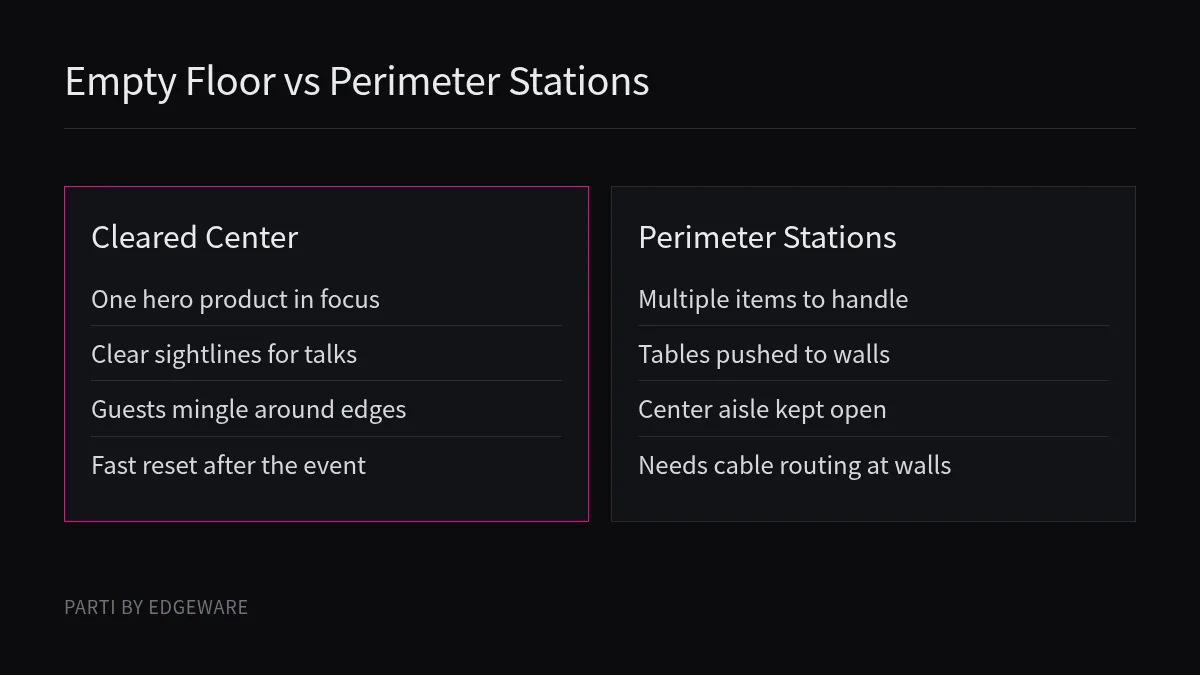
What one object on the floor does to a room
When you clear the center of the floor and leave a single table or pedestal under a light, guests understand the room immediately. Nobody wonders where to look. The empty floor acts as a buffer so people can view the item from several steps back while a founder speaks. It also keeps the route from the door to the bar clear, which matters more than most hosts expect once twenty people are holding cups. Photograph the room from the doorway before guests arrive; if the object is not the first thing in the frame, move something.
If the launch involves a line of ceramics, coffee gear, or printed goods that people should hold, a bare center works poorly. Guests need waist-high surfaces along the walls where they can set down a drink and pick up a sample. We describe how one footprint shifts between setups on the room page and in our guide on what one room does across six planned uses.
| Layout Choice | Best For | Furniture Needed | Main Risk |
|---|---|---|---|
| Cleared Center | One hero object and a short speech | One central plinth, bar counter open | Guests bunching near the door if edges lack interest |
| Perimeter Stations | Hands-on products or multiple samples | Narrow tables pushed against walls | Bottlenecks if stations sit too close to the entrance |
| Clustered Islands | Guided demos with staff at each table | Two or three high tables with clear aisles | Blocked sightlines during an announcement |
How do you plan for people, not for the product?
Hosts often design the room around the display table while the space is empty. Once guests arrive with coats and drinks, the display vanishes behind shoulders. Plan for bodies first.
Plan for people by tracing their path from the entrance to the drink station, then to the product, and finally to the exits. Keep power cables off walking paths and leave the doorway clear so arrivals never block emergencies.
Mapping entry, drinks, and exit paths
The product sits still, while guests move in predictable patterns. When people walk into an event, they pause just inside the door to orient themselves, look for the host, or grab a drink. If you put the product display right inside the entrance, the first arrivals will stop and block everyone behind them.
Place the welcome check-in and drink counter further inside the room, away from the front door. Place the product where people naturally turn after they have a glass in hand. Just as important, keep every escape route completely clear of coat racks, empty product boxes, and extra chairs. If you switch the room between daytime trade and evening guests, see our notes on planning a café for coffee by day and events by night.
Routing power and handling flammable items
Product launches often bring in outside gear: spotlights, chargers, monitors, or packaging displays. Every cable laid across a walkway is a trip hazard. Pull display tables close to existing wall sockets, or run cables strictly along wall edges where feet never go.
Under the England fire safety guidance for small and medium assembly places, if you handle and store flammable materials and substances, your fire risk assessment must take account of them to help determine the precautions needed to minimise the likelihood of them being involved in a fire. Launch props, cardboard shipping cartons, and tissue paper pile up quickly during unboxing; clear them out of the room before doors open.
What should be settled before the day?
Last-minute surprises happen when the visiting brand brings extra staff, unexpected music, or late-night plans. Sorting out permits and safety duties the afternoon of the launch is too late.
Before launch day, confirm whether the event involves licensable activities like alcohol sales or entertainment, verify that any required notice is served on time, and brief all outside contractors and temporary staff on your fire safety procedures.
Checking licences and notices
A quiet daytime product viewing uses a café much like normal opening hours. Once a client asks to sell alcohol, play music, or stay open late, licensing rules step in. In England and Wales, according to GOV.UK guidance on a Temporary Events Notice for England and Wales2, you need a Temporary Event Notice (TEN) to carry out a licensable activity on unlicensed premises, or if a licensable activity is not included in the terms of your existing licence. Licensable activities include selling alcohol, serving alcohol to members of a private club, providing entertainment such as music, dancing or indoor sporting events, and serving hot food or drink between 11pm and 5am.
In England and Wales, the GOV.UK rules set strict limits and deadlines for a TEN: * Your event must have fewer than 500 people at all times, including staff running the event, and last no more than 168 hours (7 days). * You must be at least 18 to apply as an individual (not an organisation), pay a fee of £21, and apply at least 10 clear working days before your event (or between 5 and 9 clear working days before for a late TEN). * Without a personal licence, you can get up to 5 TENs a year (including up to 2 late TENs); apersonal licence holder can get up to 50 TENs a year (including up to 10 late TENs). * A single premises can have up to 15 TENs applied for in one year, totaling no more than 21 days, with at least a 24 hour gap between separate consecutive events. * You must keep your TEN in a safe place where the event is held and display a copy where it can be easily seen.
Briefing visiting teams and sharing building risks
A product launch almost always puts non-employees on your floor: PR helpers, photographers, or agency staff. Under the fire safety guide for England and Wales, the responsible person (such as the employer or occupier in control of the premises) must inform non-employees, like temporary or contract workers, of the relevant risks to them, who the nominated competent persons are, and the fire safety procedures for the premises. You must also provide the employer of anyone from an outside organisation working in your premises with clear information on risks and preventive measures, and give those employees appropriate instructions. If your room adjoins other complexes or sits in a multi-occupied building, you must co-operate and co-ordinate with the other responsible persons.
Conclusion
A small room handles a product launch well when you let one focal point breathe, guide foot traffic past clear exits, and settle permits and fire briefings ahead of time.
About Parti
Parti by Edgeware is Edgeware's first industry solution. We are designing a café where one room can serve several uses, reset by hand between them. We have not published how long a reset takes, because we have not tested it. That is a design aim, not a result. The first café is planned for Hangzhou and is not open. See the room and how the floor connects. This guide is for people who run a café, studio or event space. It is general information, not legal advice, and your own contract and local rules decide.
Sources
- GOV.UK: Fire safety risk assessment, small and medium places of assembly: Read official fire risk assessment duties, capacity tiers, and contractor briefing rules for England and Wales.
- GOV.UK: Temporary Events Notice (England and Wales): Check deadlines, fees, headcount limits, and rules for alcohol or entertainment at one-off events.